 Follow Us on Google News


 Follow Us on Google Discover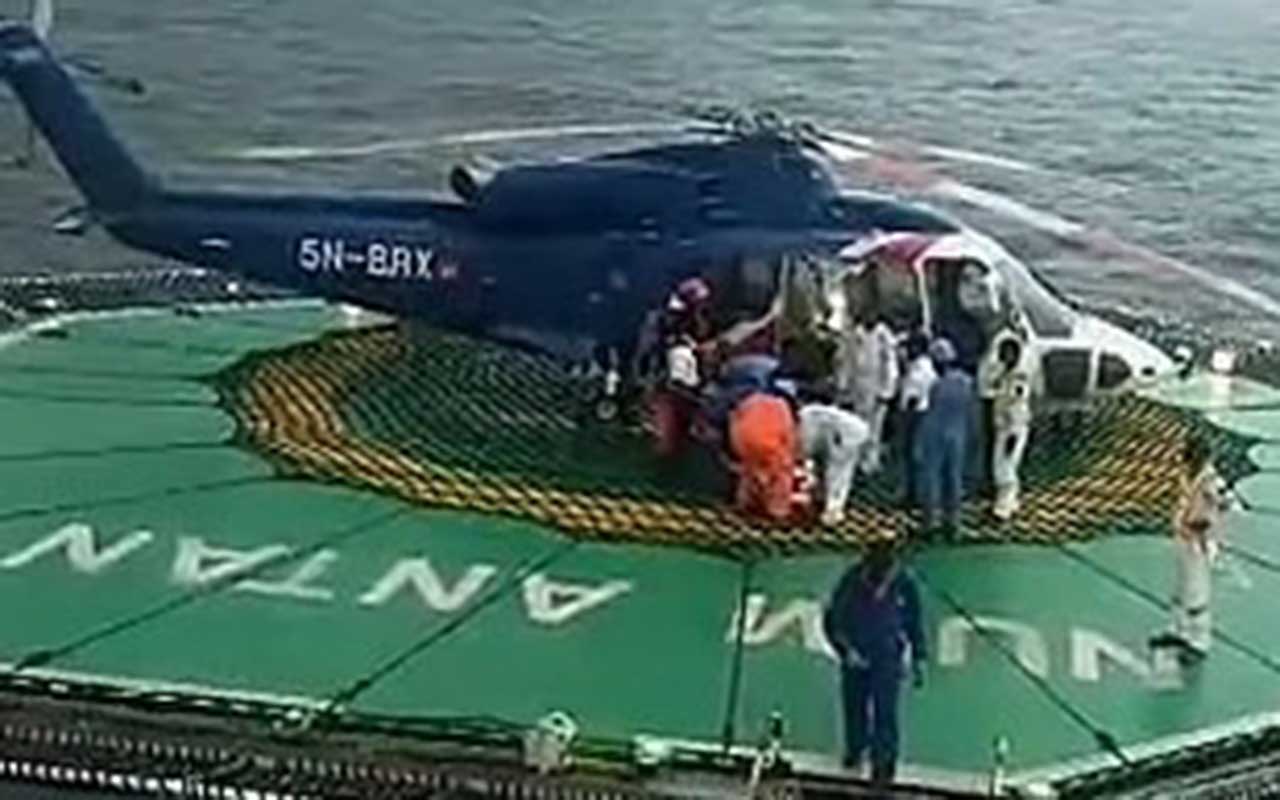
 The Nigerian Maritime Administration and Safety Agency (NIMASA) is facing growing scrutiny over its involvement in the search and rescue operation in aviation distress signals, following the crash of a helicopter off the coast of Port Harcourt.
[ad]
The Sikorsky SK76 helicopter, which plunged into the Atlantic Ocean on October 24, 2024, has sparked a debate regarding the agency’s jurisdiction and its handling of aviation distress signals.
NIMASA claimed that it received a distress signal at its Regional Maritime Rescue Coordination Centre (MRCC) and the C4i Centre of the Deep Blue project, which led to the recovery of 80 per cent of the helicopter’s critical components, including parts of the Flight Data Recorder (FDR) and Cockpit Voice Recorder (CVR).
The agency also announced plans to share its findings with the International Maritime Organisation (IMO) via the Global Integrated Shipping Information System (GISIS).
However, experts are questioning whether NIMASA can handle aviation distress calls, given its traditional focus on maritime safety.
Maritime stakeholders are particularly concerned about the role of the Nigerian Civil Aviation Authority (NCAA), the regulatory body for civil aviation in Nigeria, which was not visibly involved in the search and recovery efforts.
A retired pilot and maritime security expert, Captain Warredi Enisuoh, expressed surprise at NCAA’s absence, emphasising that aviation incidents fall under the jurisdiction of civil aviation, not maritime agencies.
Enisuoh also raised concerns about the coordination between agencies, stressing the importance of a clear standard operating procedure (SOP) in responding to such incidents.

“Aviation investigations require collaboration between the flag state, aircraft manufacturers, technical experts, and the relevant aviation authorities, including air traffic control. Without this, the investigation risks being inadequate,” Enisuoh said.
The retired pilot also questioned how NIMASA could have received the distress signal, as aviation distress communications typically do not operate on maritime frequencies. He further pointed out that NIMASA might lack the technical capacity to interpret flight data from the FDR, which could undermine its involvement.
The General Manager of Regulatory Services at the Nigeria Ports Authority (NPA), Ahmad Yakubu Wanka, also raised concerns about NIMASA’s role in reporting the incident to the IMO. Wanka expressed skepticism, noting that it is unusual for maritime authorities to report aviation-related incidents to the IMO.
[ad]
“I have never heard of a maritime authority reporting any accident or wreck to the IMO. This is indeed a first,” Wanka remarked.
He questioned whether NIMASA’s involvement was due to the helicopter crash occurring in water and emphasised that standard protocols under the International Aeronautical and Maritime Search and Rescue (IAMSAR) Manual do not typically place the responsibility for reporting aviation incidents on maritime bodies.
Wanka suggested that the Nigerian Safety Investigation Bureau (NSIB) would be better suited to handle the investigation.
While acknowledging the value of cooperation between NIMASA and aviation authorities, Wanka called for a statement from NIMASA to clarify its actions and provide justification for its role in reporting the incident to the IMO.
As the investigation into the crash continues, experts are calling for clearer roles and responsibilities between aviation and maritime authorities.
In response, NIMASA’s Head of Public Relations, Osagie Edward, explained that the crash occurred near a Floating Production Storage and Offloading (FPSO) facility, which falls within NIMASA’s operational jurisdiction.
Edward stated that NIMASA’s advanced Command, Control, Communication, Computers, and Intelligence (C4i) Center and its Regional Maritime Rescue Coordination Center (RMRCC) enabled it to quickly monitor and respond to distress signals, including those across the West African region.
[ad]
Regarding NIMASA’s communication with the IMO, Edward emphasised that reporting maritime incidents to the IMO via GISIS is standard protocol, expressing surprise that this procedure had been questioned.
Edward also clarified that NIMASA did not claim responsibility for the recovery of the helicopter’s black box, but rather the Nigerian Safety Investigation Bureau (NSIB) announced its retrieval. He highlighted the collaborative efforts of NIMASA, the Nigerian Navy, and the Nigerian National Petroleum Corporation (NNPC) in responding to the incident.
Edward further underscored NIMASA’s technological advancements, particularly the establishment of the C4i facility, which enhances its ability to manage maritime communications.
He called for broader support for the agency’s efforts, emphasising that constructive collaboration is essential to improving Nigeria’s maritime capabilities and international standing.
[ad]

