 Follow Us on Google News
 Follow Us on Google Discover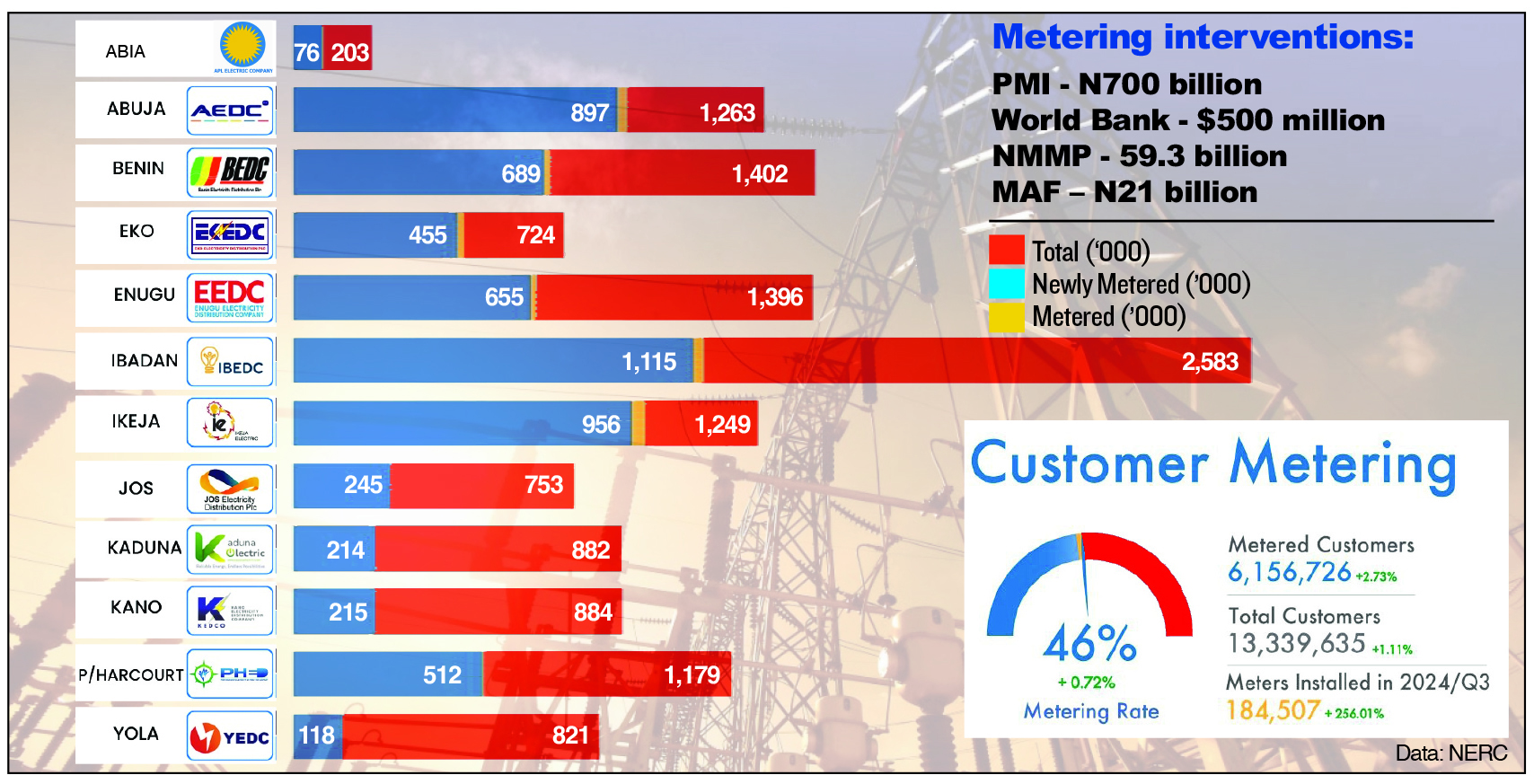

• Meter prices near N200,000 in liberalised market, manufacturers project reduction
• N700b drawn from FAAC last year to fund Presidential Metering Initiative
• 4,000 installers to be trained across six geopolitical zones
The series of interventions by the Federal Government and multilateral loans, which hovers around N1.5 trillion, fall short of providing meters to Nigerians, a development that is worsening arbitrariness in the electricity billing system.
[ad]
Instead of dropping after the FG allocated a total of N700 billion to the Presidential Metering Initiative (PMI) and N59.3 billion under the National Mass Metering Programme, unmetered customers remained at over seven million.
Efforts to reduce the gap have increased the sovereign debt by $500 million, a facility obtained from the World Bank loan, and another N21 billion arranged under Meter Asset Financing (MAF).
These come as the cost of a prepaid meter has soared above N200,000 as customers have to pay for the units owing to the inability of the Nigerian Electricity Regulatory Commission (NERC) to compel the distribution companies (DisCos) to perform their statutory responsibilities of metering customers.
Amidst the failure also comes a series of court cases and allegations labelled against most of the metering companies and the DisCos under the National Mass Metering Programme (NMMP) for misusing and embezzling funds meant for free metering.
The Federal High Court in Abuja will on February 4 hear a case by Ziklagsis Network Ltd hoping to stop the Federal Government, Ministry of Power and four others, from recovering N39.1 billion meant for a mass metering contract.
The latest report by NERC has shown that the total number of registered customers stands at 13.3 million with only 6.1 million metered. This leaves the total number of unmetered customers at 7.1 million.
Under the government of President Muhammadu Buhari, the Central Bank of Nigeria (CBN) provided N10.3 trillion in intervention across sectors of the Nigerian economy. The power sector received N2.3 trillion out of which N59.2 billion went into NMMP.
The first phase of the programme was meant to provide about one million prepaid meters, but the scheme became messy as the apex bank later approached a Federal High Court in Lokoja, Kogi state, for an order compelling 15 commercial banks and the Bank of Industry (BoI) to freeze the accounts of the 157 companies that participated in the scheme.
[ad]
Currently, the 36 states and Federal Capital Territory (FCT) are burdened with the cost of the failed metering programme as the government last year deducted about N700 billion from the Federal Account Allocation Committee (FAAC) in tranches to fund the Presidential Metering Initiative (PMI) that was scheduled to start this quarter.
There was an initial N75 billion seed capital and N250 billion pledged by Nigerian Sovereign Investment Authority (NSIA). Also, the World Bank committed $500 million under the Distribution Sector Recovery Programme (DISREP) to support the DisCos in bridging the metering gap and improving distribution infrastructure.
Also, N21 billion was earmarked through the Meter Asset Financing (MAF) scheme to provide affordable meters for consumers, particularly those in Band ‘A’. Despite the substantial investments, over seven million Nigerians are still waiting for the promised meters while bearing inflated and estimated electricity bills.
Last June, the Minister of Power, Adebayo Adelabu, told Nigerians that 3.5 million meters would be installed at the 2024 year-end. However, the Minister told The Guardian that the procurement of the initial 1.4 million units under DISREP was done in December 2024, with supply expected this quarter.
Special Adviser to the Minister of Power on Strategic Communications and Media, Tunji Bolaji, told The Guardian that the procurement of the initial two million meters would be done by February as the Ministry expects supply of the PMI meters by the third quarter. He noted that the meters must be tested before being installed, which is part of the delay, but installers are undergoing some professional training.
“The PMI is currently training meter installers with the National Power Training Institute of Nigeria (NAPTIN) as we will not have the capacity to install all the DISREP and PMI meters when supplied,” he said. He also disclosed that the budget for the funding of meters for 2025 has not yet been passed.
The Director General of NAPTIN, Ahmed Bolaji, confirmed to The Guardian that the institute was about to commence a training exercise on electrical and meter installation through the PMI. He revealed that the institute is looking at 4,000 participants across the six geo-political zones.
[ad]
“We are training 4,000 people inclusive of the female gender across the geopolitical zones, we are looking at the statistics we got from NERC to make sure that we address the human capacity in meter installation. It would enable us to have enough pool of talent and skills to install the meters,” he said.
He commended the FG and Minister as the initiative would help in bridging the metering gap and as well as create more jobs for the youths as the initiative is gender inclusive.
The failure of the past metering initiatives has left a trail of disappointment and distrust among Nigerians as many are wary of fresh promises. A Lagos-based teacher, Olubunmi Adeyemi, shared her frustration about metering as promises have been elusive.
“We have been waiting for a meter for over three years. Meanwhile, every month, the bill increases even though we do not get a regular supply. We saved up to buy a meter, but the cost is outrageous,” she said.
On the MAF Scheme, Oluwaseun Adebayo expressed doubt that the fund was used for metering, fearing that DisCos might have pocketed the money. He called for transparency on how the disbursed funds are utilised by each DisCo, stressing: “We have heard this before. The government promised meters years ago, but we are still dealing with crazy estimated bills. What is different this time? They should focus on fixing the existing problems first.
“We need reliable power, not just promises of meters that never arrive. It is frustrating that we keep hearing about these funds being approved; there is no accountability. What guarantees do we have that this will be different?” he asked.
In a breakdown of the MAF disbursement to the DisCos by the commission, Abuja DisCo (AEDC) received N2,990,745,647; Benin DisCo (BEDC) received N1,571,276,806; Eko DisCo (EKEDC) received N2,921,896,285 while Enugu DisCo (EEDC) received N1,726,893,467.
Ibadan DisCo (IBEDC) received N2,516,469,752; Ikeja Electricity Distribution Company (IE) received N4,358,122,421; Jos DisCo (JEDC) was handed N521,905,774 and Kaduna DisCo (KAEDC), N1,220,367,039.
Kano DisCo (KEDCO) received N1,568,029,563; Port Harcourt DisCo (PHEDC) received N1,360,944,608; just as Yola DisCo (YEDC) got N243,349,639.
However, IBEDC told The Guardian that it is working according to the commission’s timeline on the MAF scheme.
Meter prices are influenced by vendors and meter models (single-phase and three-phase). Prices from the same vendors vary among the DisCos, with costs hovering between N124,700 for a single-phase meter and N230,000 for a three-phase meter.
[ad]
For Abuja DisCo (MBH Power Limited), the single phase is N131, 257.50 while the three phase is N220,428.75. Integrated Resources Limited’s single phase is N131,741.25 while three phase is N221,209.04.
Chris Ejik International Agencies Ltd’s single phase is N105,565 while three phase is N198,875. Klartek Nigeria Ltd’s single phase goes for N129,430 while three phase is N220,912.50.
KIGG meters and Systems Ltd single-phase costs N134,041.24, while three-phase is N223,767.76. Holley Metering Nigeria Ltd’s single-phase goes for N139,254.99 just as the phase is N225,057.76.
The Executive Director of PowerUp Initiative, Adetayo Adegbemle, stated that the government lacks a clear metering policy, which is why the PMI has established a framework.
“There are issues that we have raised from the beginning; they’re still there like the awarding of the NMMP Phase 2 procurement to Chinese companies, the procurement process for the PMI Meters as well. I have also asked that we should change our approach to this metering challenge. Government should enable a policy that makes it profitable for investors to take up metering and recoup their investments over some time, with guarantee of returns,” he said.
He, however, expressed doubts about the long-term effectiveness of the MAF scheme, pointing out that addressing the metering gap will require consistent investment and a clear strategy for cost recovery to ensure lasting success.
He described the MAF scheme as a positive regulatory intervention by NERC, noting that, in the short term, it helps DisCos acquire meters they have struggled to fund. In the long term, it is expected to enhance revenue collection, lower ATC&C losses, and bridge the metering gap.
“What closing the metering gap needs is a consistent investment and a clear path to cost recovery of that investment. More importantly for me is to see the government not continue to put funds to metering when investors can be easily encouraged to do this,” he said.
[ad]
On the MAF scheme, the President of the Nigerian Consumer Protection Network (NCPN), Kunle Olubiyo argued that such funds are often not used for their intended purposes. He suggested that the MAF funds should have been disbursed directly to local meter providers to prevent the failures seen in the past.
Olubiyo stressed that direct disbursement to the DisCos is ineffective, as a significant portion of the funds could be diverted. He urged the Federal Government to investigate and appraise the meter assembly plants, identifying those who have failed to deliver and those capable of fulfilling their commitments.
Director and Chief Operating Officer of MBH Power, Rakesh Mahapatra, highlighted that the government is making significant efforts to secure funding for metering.
He noted that the liberalisation of the meter market has provided them with the opportunity to bid for metering contracts, as they are receiving orders as local content manufacturers through the DisCos platform.
Managing Director of Momas Electricity Meters Manufacturing Company Limited (MEMMCOL), Abiodun Hammed, said Nigerians should not overlook the fact that the population is growing, which will inevitably lead to a metering gap. However, he assured that with the concerted efforts of the current administration, this gap would be significantly reduced within the next two to three years.
[ad]

