 Follow Us on Google News
 Follow Us on Google Discover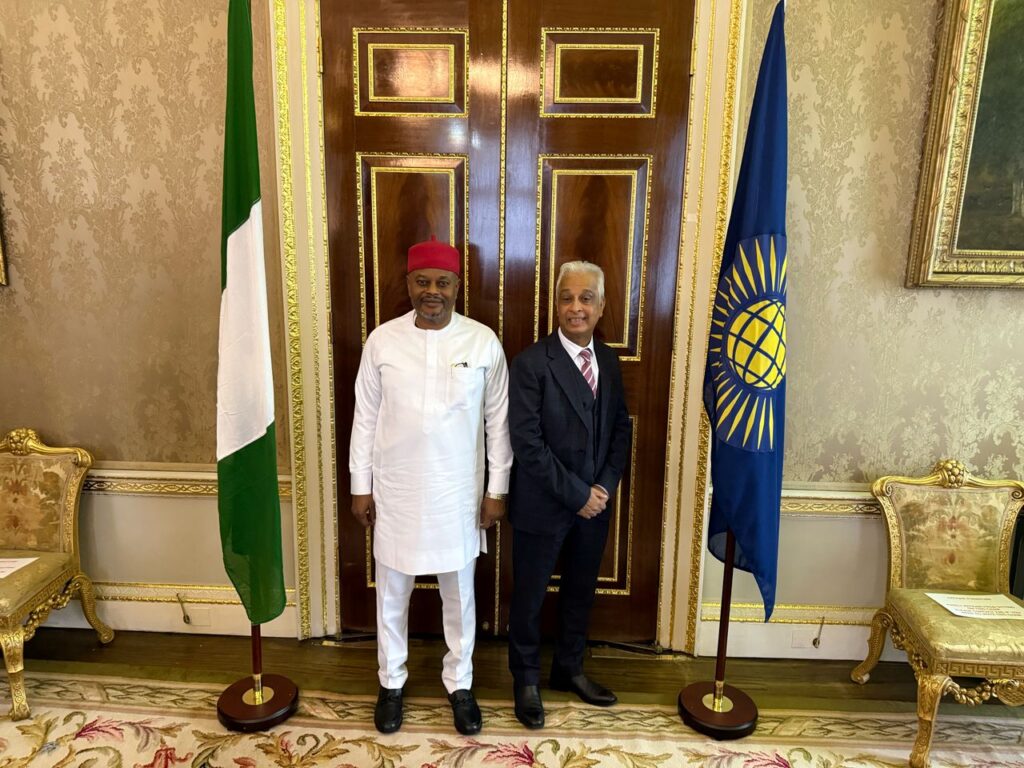
 The interdependency of countries, precipitated by the agitation for a New International Economic Order (NIEO) in the late 20th century, is obviously expanding in this 21st century through shared interests and collaboration among nations. With technological advancements that have literally reduced the world to a “global village,” it has fast become the practice in contemporary times for countries to seek collaboration in different spheres with a view to enhancing the chances of improved development.
Remarkably, Nigeria’s Honorable Minister of Innovation, Science and Technology, Chief Uche Geoffrey Nnaji, has leveraged this global occurrence to seek partnerships where necessary to boost the chances of his ministry operating at the same frequency, thereby positioning Nigeria higher than it would ordinarily be within the science and technology space in the comity of nations.
Driven by the passion to achieve a higher level of scientific and technological breakthroughs during his tenure as Hon. Minister of Innovation, Science and Technology, Chief Uche Geoffrey Nnaji, in January 2025, called on the Mining and Geosciences Society of Nigeria (NMGS) to partner with the agencies under his ministry to leverage government programms for the scientific and technological development of the country. This ministerial directive was borne out of the fact that his ministry recognizes the NMGS’s critical role in economic development, adding that the mining and geosciences field is key to the economic diversification and industrialization of the nation.
Speaking when the Nigerian Mining and Geosciences Society (NMGS), led by its President, Prof. Akinade Olatunji, paid him a courtesy visit in Abuja, Nnaji was quick to say, “We must strengthen collaboration to integrate cutting-edge technologies for efficiency, safety, and economic sustainability of the country.” He emphasized that modernization of the sector can be successfully achieved if everyone leverages Artificial Intelligence (AI) data analysis for optimal resource management, renewable energy to enhance efficiency and reduce environmental impact, and advanced geopolitical surveys for improved resource estimation.
At the global level, the minister has stated that Nigeria seeks to strengthen technology and commercialization, ensuring that research is translated into industrial applications through collaboration and partnership with the European Union (EU) for the technological advancement of the country. He noted that “the existing bilateral agreement provides a structured framework for cooperation that seeks to enhance its implementation to promote joint research, knowledge sharing, and investment in priority technological areas.”
The minister shared his thoughts when a delegation from the European Union, led by the new Ambassador to Nigeria and ECOWAS, Mr. Gautier Mignot, paid him a courtesy visit in February 2025 in Abuja. He disclosed that Nigeria aims for greater inclusion of its public research institutes in European funding programs to foster knowledge exchange and drive new innovations for economic growth. Furthermore, Nnaji explained that the European Union’s technical assistance for the Inter-Ministerial Committee on Research and Innovation will support Nigeria’s scientific and industrial advancement, boost the country’s Gross Domestic Product (GDP), enhance job creation, and reduce poverty.

When discussing partnerships, Nnaji leaves no one in doubt about the advantages of any partnership before endorsing it. For example, in an attempt to address identified weaknesses and bridge the gap between academia and industry, NOTAP introduced several industry partnership initiatives, including the NOTAP-Industry Research Laboratory Upgrade. This initiative was designed to bridge the gap between academia and industry by enabling credible and industry-driven research for the advancement of the sector.
With deep conviction that partnerships, particularly viable ones, have significant advantages, Chief Uche Geoffrey Nnaji, in October 2024, shared insights from a high-level bilateral meeting he held with the Commonwealth Secretary-General, Rt. Hon. Patricia Scotland KC, on the sidelines of the 79th United Nations General Assembly. Their discussion focused on the Commonwealth AI Initiative and Nigeria’s involvement.
At the event, they discussed launching and onboarding Nigerians into the ambitious AI training initiative through the Commonwealth AI Academy, powered by Intel. This program aims to equip millions of Nigerians, particularly youth and women, with industry-ready AI skills. This initiative is more than just an exciting opportunity; it positions Nigeria at the forefront of AI adoption, with the potential to transform key sectors like governance, healthcare, and agriculture through capacity building.
The AI Academy, which is part of the Commonwealth Artificial Intelligence Consortium, will offer specialized courses such as AI for the public sector and AI for youth, helping build a skilled workforce capable of driving innovation and addressing global challenges.
As expected, the minister reaffirmed Nigeria’s commitment to integrating technology into climate action, particularly in sustainable agriculture. With techniques like Enhanced Rock Weathering (ERW) and biochar, the country is improving soil health and aligning with global climate goals under the Paris Agreement. The minister’s eagerness for Nigeria to present innovative, tech-driven solutions to climate challenges ahead of COP29 cannot be overemphasized. According to him, “this collaboration with the Commonwealth further strengthens our leadership in using technology for sustainable development and climate resilience.”
There is no doubt that Chief Uche Geoffrey Nnaji, the current Minister of Innovation, Science, and Technology, has emerged as a leader who understands his field. As someone who possesses not only a deep understanding of science and technology but also an acute business acumen, Chief Nnaji is the “round peg in a round hole” that Nigeria so desperately needed in its drive toward socio-economic development through innovation, science, and technology. From his successful participation in the 79th United Nations General Assembly (UNGA) in New York to his ongoing commitment to expanding Nigeria’s space economy, Chief Nnaji’s impact has been profound, commendable, and outstanding. His approach has invigorated the ministry, ensuring that its activities resonate with global standards while remaining grounded in national realities. As a result, Nigeria has seen a steady and strategic expansion in the role of space technology within its economic agenda.

