 Follow Us on Google News


 Follow Us on Google Discover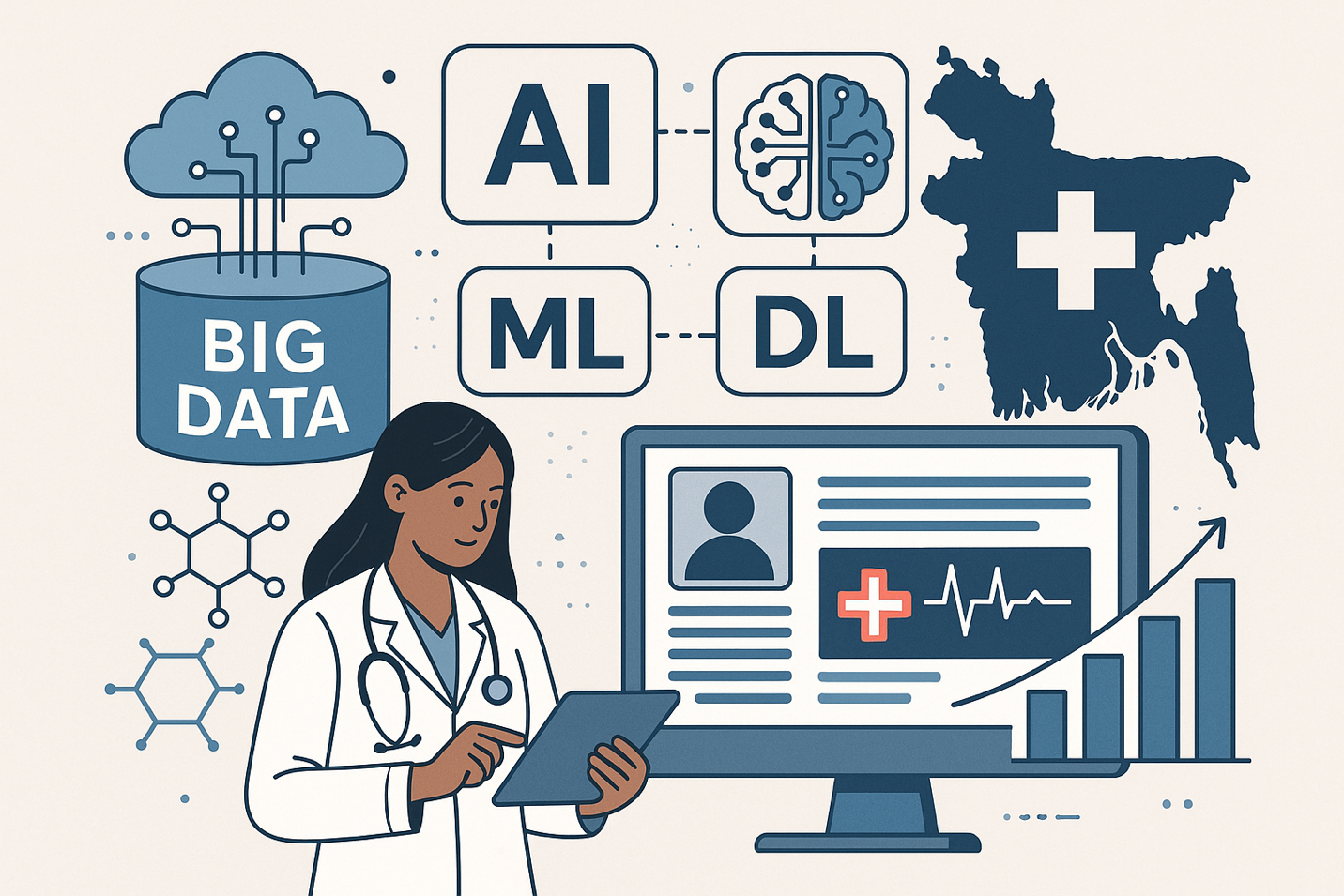
Introduction
The integration of Big Data Analytics (BDA), Artificial Intelligence (AI), Machine Learning (ML), and Deep Learning (DL) is transforming Bangladesh’s healthcare ecosystem by enabling more efficient disease management, patient monitoring, and healthcare delivery. According to Harsha Vardhan Reddy Goli in the IJRITCC (International Journal on Recent and Innovation Trends in Computing and Communication) Journal, these technologies have the potential to bridge the urban-rural healthcare divide through remote diagnostics and personalised treatments. However, the adoption of these advancements is hindered by infrastructure challenges, insufficient training, and data security concerns. This paper emphasises the need for robust data governance, interoperability standards, and public-private partnerships to ensure the ethical and effective application of these technologies across the healthcare sector in Bangladesh.
Big Data Analytics in Healthcare
Big Data Analytics (BDA) plays a crucial role in processing and interpreting large volumes of structured and unstructured data from various sources such as electronic health records, wearable devices, and patient monitoring systems. In Bangladesh, BDA is applied to predict disease outbreaks, optimise patient treatments, and improve overall health system management. For example, predictive models analysing epidemiological data have proven effective in forecasting outbreaks of diseases like dengue and cholera, enabling targeted interventions. Similarly, real-time analytics of wearable device data supports clinicians in making data-driven decisions, enhancing patient outcomes. Despite its potential, BDA adoption faces challenges such as inadequate infrastructure and the absence of standardised data-sharing frameworks, particularly in rural regions.
AI and Machine Learning in Healthcare
Artificial Intelligence (AI) and Machine Learning (ML) are reshaping healthcare through their capabilities to automate decision-making, improve diagnostic accuracy, and enable personalised care. In Bangladesh, AI is widely used in medical image processing, assisting radiologists in detecting conditions such as cancer and tuberculosis at earlier stages. ML algorithms further enable predictive analytics, facilitating the creation of tailored treatment plans for managing chronic illnesses such as diabetes and hypertension. These advancements significantly reduce diagnostic errors and improve treatment efficacy. However, the integration of AI and ML is constrained by a shortage of skilled professionals and limited access to high-quality datasets essential for training accurate models.

Deep Learning and Advanced Diagnostics
Deep Learning (DL), a subset of AI, excels in processing complex datasets using multi-layered neural networks. Its applications in Bangladesh include automated analysis of medical images and the use of Natural Language Processing (NLP) for extracting insights from Electronic Health Records (EHRs). For instance, DL models enhance diagnostic accuracy in radiology by analysing X-rays, MRIs, and CT scans, particularly in rural areas where radiologist availability is limited. Additionally, NLP-driven tools streamline the extraction of actionable information from unstructured medical records, improving clinical decision-making processes. However, the high computational costs and limited access to healthcare data pose significant barriers to the widespread use of DL in the country.
Challenges and Opportunities in Implementation
The integration of these technologies in Bangladesh’s healthcare system is not without obstacles. Infrastructure limitations, such as unreliable internet connectivity and inadequate computing power, particularly in rural areas, restrict the deployment of advanced tools. Furthermore, data privacy and security concerns remain critical issues, exacerbated by the lack of robust regulatory frameworks to govern the ethical use of sensitive patient information. The shortage of trained professionals in fields like data science, AI, and healthcare informatics further complicates adoption efforts. Addressing these challenges through investments in capacity building, enhanced data governance, and public-private collaborations is essential to unlock the full potential of these technologies.
The Future of Healthcare in Bangladesh
The successful integration of Big Data Analytics, AI, ML, and DL promises to revolutionise Bangladesh’s healthcare sector by making it more accessible, efficient, and equitable. These technologies can mitigate the urban-rural healthcare divide, improve diagnostic accuracy, and optimise resource allocation. By focusing on infrastructure development, establishing data privacy standards, and fostering a skilled workforce, Bangladesh can create a healthcare system that not only meets the needs of its diverse population but also sets a precedent for innovation in developing nations. The collaborative efforts of policymakers, healthcare providers, and technology stakeholders will be instrumental in driving this digital transformation, ensuring that advancements in healthcare technology translate into tangible benefits for all citizens.
Conclusion: Paving the Way for a Digital Healthcare Revolution
Harsha Vardhan Reddy Goli’s research on the integration of Big Data Analytics, AI, ML, and DL provides a strategic blueprint for transforming Bangladesh’s healthcare system. By showcasing the tangible benefits of these technologies, such as predictive disease management, improved diagnostic accuracy, and personalised treatment plans, his work highlights practical solutions to address critical gaps in accessibility, efficiency, and equity in healthcare delivery.
Harsha’s insights emphasise the importance of leveraging technology to bridge the urban-rural healthcare divide, enabling targeted interventions and data-driven decision-making. The proposed strategies, including investments in capacity building, data governance, and infrastructure, provide a clear and actionable path for stakeholders to overcome existing challenges. His article serves as a vital resource for policymakers, healthcare providers, and technologists, illustrating how innovation, when aligned with strategic implementation, can drive sustainable progress and redefine healthcare standards for emerging economies like Bangladesh.
Nweke writes from Bangladesh

