 Follow Us on Google News
 Follow Us on Google Discover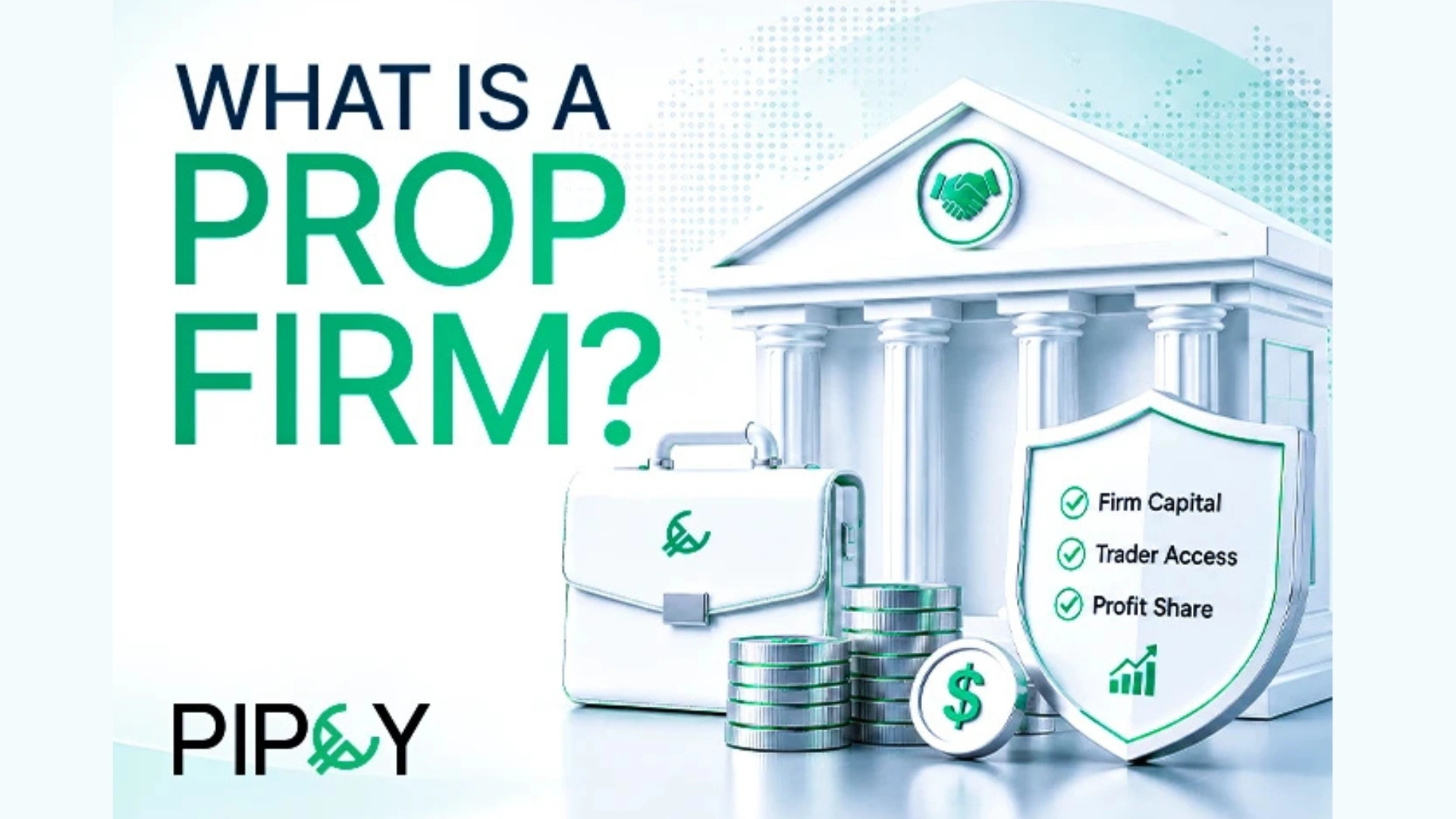
In 2026, you can walk into a trading career the way you’d walk into a franchise: prove you can run the operation, and someone else supplies the capital. The company supplying it is called a prop firm, and the model has quietly become one of the fastest-growing corners of retail finance.
It has also collected more than its share of confusion. So instead of another dictionary definition, here’s what a prop firm actually is — through the model, the maths, and the myths.
The Model in One Paragraph
A prop trading company evaluates traders through a paid simulation test, called a challenge, and gives those who pass a funded account to trade under strict risk rules. Profits generated on that account are split heavily in the trader’s favour — up to 95% at firms like Pipcy — and paid out on a defined schedule. The trader risks only the challenge fee; the firm carries the capital risk.
The Maths: A Worked Example
Numbers make the model clearer than any definition. Take a mid-range setup at Pipcy, a prop firm launched globally in 2026:
- You pay a $99 one-time fee for a $10,000 one-step challenge
- You must reach an 18% profit target without ever dropping 12% below the starting balance, trading at least three days
- Pass, and you trade a funded $10,000 account with up to 95% of profits paid to you — eligible after five trading days, processed within 48 hours of request
- Perform consistently and the account scales: every 25% of accumulated profit earns a 50% balance increase, up to a ceiling of $300,000 on that plan — with no scaling fees, resets, or deadlines
Cheaper entries exist (from $18 for a $2,500 account) and larger ones too ($619 for $100,000, scaling toward $3 million). The structure, though, is always the same: small known cost, large conditional opportunity.
Three Myths Worth Killing
“It’s free money.” No — it’s gated money. Around 90% of challenge participants fail, usually by breaking drawdown rules rather than by lacking a strategy. The gate is the product.

“Firms want you to fail.” The better firms demonstrably don’t: transparent rulebooks, static rather than trailing drawdowns, no daily loss limits, published payout terms. Pipcy, for instance, measures its 12% maximum loss from the initial balance — it never trails your profits — and imposes no daily drawdown at all. Firms with hostile rules get named in forums quickly; the market punishes them.
“It’s the same as trading your own account.” It’s better in one way and harder in another. Better: your downside is capped at the fee, and the capital ceiling is far beyond most personal accounts. Harder: rules are absolute. Blow through a limit on your own account and you can keep trading; do it on a funded account and it’s over. If the mechanics are new to you, this plain-English guide to what is a prop firm walks through the full lifecycle.
Where the Industry Is Heading
Competition has pushed terms sharply in traders’ favour: splits have climbed from 70% toward 95%, payout cycles have compressed from monthly to days, and evaluation design is diversifying — Pipcy recently introduced the industry’s first pip-based challenge, which fixes lot sizes to eliminate overleveraging entirely.
The direction of travel is clear: firms increasingly win by being more trader-friendly, not less. Multi-asset access (forex, indices, commodities, crypto), MetaTrader 5 support, allowed news trading, and free trials are becoming table stakes — all of which Pipcy offers, alongside rotating promotions listed on its site.
Should You Try One?
A prop firm rewards a specific kind of trader: one with a tested strategy, hard risk habits, and the patience to treat a challenge like an exam rather than a lottery ticket. If that’s not you yet, the fee will teach you an expensive lesson the demo account could have taught for free.
But if you’ve done the work and your only missing ingredient is capital — the prop model exists precisely for you. Read the rulebook twice, size conservatively, and remember: in this business, surviving the drawdown limit is the strategy.

