 Follow Us on Google News
 Follow Us on Google Discover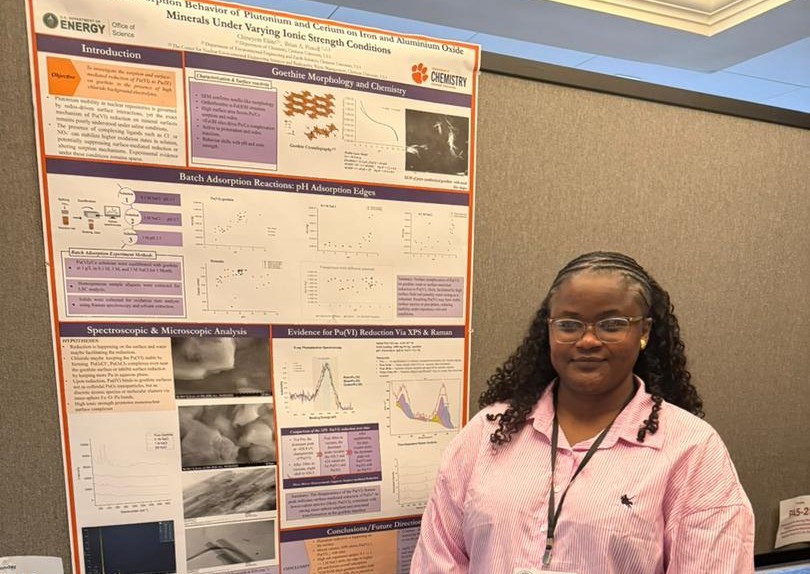
The river taught her first. Growing up in Nigeria’s Niger Delta, Chineyem Ebite saw creeks shine with the wrong kind of rainbow and learned early that what runs through water runs through a life. That clarity pushed her towards science and towards work that protects people.
At Delta State University, she studied hard and graduated at the top of her class with First Class Honours, the department’s first in years. A fully funded scholarship then took her to the United States for doctoral study. She is now a PhD student in environmental nuclear chemistry at Clemson University in the Powell Lab.
Her research looks at a tiny place with big consequences: the boundary where minerals meet water. She investigates how plutonium changes oxidation states at the mineral–water interface under conditions that mimic repositories. In plain words, she studies why plutonium (VI) lets go and becomes plutonium (IV) when it reacts with iron oxide surfaces such as goethite or haematite, and what that means for whether plutonium moves with groundwater or stays immobilised.
Ebite’s contribution is to understand those decisions well enough to turn them into clear guidance for people who design and regulate waste systems. The aim is simple: better thresholds, clearer predictions, safer designs.
Her recent recognition underscores the impact of that work. She recently received a competitive student registration waiver/grant to attend Migration of Actinides and Fission Products in the Geosphere, a leading international conference, and she was nominated among the best posters for her presentation, “Redox Driven Sorption Behaviour of Plutonium and Cerium on Iron and Aluminium Oxides under Varying Ionic Strength Conditions.” These honours validate the significance of her research for legacy waste clean-up in the United States and beyond.
Her impact is visible in print as well. Ebite’s work has contributed to peer-reviewed publications and has been cited by scholars around the world. She affirms that her research is original and influential and that it is critical to addressing scientific challenges in environmental stewardship and nuclear waste management.
Service runs alongside the science. She mentors young students and volunteers with STEM NOLA, leading hands-on chemistry activities that turn abstract ideas into “wow” moments. She also collaborates with researchers in South Africa, Nigeria, and the United States on writing and publishing about environmental sustainability.

