 Follow Us on Google News


 Follow Us on Google Discover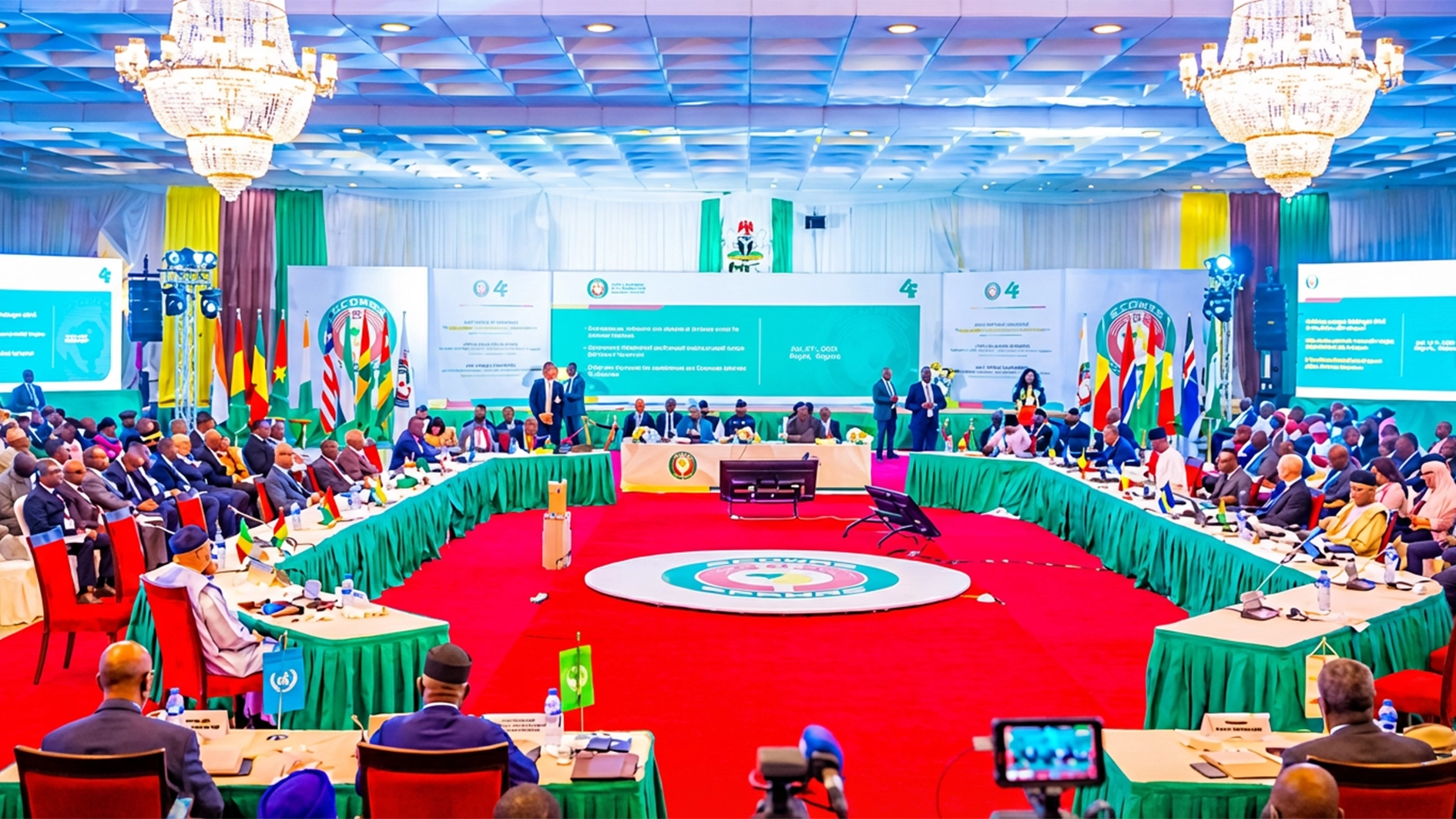
- Tinubu urges coordinated action as region taps Dangote to anchor economic integration
The Authority of Heads of State and Government under ECOWAS on Sunday hailed the swift mobilisation of troops and air assets spear-headed by Nigeria, to respond to political crises in West Africa, following the unconstitutional coup in Guinea-Bissau and the attempted overthrow in Benin.
The rapid deployment, commended by ECOWAS Chair and Sierra Leonean President Julius Maada Bio during the 68th Ordinary Session of the Authority in Abuja, underscoring the bloc’s unwavering commitment to defending democracy and stabilising the sub-region.
Speaking at the summit held at the Presidential Villa, Abuja, President Bio described the recent coups as existential threats to regional stability, warning that political upheavals in any member state have far-reaching consequences across West Africa.
“ECOWAS does not and will not compromise on democratic governance,” Bio said, emphasising the need for credible, inclusive, and time-bound pathways to restore constitutional order.
He expressed solidarity with the people of Guinea-Bissau and reaffirmed support for President Patrice Talon and the citizens of Benin, highlighting ECOWAS’ readiness to act decisively whenever democratic norms are threatened.
Opening the summit on Nigeria’s behalf, President Bola Ahmed Tinubu, represented by Vice President Kashim Shettima, urged West African leaders to confront terrorism, violent extremism, arms proliferation, cyber insecurity, climate shocks, food insecurity, and irregular migration through fraternity, dialogue, and coordinated action.

“Our unity is not transactional but foundational. Fraternity, not force, must define the future of our community,” Tinubu said, warning that internal divisions pose a greater threat than external challenges. The Nigerian leader reaffirmed his country’s commitment to collective security, regional stability, and a cooperative approach to shared threats.
While security dominated the summit held in the Banquet Hall, Abuja, attention also turned to regional economic integration.
ECOWAS Commission President Dr Omar Alieu Touray unveiled the ECOWAS Business Council, naming Nigerian industrialist Alhaji Aliko Dangote as its pioneer chairperson.
“Given his extensive experience across West Africa, the council will mobilise regional capital, strengthen intra-regional investment, and drive economic growth,” Touray said.
Plans were also announced for a West African Economic Investment Summit, envisioned as a Davos-style platform to coordinate investment and track progress across the region.
President Bio reaffirmed that economic integration remains central to ECOWAS’ vision.
He highlighted the bloc’s commitment to eliminating trade barriers, harmonising policies, deepening the ECOWAS Trade Liberalisation Scheme, and advancing monetary convergence in line with the African Continental Free Trade Area (AfCFTA).
Bio noted that a single regional currency by 2027 remains a transformative goal, capable of expanding trade, reducing transaction costs, and strengthening competitiveness across West Africa.
He also called for accelerated investment in roads, railways, energy grids, telecommunications, and transport corridors, describing them as catalytic to growth and regional cohesion.
In a move, he said, is aimed at improving mobility for citizens, Bio announced that from January 1, 2026, ECOWAS will abolish air transport taxes and reduce passenger and security charges by 25 per cent, a reform designed to boost tourism, trade, and connectivity while easing travel costs for millions of West Africans.
The leaders agreed that the success of ECOWAS over the next 50 years depends on unity, strong institutions, and the political will to implement key decisions.
“Our unity is not optional. It is our greatest asset,” Bio said, adding “history shows that when ECOWAS acts together, we act effectively.”
With Nigeria at the forefront of military action, Tinubu advocating fraternity over force, and Dangote anchoring private-sector economic integration, the Abuja summit signaled the bloc’s readiness to protect democracy, strengthen security, and accelerate regional prosperity, setting the stage for a transformative half-century in West Africa.

