 Follow Us on Google News
 Follow Us on Google Discover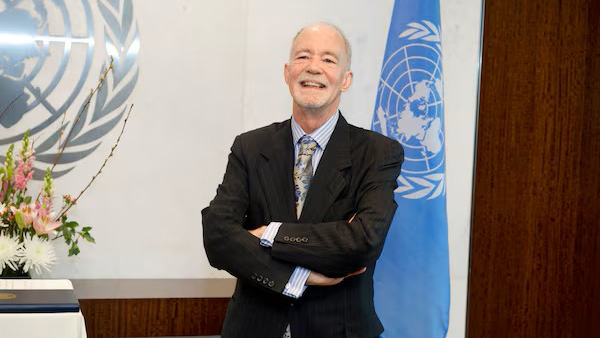
David Malone, a cosmopolitan Canadian scholar-diplomat, recently died at the age of 71. His father, Paul, was a diplomat (as were two of his brothers, Anthony and Christopher) who had served in Nigeria during its civil war (1967-1970). His mother, Deidre, was a journalist who encouraged her son’s lifelong love of travel across India. David attended a boarding school in Paris before completing his undergraduate at the University of Montreal, and thus spoke fluent French and English. He later went on to obtain a Master’s degree at Harvard University in the U.S. and a doctorate from Oxford University in England, while already working as a diplomat. He never married, and felt that his single status afforded him greater freedom to be adventurous and to take more risks with his career choices.
David served in Cairo and Amman (secretly liaising with Palestinian political leaders in Damascus), learning Arabic, before assuming senior positions in the Canadian foreign ministry in Ottawa (successfully lobbying for Canada to win a two-year non-permanent seat on the UN Security Council in 1999-2000), becoming deputy permanent representative to the UN, and High Commissioner in New Delhi (his favourite post).
Canadian journalist, Patrick Martin, described him as “one of the giants of Canada’s Foreign Service.” David directed the New York-based International Peace Academy (IPA), now the International Peace Institute; Canada’s International Development Research Centre (IDRC) in Ottawa; and the United Nations University (UNU) in Tokyo. A leading global scholar of the UN Security Council, he published 18 books on diverse topics such as Haiti, Iraq, India, Asia/Pacific, the US, the UN, foreign policy, higher education, economic dimensions of civil wars, and economic development, working increasingly with global South scholars.
His single-authored books, on Indian foreign policy and the two volumes on the UN Security Council’s roles in Iraq and Haiti (an outgrowth of his Oxford doctorate), were particularly influential. He also had a passion for teaching, which he did at New York University (with eminent legal scholar Thomas Franck) and at UNU.
David was most proud to have mentored a long list of younger scholars. I first met him at Oxford in 1995 where we were both completing our doctorates on security-related topics (he later quietly sponsored an International Relations thesis prize at the university). I would later work with him at IPA in New York for five years, along with his vice-president, John Hirsch, a seasoned former American diplomat.
David was a formidable mentor from whom I learned a great deal. I once travelled with him to Europe on a fundraising trip, and was awed by his mastery of detail and effortless engagement with an extensive network built up over decades in government and academia. I observed how he produced a bountiful harvest of 31 books, over six years, on cutting edge issues related to the UN’s work; engaged in policy development at the very highest levels of the world body – often interacting with its Ghanaian Secretary-General, Kofi Annan, and his senior management team – while building close relations with the most powerful permanent representatives in Turtle Bay. Among researchers he mentored at IPA who became prominent academics or diplomats were: Simon Chesterman, Chandra Lekha Sriram, Waheguru Pal Singh Sidhu, Karen Ballentine, Heiko Nitzschke, and Sebastian von Einsiedel.
David was a quick thinker, and often made decisions with the same speed, sometimes rendering it difficult to raise alternative suggestions. But I eventually discovered he could sometimes be persuaded to change his mind. When he asked me to contribute a chapter to his first edited book on the UN Security Council, I agreed, but complained that his authors were too Eurocentric for a volume on such an important global topic. After some reflection, he agreed to add several authors from the global South.
Early on in our collaboration, he called me into his office after a particularly robust presentation I had made criticising French and U.S. neo-colonial military interventions in Africa. He asked me to tone down my criticisms, but I politely demurred, and continued to speak my mind. It was to his great credit that rather than holding this against me, he promoted me to Director of the Institute’s Africa programme at the age of 34, and later invited me to co-author an article with him for his regular column in the International Herald Tribune. When I left IPA with David’s full blessing to direct the Centre for Conflict Resolution (CCR) in Cape Town, he remained a consistently supportive mentor who was always willing to write references, and often praised my leadership of what he considered Africa’s best conflict resolution think tank. Much of my success during my 13 years at CCR built on what I had learned from David in New York.
As President of IDRC, he supported our work at CCR, and invited me to contribute a chapter on two prophets of regional integration in Africa and Latin America – Adebayo Adedeji and Raúl Prebisch – to a book he was co-editing on economic development. As Rector of UNU, he was the extravagant host in Tokyo, interviewing me on some of the issues in my 2010 Curse of Berlin: Africa After the Cold War book, and skilfully chairing a public lecture I delivered on Conflict Resolution in Africa. I was surprised, though, to see at UNU so many white and male researchers: a far cry from his diverse and cosmopolitan team at IPA.
I returned the favour by hosting David at a lively lecture on the UN Security Council in 2021 at the Institute for Pan-African Thought and Conversation which I was directing at the University of Johannesburg, following completion of his writing fellowship on UN development issues at Stellenbosch University in the Western Cape.

He consistently offered encouraging comments on my fortnightly columns until three weeks before his death. The last time I saw David in person was when he hosted a post-Thanksgiving brunch with a small group of us in New York in 2023. His generosity, mentorship, and intelligence shone through until the very end. These are the qualities for which he will most fondly be remembered.
Prof. Adebajo is a senior research fellow at the University of Pretoria’s Centre for the Advancement of Scholarship in South Africa.

