 Follow Us on Google News


 Follow Us on Google Discover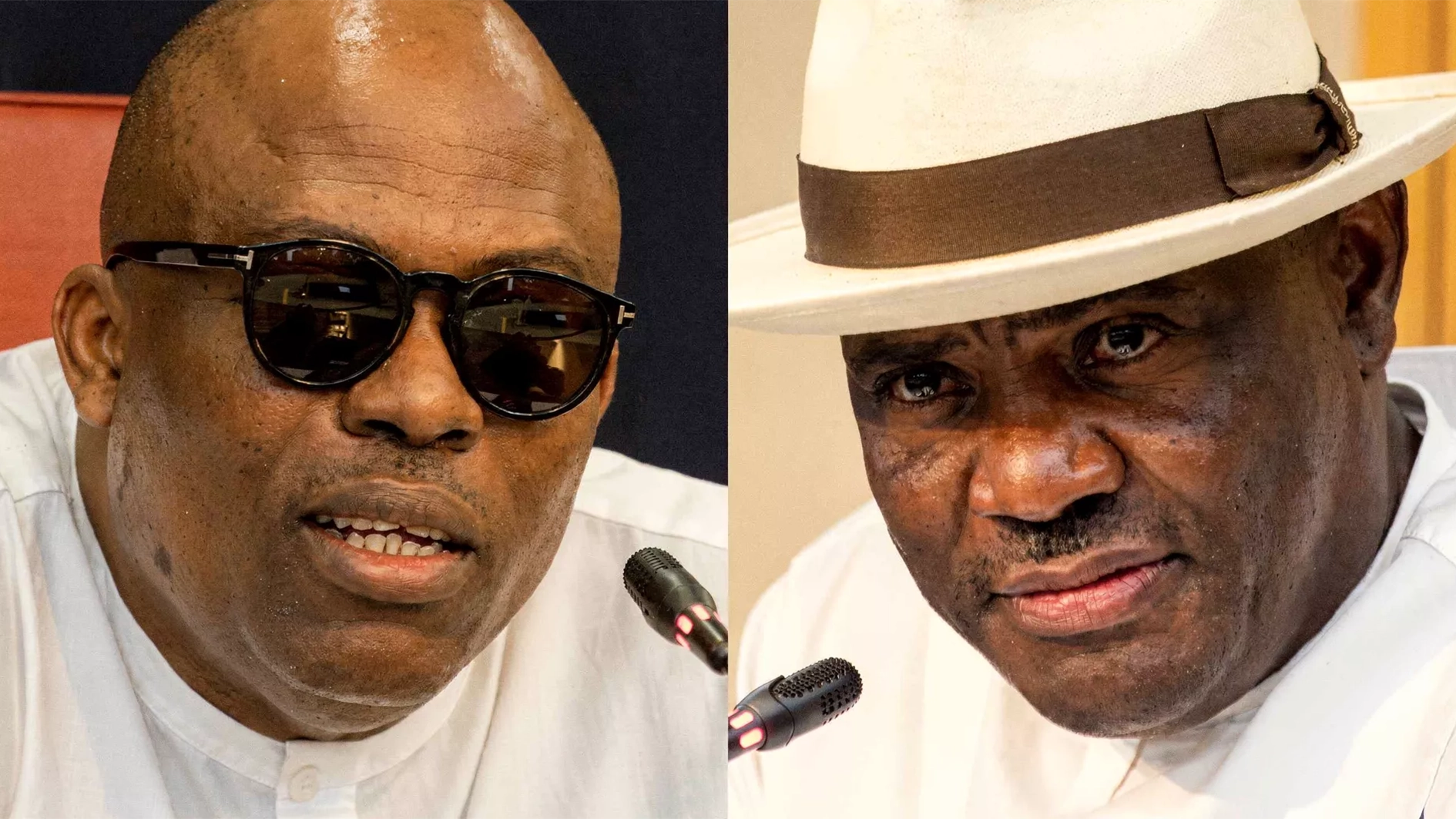
The protracted face-off between Rivers State Governor, Siminalayi Fubara, his predecessor and now Minister of the FCT, Nyesom Wike, and a fractured House of Assembly has gone far beyond a power tussle. It has paralysed governance, eroded public trust and left nearly the 9.8 million residents of the so-called Treasure Base of the Nation hostage to elite brinkmanship, ANN GODWIN reports.
While the media is feasting daily on the protracted face-off between the governor of Rivers State, Siminalayi Fubara, his predecessor, Nyesom Wike, and the divided members of the State’s Assembly, citizens are not finding the development funny.
Six months after Fubara assumed office, the state witnessed significant changes, particularly within the civil service. Long-stagnant workers were promoted, salaries were increased, pensioners received their entitlements, and the health sector also experienced a notable boost.
However, just as the administration was preparing to extend reforms to other areas of development, a crisis erupted in October 2023 between the governor and his estranged godfather. Since then, little appears to have functioned effectively, including governance itself.
When two elephants fight…
Until recently, the modest auto-repair garage of Mr Akinwatimi Gabriel along Mile 3, close to the Rivers State University roundabout, was a daily theatre of hustle, cars jostling for space, customers waiting their turn, mechanics working against time. Today, the yard tells a different story. Empty spaces outnumbered vehicles. Silence has replaced the usual clang of tools.
Mr Akinwatimi’s experience is not an isolated misfortune but a metaphor for a state slowing to a crawl.

Across Port Harcourt and Local Government councils in Rivers State, livelihoods are being bruised by a political crisis that has drifted from the corridors of power into the daily lives of ordinary citizens.
Mrs Fortune Gift learned this the hard way when she fell into an open gully near the Rumosi Flyover, in the Obio/Akpor Local Government Area of the state, on a ring road project awarded in 2023 by the erstwhile governor, Wike, but long abandoned.
These are a few of the unseen repercussions of the protracted face-off between Governor Fubara, Wike, and a divided State House of Assembly. While the political camps remain locked in a battle of supremacy, governance has taken a back seat.
Commissioners and appointees are still largely absent from their desks due to the crack between the executive and legislature.
Major projects, among them the over N200 billion Ring Road, are stalled, and investors’ confidence is evaporating. The result is an economy gasping for breath.
Money no longer circulates like before; businesses are shrinking, and Rivers State, once a magnet for investment in the Niger Delta, now stands on its knees.
Beyond the rhetoric and power plays lies a sobering truth: the greatest casualty of the political turmoil is not any individual faction, but the collective well-being of the state itself, the citizens.
State of emergency
The prolonged crisis effectively imposed a governance freeze. The declaration of a state of emergency in March 2025 stalled investment, crippled empowerment programmes and paralysed development planning.
Rivers State has not passed a substantive budget since 2023. The 2024 budget was nullified by the Supreme Court, plunging the state into further uncertainty. By 2025, the National Assembly-approved state budget offered little relief, yielding minimal tangible outcomes.
Even projects announced under this arrangement, led by the ex-State Administrator, Vice Admiral Ibok Ibas (RTD), struggled to take off. The renovation of the State Secretariat, for instance, was awarded but failed to commence until the end of Ibas’ emergency rule, underscoring the depth of administrative paralysis.
However, upon returning from emergency rule, Fubara’s administration began renovating the deplorable State Secretariat. Without a functioning fiscal framework or coordinated executive-legislative engagement, policy execution has remained largely theoretical.
Latest flashpoint
In January, the protracted feud between Wike, Fubara, and the state lawmakers escalated into a fresh impeachment crisis, worsening the struggle for political control of the state following Fubara’s defection to the federal government-controlled All Progressives Congress (APC).
On January 8, 2026, the Rivers State House of Assembly, led by Speaker Martins Amaewhule, a political ally of Wike, initiated a third impeachment process against Fubara and his deputy, Professor Ngozi Odu.
The lawmakers accused the executive of gross misconduct, including the purported expenditure of public funds without legislative approval and directed the State chief judge, Justice Simeon Amadi, to set up a panel to investigate the allegations, but Judge Amadi declined the request, stating that he was legally restrained from acting due to subsisting interim injunctions issued by a High Court.
The Governor and his deputy Governor, Prof. Odu, had filed a separate suit on January 16, challenging the impeachment process, particularly the alleged improper service of notices of allegations.
However, the crisis seems not to be ending anytime soon, as a Rivers State High Court presided by Justice Florence Fiberesima adjourned the suit by the governor and the deputy indefinitely following confirmation that two separate appeals by the lawmakers have been formally entered at the appellate court.
Beyond the economy, the crisis has fractured the social fabric. The Rivers crisis has exposed a structural weakness in political representation.
The unfolding drama showed that many elected and appointed officials appear more accountable to their sponsors than to the electorate they represent. Their loyalty is to those who endorsed them, at the expense of the populace, thereby hollowing out democratic responsibility.
The political struggle has also polarised citizens, escalating mistrust and sharply dividing the people. These divisions now play out at the grassroots. Sadly, community-level opportunities, jobs, contracts, development projects and development interventions are increasingly determined by political loyalty rather than collective need. As of today in Rivers, benefits meant for the wider public are perceived to be channelled to party faithfuls and cronies, reinforcing exclusion and deepening resentment. Governance, in this sense, has become partisan even at the lowest levels.
Rivers: A still water
Paradoxically, the state remains largely peaceful; there is no widespread violence, no breakdown of law and order.
Security presence remains visible, though not without usual extortions from motorists. What the state is experiencing is not chaos, but stagnation. Businesses are shrinking, cash circulation is thinning, and economic activity is dulled by the absence of decisive governance.
This is evident in the cost of political paralysis, indicating that Rivers is bleeding from negligence and prolonged political fighting.
With governance largely grounded, the overriding focus of the warring political camps in Rivers State appears to be survival and supremacy rather than service. Energy that should be directed at stabilising the economy and restoring public confidence has been consumed by manoeuvres aimed at winning the political battle.
Governor Fubara has repeatedly signalled an intention to entrench good governance and assert institutional independence. However, his efforts have been constrained by relentless distractions, ranging from a hostile State House of Assembly and internal party tensions to sustained pressure from Wike’s political camp. In such a charged atmosphere, navigating the machinery of government and reviving a slowing state has proven exceedingly difficult.
While a segment of the population views Fubara as a leader under pressure, constrained by Wike’s influence, others believe the governor has failed to act with the sincerity and political deftness required to manage the transition of power. These opposing narratives have filtered down to the grassroots, shaping interactions at the community level.
Several residents and stakeholders in Rivers State say the lingering political crisis is exacting a heavy toll on the state’s economy, governance, and social cohesion.
Recounting his experience, a Port Harcourt–based civil society leader and Executive Director of the Youths and Environmental Advocacy Centre (YEAC–Nigeria), Dr Fyneface Dumnamene Fyneface, lamented that the political standoff has significantly disrupted business activities, slowed economic growth and discouraged investment.
According to him, the apparent absence of effective governance, an opportunity cost of the crisis, has stalled public projects and weakened economic circulation. “Most commissioners and political appointees are not fully in office, while major projects, including the over N200 billion Ring Road, are at a standstill. Investors are staying away due to instability, and the state economy is gradually grinding to a halt,” he said.
Fyneface noted that the crisis has also affected civil society organisations operating in the state. He explained that many international development partners now classify Rivers as a high-risk environment, leading to the suspension or outright cancellation of projects and funding.
“Donors are reluctant to commit resources where political uncertainty threatens project implementation. This has negatively affected our work, our organisation and the wider civil society space, with no clear end to the crisis in sight,” he added.
On the political roots of the conflict, he argued that Fubara’s refusal to submit to what he described as prebendal demands from Wike lies at the heart of the crisis.
He maintained that the governor’s stance aligns with public interest, accounting for the popular support he enjoys across the state.
Similarly, a journalist and gender advocate, Mrs Daba Benebo, said the crisis has affected women and their children, especially with the high cost of foodstuffs and less income.
She lamented that the state has been destabilised by what she described as the selfish interests of political actors. She observed that the crisis has deepened divisions among citizens, heightened hate speech and revived ethnic rivalries between upland and riverine communities. “Politics has now filtered into communities. Opportunities meant for everyone are given only to party loyalists and their associates,” she said, adding that she has gradually lost interest in political participation.
A lecturer in the Department of Journalism and Media Studies at the University of Port Harcourt, Dr Otikor Samuel, described the conflict as a struggle for political survival rather than public good.
“Whether Wike brought Fubara to power or not is immaterial. What matters is that Governor Fubara will ultimately be judged on his stewardship. He appears determined to leave a legacy despite the obstacles placed before him,” he said.
A retired civil servant and policy analyst, Mr Blessing Wikina, said the crisis reflects a deep-seated fear of political irrelevance.
He warned that the involvement of the State House of Assembly, in what he described as a disregard for the principle of separation of powers, could further destabilise the state’s economy.
“Private businesses, banks and the oil sector thrive on stability and projections. Rivers State is losing opportunities, investments and relevance as a result of this crisis,” he said.
At the grassroots level, the economic impact is already evident. An auto mechanic, Mr Akinwatimi Gabriel, said patronage has declined sharply as residents struggle with dwindling incomes.
A foodstuff trader, Mrs Fortune Gift, who recently sustained injuries after falling into ditches near the abandoned Rumosi flyover project, lamented the slow pace of development and urged the government to complete stalled infrastructure. Hairdressers and barbers in Mile 2, Diobu, Port Harcourt, Kingsley and Abigail said they sometimes go days without customers, a situation they attributed to economic hardship caused by the unabated political crisis.
Professor Clement Asadu of the University of Port Harcourt described the political battle as largely self-serving. “Politics here is driven by personal ambition rather than statesmanship. Investors are understandably afraid because they cannot predict what will happen next,” he said.
Way Forward
Dr Fyneface called on the FCT Minister to allow Governor Fubara the space to govern, insisting that Rivers State “is not the personal estate of any individual.”
He advised political actors to shelve impeachment threats and allow the electorate to decide the governor’s fate at the polls in 2027.
Mrs Benebo, on her part, stressed the need for strong institutions rather than strong individuals. She urged the Independent National Electoral Commission (INEC), the judiciary and security agencies to act without fear or favour, while encouraging citizens to remain vigilant and actively demand accountability.
In effect, Rivers is trapped in a cycle where political contestation has overwhelmed governance. Until attention shifts from political brinkmanship to institutional stability, the state’s capacity to plan, invest and deliver dividends of democracy will remain severely constrained.
Beyond the personalities and power plays, the feud between Governor Fubara and Wike has translated into real costs for ordinary residents. From stalled businesses and abandoned projects to shrinking civic space and deepening social divisions, the crisis has pushed governance to the margins while uncertainty dominates daily life.
As residents’ voices suggest, the enduring impact of the conflict is not merely political but also economic and social, raising a pressing question: Will leadership in Rivers State ultimately be defined by rivalry or by the resolve to restore stability, trust, and purposeful governance?

