 Follow Us on Google News
 Follow Us on Google Discover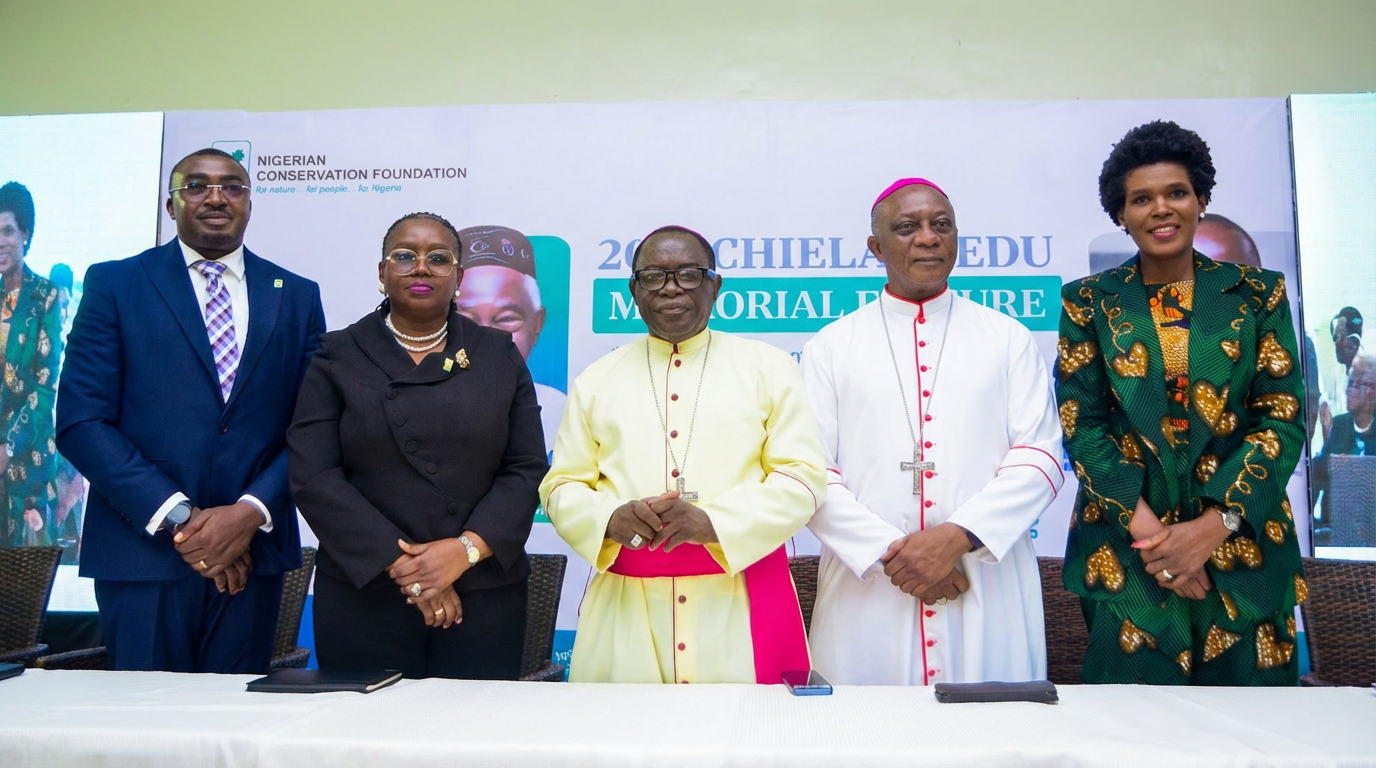
THE Bishop of the Catholic Diocese of Sokoto, Most Rev. Matthew Kukah, has urged Nigerians and the global community to embrace moral responsibility in caring for the environment, warning that unchecked exploitation of natural resources threatens peace, justice, and future generations.
Delivering the 24th Chief S.L. Edu Memorial Lecture organised by the Nigerian Conservation Foundation (NCF), in collaboration with late Shafi Edu family and support of Chevron Nigeria Limited in Lagos, themed, “To Have and to Hold: Faith and Care of the Environment,” Kukah framed humanity’s relationship with the earth as a sacred covenant rooted in faith, restraint, and accountability rather than domination.
Drawing from the matrimonial vow “to have and to hold,” the cleric said the phrase symbolises love, co-responsibility, and commitment, not ownership or license to exploit. “To frame our relationship with the earth in these terms is both profoundly theological and urgently political,” he said, stressing that stewardship must replace the culture of extraction that has separated development from ethics.
Referencing biblical teachings, Kukah explained that humanity’s mandate to “subdue and rule the earth” was never intended as a call to conquest but as a responsibility to align creation with God’s will.
“The earth, like a spouse, was not given to us to plunder or abuse with arrogance. Stewardship is rooted in service and sacrifice, not sovereignty,” he said, quoting Genesis to underscore the inseparable moral obligation “to till and to keep, to use and to preserve.”
However, he lamented that modern society has allowed us to devour preservation, pointing to deforestation, open-pit mining, and polluted rivers as signs of what he described as “moral failure disguised as progress.”
The bishop criticised prevailing attitudes toward nature in Africa, where he said the environment is often approached from a standpoint of domination and utility rather than care. According to him, many Nigerians view animals solely as sources of meat and rarely acknowledge obligations toward their welfare. Domestic animals are frequently left to fend for themselves, feeding on waste without proper care.
“This culture of consumerism has produced what Pope Francis called the ‘throwaway culture,’ reducing both people and nature to instruments of economic gain,” Kukah noted. He linked ecological destruction to the struggles of indigenous communities, referencing the Niger Delta, where oil exploration has devastated livelihoods. Kukah recalled his involvement in reconciliation efforts in Ogoniland alongside the United Nations Environment Programme, which led to a scientific response and remediation initiative.

Tracing environmental exploitation to colonial expansion, slavery, and the industrial revolution, Kukah said profit motives have long shaped the manipulation of natural resources. Although African countries have gained political independence.
He also maintained that many still lack meaningful control over their resources, with conflicts often tied to competition for resource rents. “African leaders have largely been reduced to presiding over the collection of these rents, driving cultures of patrimonialism and prebendalism that weaken democracy,” he said.
The result, according to Kukah, is a pattern in which resources enrich distant markets and elites while local communities are left with contaminated water, destroyed livelihoods, and fractured social systems.
“These are not merely environmental crimes; they are sins against justice, against the poor, and against future generations,” he added.
Kukah warned that environmental destruction erodes trust in institutions and fuels grievances that later manifest as communal violence, often mischaracterised as ethnic or religious conflicts. “A state that cannot protect its land cannot protect its people,” he said, noting that when ecological funds are diverted and regulatory agencies weakened, governments forfeit moral authority.
He called on religious leaders to move beyond passive observation and provide moral clarity by naming exploitation as a violation of divine trust. “Faith demands restraint in consumption, equity in distribution, and accountability in governance,” he said.
Central to Kukah’s message was the concept of “integral ecology,” which recognises the interconnectedness of human, economic, cultural, and environmental systems. He argued that while past injustices should not be ignored, the priority must be shaping a better future through conscious action.
Among his recommendations was a stronger response to the “Cry of the Earth,” urging Nigeria to scale up efforts against climate change, desertification in the Sahel, deforestation in the Middle Belt, coastal erosion in the Niger Delta, and biodiversity loss nationwide.
Environmental protection, he said, should be treated not merely as compliance with international agreements but as a moral duty, emphasising prevention, restoration, and long-term ecological integrity.
Kukah also highlighted the “Cry of the Poor,” describing it as morally unacceptable that resource-rich nations remain trapped in poverty while corrupt elites accumulate unearned wealth. He called for alliances between the church, civil society, the judiciary, and the media to expose injustice and pursue structural reforms that guarantee land security and restore livelihoods. “Poverty eradication cannot occur without environmental justice and equitable access to land and resources,” he said.
The bishop advocated sustainable lifestyles grounded in moderation, warning against unsustainable consumption patterns such as deforestation for fuelwood, waste mismanagement, and uncontrolled urban expansion.
He illustrated widening inequality with an anecdote about extravagant spending in nightlife culture, describing it as a reflection of social imbalance in a country where many struggle to survive.
Kukah also called for a rethink of the Land Use Act of 1976, arguing that vesting land control in state governors has blurred responsibilities and enabled the displacement of communities through discretionary allocations. “The environment has not received the attention it deserves,” he said, criticising a governance culture where public office is often valued for personal gain rather than service.
Chairman of the National Executive Council of the NCF, Hon. Justice R.I.B. Adebiyi, called for collective responsibility in safeguarding the environment, stressing that conservation is a shared duty that extends beyond governments and environmental organisations.
She said the theme was timely, given rising threats such as deforestation, pollution, and climate change. She urged individuals, faith communities, and institutions to adopt practices that protect natural heritage for present and future generations, noting that humanity remains accountable to God for the gift of the Earth.
Adebiyi also paid tribute to the late Chief Shafi Lawal Edu, widely regarded as the father of conservation in Nigeria, describing his life as a testament to hard work, discipline, faith, and service. His enduring legacy, she noted, includes founding the NCF in 1980 alongside other environmentalists, driven by his belief that the natural environment is governed by divine laws.
Also, the Metropolitan Archbishop of the Catholic Archdiocese of Lagos, Most Rev. Dr Alfred Martins, reaffirmed the church’s commitment to environmental stewardship, describing care for the Earth as a moral, spiritual, and social obligation.
Delivering a goodwill message, the Archbishop said the archdiocese remains guided by Laudato Si’, Pope Francis’ encyclical on integral ecology and climate change, which underscores the link between human dignity, protection of the poor, and the pursuit of the common good. He noted that environmental responsibility is no longer optional but central to the church’s social justice teachings.
Martins highlighted several initiatives undertaken by the Archdiocese to translate the principles of Laudato Si’ into action, including pastoral teachings, parish sensitisation, environmental education in Catholic schools, and youth engagement through the Network of Young Catholic Carers for the Environment (NYCCEN). He recalled collaborations with NCF, conferences on sustainable lifestyles and energy alternatives, advocacy for responsible consumption, and campaigns promoting waste reduction, tree planting, and the “reduce, reuse, recycle” approach.
According to him, these efforts reflect the church’s belief that the “cry of the earth” and the “cry of the poor” must be addressed together.
The Archbishop warned that unchecked exploitation, pollution, biodiversity loss, and climate change have turned the planet into a fragile ecosystem facing existential threats, urging individuals and institutions to embrace lifestyles rooted in restraint and gratitude.

