 Follow Us on Google News
 Follow Us on Google Discover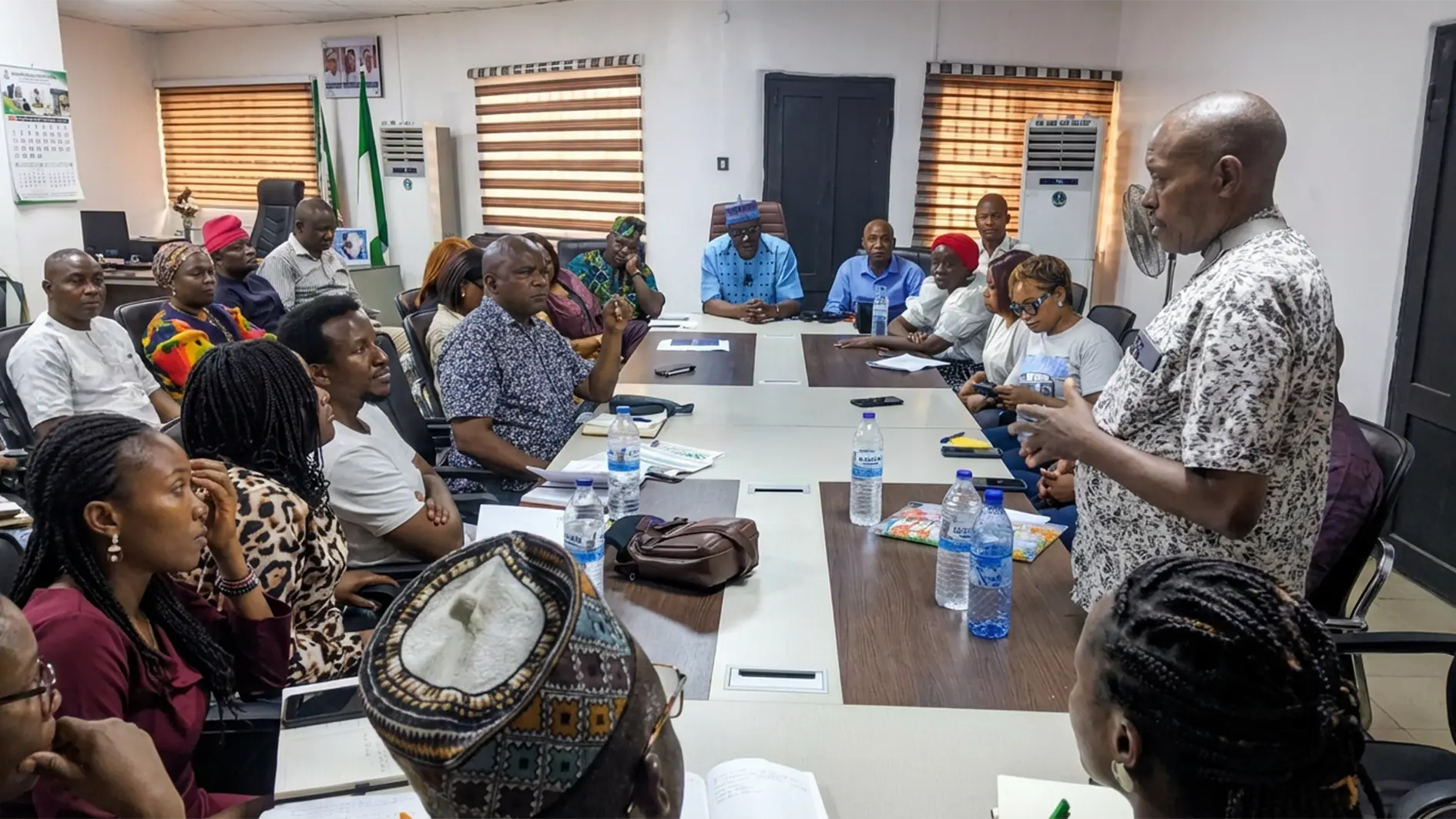
A new phase of collaboration between local government authorities and urban researchers has been launched following a strategic meeting at the Igando-Ikotun Local Council Development Area (LCDA) headquarters in Lagos, aimed at strengthening community-level water and sanitation services.
The engagement brought together a diverse delegation from the African Cities Research Consortium (ACRC), including teams from Lagos and Nairobi, in what participants described as a deliberate effort to bridge research and on-the-ground implementation. The session outlined the purpose of the visit, signalling a shift from academic discussions to actionable community planning. ACRC is hosted by the Centre for Housing and Sustainable Development, University of Lagos (CHSD-UNILAG).
Setting the tone, the ACRC Lagos City Manager, Dr Temilade Sesan, explained that a study visit to Nairobi in December had exposed the Lagos team to notable advances in inclusive urban planning and service delivery. According to her, the visit sparked a sense of “healthy competition” and a determination to show that Lagos communities could also deliver impactful infrastructure projects.
Quoting the popular phrase “Nigeria no dey carry last,” Sesan said the Igando-Ikotun engagement was aimed at moving beyond talk to initiate a broader dialogue on community-led planning, with a specific focus on water, sanitation and hygiene (WASH). She stressed that the project was designed to test practical solutions that could be scaled beyond the pilot community.
Responding, the Chairman of Igando-Ikotun LCDA, Lasisi Akinsanya, expressed appreciation to the ACRC for involving his council, particularly acknowledging the opportunity given to the Councillor, who participated in the Nairobi exchange programme.
Akinsanya placed the discussion within a broader political and historical context, recalling that the creation of Local Council Development Areas in Lagos State was driven by the vision of then-Governor Bola Tinubu to take governance closer to the grassroots.
He noted that the policy was implemented despite stiff financial resistance from the federal government at the time.
“These LCDAs are like children that were nurtured from infancy,” the Chairman said, adding that he was proud of how they have matured into functional administrative units delivering tangible projects.
He outlined key interventions under his administration, including renovation of public schools, construction and rehabilitation of roads, and youth empowerment initiatives designed to reduce crime. Akinsanya repeatedly thanked the ACRC team for selecting Igando-Ikotun as a pilot location, assuring them of his full support for the project until the end of his tenure.
On water provision, the chairman cited partnerships with WaterAid and PepsiCo that have delivered water facilities to primary healthcare centres and schools in Ijegun and Egan communities. However, he also narrated challenges, including a failed community-managed borehole project in Ijegun where residents allegedly neglected the facility, filled it with refuse and failed to safeguard critical equipment.
He said his administration declined to immediately repair the damaged facility, describing the decision as a lesson in public accountability and shared responsibility.
Akinsanya also explained that the LCDA has seven wards, making equitable distribution of projects a key consideration. He disclosed that focused water interventions had so far reached only two of the seven wards, underscoring the scale of unmet needs.
On institutional capacity, the Chairman clarified that local governments no longer have the legal authority to operate “mini water works,” as water management has been restructured under the Lagos State Water Corporation. While acknowledging ongoing debates around local government autonomy, he said councils currently operate within defined limits.
When asked about sectoral priorities, Akinsanya listed education, primary healthcare and road infrastructure as the top three focus areas of his administration.

Providing technical details of the proposed intervention, Ms Oluwaseun Muraina presented the WASH Action Research Project planned for the Okerube community. She described the initiative as “informed advocacy,” aimed at co-producing solutions with residents to ensure long-term sustainability.
Muraina presented data showing that Lagos State requires about one million gallons of water daily, but currently operates at roughly 40 per cent of its installed production capacity. In Okerube, she said, many public water points donated by politicians or councils were either non-functional or treated as private assets, forcing residents to rely on informal water vendors popularly known as “Meriwa.”
To address this, the project is piloting a social enterprise model that moves away from one-off donations. Under the model, users pay subsidised fees that fund routine management and maintenance, ensuring the infrastructure remains functional over time.
Members of the Nairobi delegation drew on experiences from informal settlements such as Mukuru to offer guidance for the Lagos pilot. Executive Director of Akiba Mashinani Trust (AMT), Jane Weru, emphasised the importance of accurate data, noting that complex urban challenges cannot be solved without precise information. She advocated for detailed GIS mapping that assigns identifiers to every house and water point, enabling authorities to track service coverage and population impact.
Another Nairobi representative highlighted the concept of the “poverty penalty,” explaining that research in Kenya showed poorer households often pay more for basic services than wealthier residents. The findings, she said, influenced policy decisions that elevated access to water as a human right.
From a technical perspective, an engineer in the delegation pointed to the paradox of Lagos having abundant water resources but low operational efficiency. He urged stakeholders to interrogate production and pumping data to better understand sustainability challenges.
Also contributing, Executive Director of the Shantytown Empowerment Foundation (SHEF), Mr Rasheed Shittu, stressed that women and children bear the greatest burden of inadequate water access. He called for “action research” that delivers visible community benefits rather than remaining on paper.
Drawing from insights gained during the Nairobi exchange, Shittu underscored the need for rigorous data collection and mapping to guide planning and investment. He appealed for full council backing and clear departmental ownership of the project to guarantee sustainability.
In closing, Chairman Akinsanya pledged the LCDA’s full cooperation, declaring that the ACRC had “chosen the right local government to work with.” He expressed hope that the partnership would yield results strong enough to encourage further collaboration.
To institutionalise the commitment, he assigned four departments: Budget, Agriculture and Social Services; Health and Environmental Services; and Works and Housing/Infrastructural to work directly with the research team. He also invited the delegation to return for a formal groundbreaking ceremony in the Okerube community. “Igando-Ikotun is a place to be,” the Chairman said, signalling optimism that the collaboration could become a model for community-driven service delivery in Lagos.

