 Follow Us on Google News


 Follow Us on Google Discover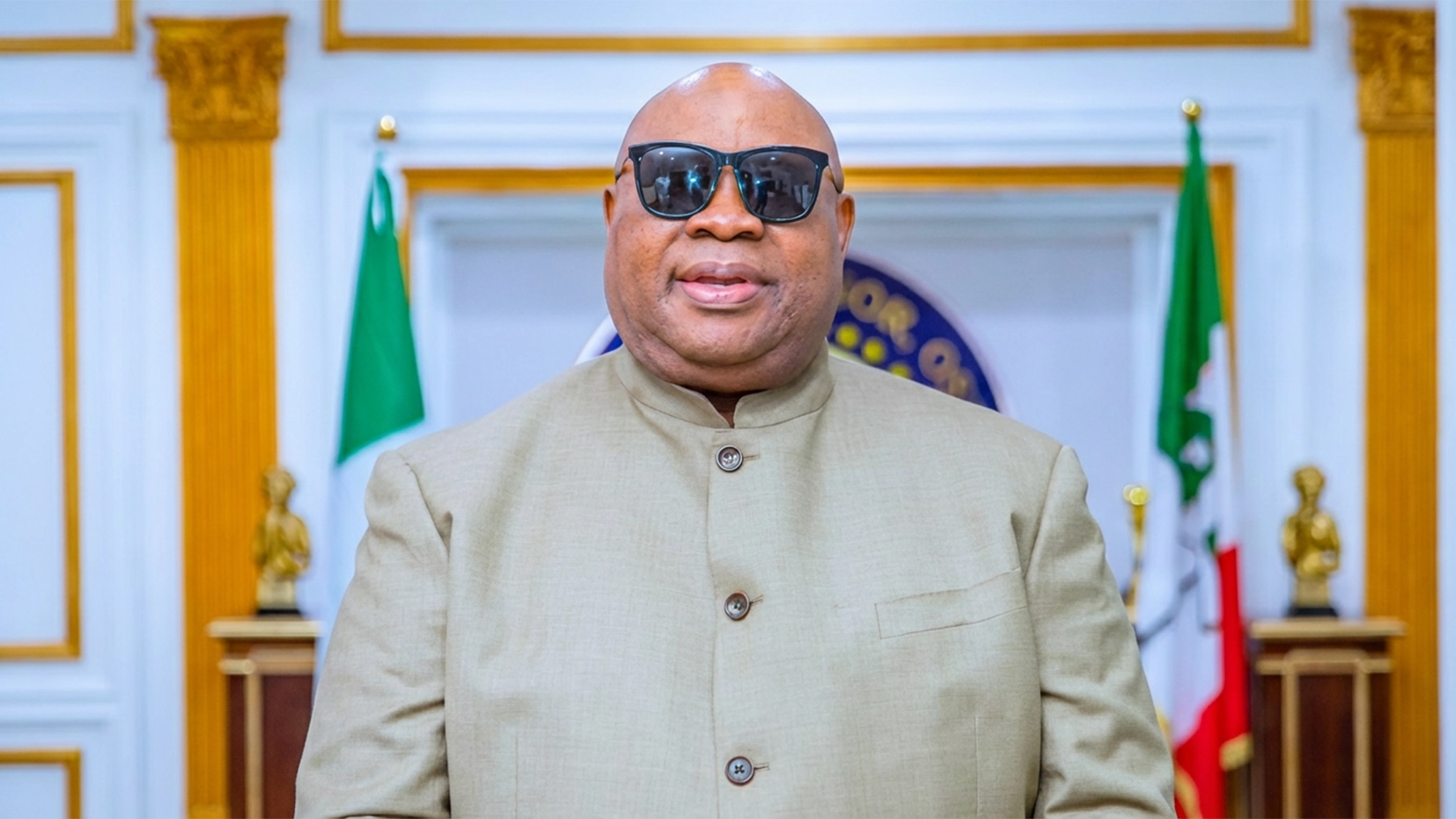
Governor Ademola Adeleke’s re-election bid on August 8 will hinge on his ability to navigate a minefield of political headwinds. The familiar dancing steps that powered his dramatic ascent may not suffice this time, especially against the weight of federal influence and the swelling ranks of defectors aligning with the All Progressives Congress (APC), TIMOTHY AGBOH reports.
As the August 8 governorship election approaches, Governor Ademola Adeleke confronts a complex path to re-election on the platform of the Accord Party (AP). Beyond the routine test of incumbency, the governor faces a resurgent and more coordinated All Progressives Congress (APC), bolstered by presidential influence, the weight of 30 governors and entrenched institutional networks. Compounding the political contest is the contentious issue of local government funds, a fiscal and legal minefield that could shape both the narrative and the outcome of the race.
With the publication of candidates’ credentials by the Independent National Electoral Commission (INEC), the August 8, 2026, governorship election in Osun State has crystallised into a defining duel between incumbent Governor Adeleke of the Accord Party and Bola Oyebamiji of the APC.
Though 14 political parties are listed on the ballot, observers agree that the race has narrowed into a high-stakes confrontation between personality-driven incumbency and a nationally coordinated opposition machine determined to reclaim lost territory in the Southwest.
The African Democratic Congress (ADC), led in the state by former governor Rauf Aregbesola, commands pockets of loyalty and an energetic online presence. Yet beyond the social media bravado, the real battlefield is between Adeleke and the APC, whose political calculations extend far beyond Osun’s borders.
For Adeleke, the contest is about survival, validation and consolidation. For the APC, it is about recovery, symbolism and strategic alignment.

Governor Adeleke enters the race fortified by two obvious advantages: personal popularity and the power of incumbency. His 2022 victory over then-incumbent Gboyega Oyetola, now Minister of Marine and Blue Economy, was powered by grassroots mobilisation and voter fatigue with the outgoing administration. Adeleke secured 403,371 votes against Oyetola’s 375,027, a narrow but decisive margin that overturned entrenched structures and reconfigured Osun’s political map.
Since assuming office, Adeleke has continued to cultivate that mass appeal. His populist style, once dismissed by critics, has proved electorally effective. Even opponents concede that his political branding connects emotionally with many voters.
Yet incumbency in Nigeria is both shield and exposure. It offers visibility, access to state structures and agenda-setting power, but it also attracts coordinated opposition. In this election cycle, Adeleke confronts a far more consolidated adversary than in 2022.
One of the governor’s immediate vulnerabilities lies within his political platform. After leaving the PDP for Accord, internal fissures surfaced almost immediately. Four days after Adeleke emerged as the party’s governorship candidate, another faction conducted a parallel primary and produced Clement Bamigbola as its own flagbearer.
Earlier disagreements had questioned the legitimacy of Maxwell Mgbudem’s leadership.
Although INEC’s recognition of Adeleke as Accord’s authentic candidate largely settled the legal dispute, political reconciliation remains incomplete. As Gboyega Adepega of Accord admitted:
“One of our greatest fears was when another candidate emerged in the Accord Party. Sincerely, it disturbed us, but thank God we have overcome that now. INEC has recognised Governor Adeleke as the only candidate for the August 8 gubernatorial election.
“But I think we can do better by meeting and engaging with the few elements they wanted to use against us, with a view to gaining their loyalty. We need everyone to support our governor.”
Allies insist that former PDP structures will quietly align with Adeleke. Kosolowoe Ajibade noted that the governor has “been maintaining Accord and PDP as vehicles for his re-election bid.”
Yet uncertainty persists, particularly as the PDP Southwest spokesman, Sanya Atofarati, clarified that the party is not in any pact with any political party or candidate, pending court resolutions affecting its participation.
In a tightly contested election, even subtle fractures can prove consequential.
Beyond party unity lies a deeper structural issue: the battle over local government funds. In Nigerian electoral politics, local governments function as the operational nerve centres of grassroots mobilisation. Council allocations sustain ward-level coordinators, empower councillors, finance political outreach and lubricate the informal networks that determine turnout.
Recent judicial pronouncements emphasising local government financial autonomy have altered the dynamics of fiscal control nationwide. In Osun, these shifts have reportedly constrained the state government’s latitude over council finances. If access to local government resources remains limited or administratively contested, the governor’s ability to deploy traditional grassroots machinery could be significantly weakened.
Political analyst Biodun Familoye framed the contest starkly, arguing that Adeleke is not merely running against Oyebamiji but against President Bola Ahmed Tinubu’s strategic interest. “This is where Adeleke will know how effective his dancing steps are politically. I can see that the dancing steps have been reduced in the last few months,” he remarked.
Behind the metaphor lies a structural asymmetry. While Adeleke navigates fiscal and administrative constraints at the local level, the APC candidate can potentially draw on pooled national resources.
That asymmetry is amplified by the APC’s control of 31 state governments across the federation. Governors are not merely administrators; they are financiers, coordinators and political mobilisers. In off-cycle elections, the ruling party often concentrates its attention and resources on a single battleground state.
Osun’s election, coming outside the general election calendar, provides such an opportunity. With no simultaneous statewide contests competing for attention, the APC can deploy interstate support, campaign funding and political reinforcements in a focused manner.
A civil servant in Osun, who requested anonymity, drew parallels with previous off-cycle elections in Ondo and Edo, where federal alignment and interstate mobilisation were widely perceived as decisive. “The case of Ekiti and Osun 2026 is going to be massive,” he said.
For the APC, Osun carries symbolic weight. The state’s loss in 2022 disrupted what many considered a Southwest stronghold. Reclaiming it would reinforce regional consolidation and neutralise an opposition outpost within the president’s geopolitical base.
Familoye captured this perception bluntly: Adeleke’s real opponent is Tinubu, “who desperately needs to regain his home state.” Whether framed as desperation or strategy, the presidency’s interest in the contest is undeniable.
APC spokesperson Kola Olabisi dismissed allegations of federal might. “There is nothing like the federal might. If Adeleke loses, the heavens won’t fall,” he insisted. He pointed to defections as evidence of momentum: “Formerly, Osun PDP had three senators. Out of the three senators, two are with us now. PDP had nine House of Representatives members. We have three powerful House of Reps members now with us… If PDP and Accord combine, they can’t withstand us.”
The APC’s message is one of inevitability, a projection of strength designed to influence both perception and momentum.
Historical precedents suggest that such consolidation matters. In 2018, Osun’s rerun election was shaped by intense federal mobilisation. In Ekiti and Ondo, incumbents aligned with the federal ruling party leveraged coordinated support to secure victory. Edo’s contest illustrated how national calculations and internal party realignments can dramatically reshape outcomes.
In contrast, Adeleke’s 2022 triumph demonstrated that popular mobilisation can overcome entrenched structures when opposition forces are divided or complacent.
The 2026 equation is different. The opposition is unified, strategically aligned and nationally reinforced.
Recent opinion polling places Oyebamiji ahead with approximately 52 per cent support, compared with Adeleke’s 38 per cent and the ADC’s eight per cent. While polls are snapshots rather than verdicts, the double-digit gap underscores the scale of the incumbent’s challenge.
For the ADC, the eight per cent reflects residual loyalty to Aregbesola but also highlights the structural limitations of third-party bids in high-stakes contests. Its most plausible influence may lie in shaping vote distribution rather than securing an outright victory.
Ultimately, the August 8 election presents a stark contrast. Adeleke represents grassroots charisma, incumbency, and emotional resonance, but he confronts party fragility, fiscal constraints at the local level, and limited interstate backing.
Oyebamiji represents institutional consolidation, financial depth, coordinated support from 31 governors and perceived federal alignment.
This election is not merely about individual candidates. It is about whether personality-driven politics can withstand structural power; whether grassroots appeal can overcome concentrated institutional leverage; and whether Osun remains an outlier or returns to the ruling party’s fold.
In 2022, Adeleke defied entrenched expectations. In 2026, the structures appear more unified, the stakes more symbolic, and the pressure more concentrated.
Whether incumbency advantage can withstand the combined weight of council fund constraints, interstate mobilisation, and presidential interest will determine not just Osun’s next governor but also the trajectory of political consolidation in the Southwest.

