 Follow Us on Google News
 Follow Us on Google Discover
The National Economic Council organised a two-day conference last week to chart new strategies for the attainment of the present administration’s vision of Nigeria becoming a $1tr economy by 2030. JOSEPH CHIBUEZE, who attended the conference, writes on the steps so far taken by the government and the gaps that must be filled towards achieving the ambitious target.
Barely four years from now, 2030, the magic year Nigeria hopes to achieve a $1 trillion economy, will come. That is the vision of the present administration and it has been aggressive in its pursuit with various reform measures.
Four years sounds like a long time, but for a country whose nominal Gross Domestic Product (GDP) as at 2025 was hovering around $243 billion and $252 billion and is projected to reach $334 billion in 2026, it will take a miracle to achieve the feat in just four years.
Nigeria currently ranks as the fourth largest economy in Africa after South Africa, Egypt and Algeria. As of the third quarter of 2025, Nigeria’s real GDP grew by 3.98 per cent, an improvement over the overall 2024 annual growth of 3.40 per cent.
Comparatively, South Africa had a total nominal GDP of $426.38 billion in 2025 and is projected to grow to $443 billion in 2026. Egypt has a nominal GDP of $349.26 billion in 2025 and is projected to reach $399.51 billion in 2026. Nigeria is obviously not looking at these other countries and believes it can leapfrog them and hit the $1 trillion mark in four years’ time.
That is the audacity of hope and the basis for the Renewed Hope Agenda mantra of the present administration! But it is not just about hope. The government has, like one in a race against time, initiated a number of policy reforms it hopes will help it achieve its goal, including the Renewed Hope Development Plan 2026-2030, meant to serve as the core medium-term strategy, prioritising infrastructure, job creation, and economic growth to bridge previous development gaps; the Nigeria First policy, which is to prioritise and promote local businesses; the removal of the fuel subsidy, believed to be a drain-pipe; the unification of the exchange rate; the banking sector recapitalisation to strengthen the banks and prepare them to better finance the real sector; the Renewed Hope Ward-based Development, that is targeting development at the grassroots; the tax reform, designed to improve tax-to-GDP ratios and expand the tax net, among others.
These reforms are already yielding results but not at the pace expected to achieve the target. That explains last week’s National Economic Council Conference, the second in 10 years, held in Abuja.
The conference with the theme, ‘Delivering Inclusive Growth and Sustainable National Development: The Renewed Hope National Development Plan,’ represents a final push by a government desperate to achieve its desired goal through inclusivity.
The NEC serves as the bridge between the Federal Government and the 36 states, ensuring that economic policies are synchronised across all levels of government.
More importantly, the government seems to have realised that there can be no meaningful development if the grassroots are left behind. President Bola Ahmed Tinubu let this cat out of the bag in his speech when he said, “Nigeria’s diversity is our strength. When states grow, Nigeria grows. When growth reaches the poorest households, national stability strengthens.”
This is a shift in economic strategy, moving away from traditional top-down fiscal policies, to bottom-up approach, focusing on grassroots development as the primary catalyst to propel Nigeria towards the $1 trillion economy.
Yes, there are still doubts about the feasibility of Nigeria hitting the $1 trillion economy by 2030, especially with the failure of the National Development Plan (NDP) 2021-2024 to achieve most of its ambitious targets essentially due to structural weaknesses and external shocks. The government had projected that between 2021 and 2024, per capita GDP would have hit $2,927.6, but it ended up at $2,213; real sector growth was 2.9 per cent against 4.7 per cent; and industrial growth trailed at 1.9 per cent compared to the projected rate of 8.3 per cent.
Minister of Budget and Economic Planning, Senator Abubakar Bagudu, said the failure of the NDP 2021-2024 provided vital lessons. He was particular about the failings of the previous top-down strategy, inadequate stakeholder consultation, a lack of yearly assessments, and poor alignment with the private sector.
The Governor of Anambra State, Charles Soludo, expressed strong doubt about the possibility of Nigeria achieving a $1 trillion economy by 2030. He noted that Nigeria may need to grow her GDP by possibly 20 per cent per annum to be able to achieve that. According to him, “sometimes I think we just prime ourselves to fail.”
Soludo, a Professor of Economics and former governor of the Central Bank of Nigeria (CBN), obviously knew what he was saying as the Minister of State, Finance, Mrs. Doris Uzoka Anite, also shared in his sentiment even though she gave a lower GDP growth of 10 per cent for the target to be achieved.
While not succumbing to the pessimism expressed by Soludo, Bagudu agreed that although the $1 trillion economy is a tall order, “it is the ambitious policy the government has determined to achieve,” he said.
He also hinted at the development of a prospective plan: Nigeria Agenda 2050, which aims to transform Nigeria into an Upper Middle-Income Country (UMIC). The plan, according to him, projects an average annual growth rate of seven per cent, seeking to shift Nigeria from a resource-dependent economy to a competitive, diversified production hub.
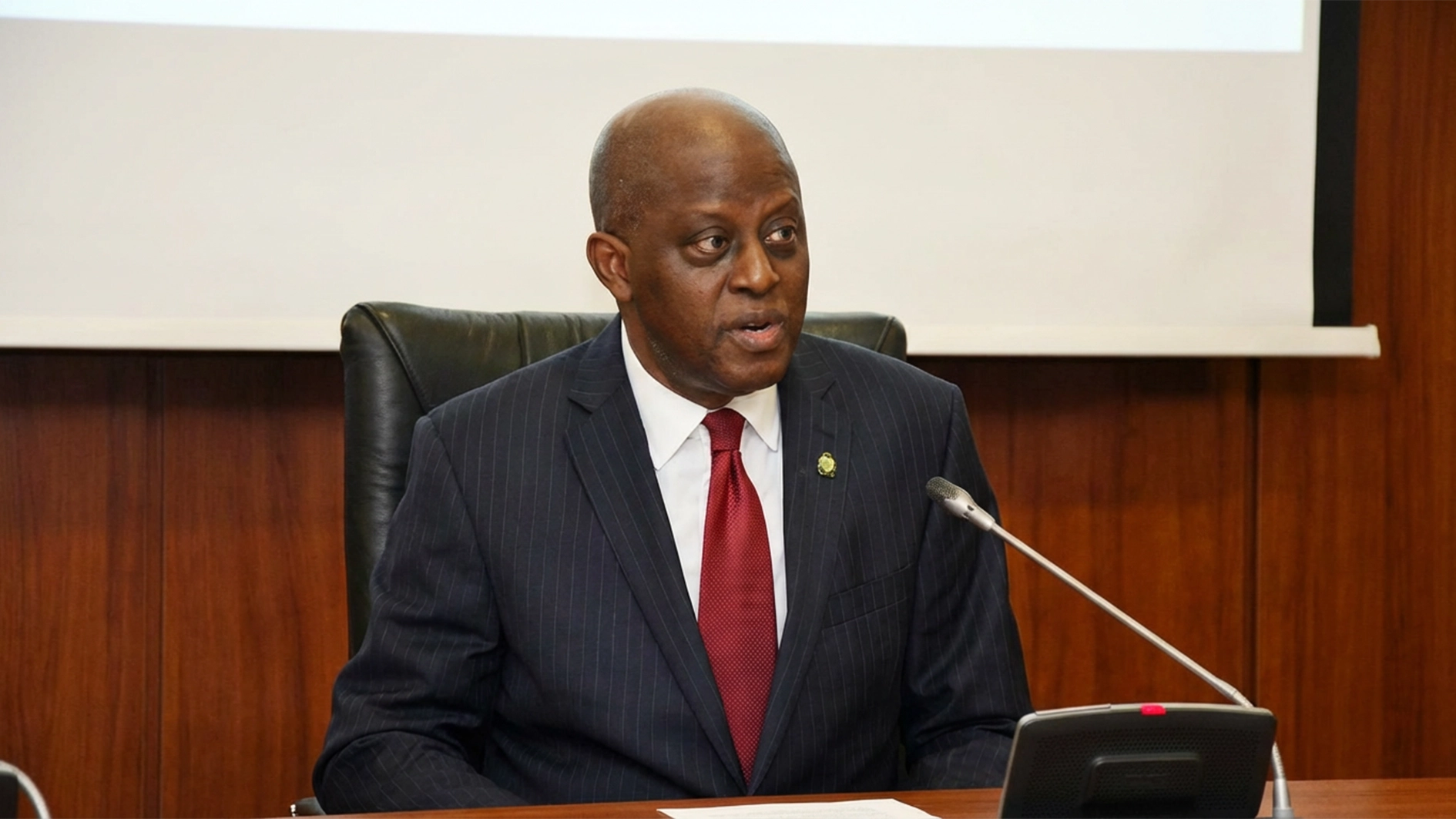
At the end of the technical presentations and panel discussions in the two-day event, the conference made far reaching recommendations that if adopted will fast-track the attainment of the $1 trillion economy.
According to the communique issued at the end of the conference, all tiers of government should move from haphazard growth financing to catalysing growth by strengthening cooperative federalism, translating macroeconomic reforms into real impact for citizens; governments at all levels should identify and prioritise bankable, growth-generating projects across strategic sectors, including agriculture, manufacturing, energy, transport and logistics, digital infrastructure etc; the Federal Government should ensure optimal investment in the oil and gas sector, while ensuring effective diversification in domestic refining and non-oil sectors to enhance energy security, reduce import dependence, strengthen value chains, and create employment.
The conference emphasised the need to strengthen fiscal, monetary and trade policy coordination for effective macroeconomic stability.
Other recommendations include: The Federal Government should ensure an efficient public-private partnership framework to drive private sector capital and mitigate investment risks to attract development; government at all levels should endeavour to key into the Renewed Hope Agenda to create and develop skills in technology and artificial intelligence to remain competitive in the global economy; states should institutionalise joint planning, shared resources, harmonised policies, and structured information exchange, supported by formal legal and institutional frameworks and regional cooperation platforms to address shared challenges and promote balanced development; the federal and state governments should establish regular intergovernmental engagements, capacity-building programmes, and conflict-management frameworks to jointly address insecurity, infrastructure gaps, and economic disparities across the federation; the federal and state governments should foster strong partnerships with the private sector, civil society, and development partners to achieve inclusive and sustainable national development; states should enact the harmonised tax law to address multiple taxation and complement the new tax reform laws; governments at all levels should prioritise spending on human capital development, enabling infrastructure and improved accountability to strengthen trust.
The conference also recommended the amendment of the constitution to remove certain inconsistencies in the implementation of fiscal federalism.
It also recommended the expansion of concessional financing for the productive sectors, secure production corridors and skill infrastructure delivery, among others.

