 Follow Us on Google News
 Follow Us on Google Discover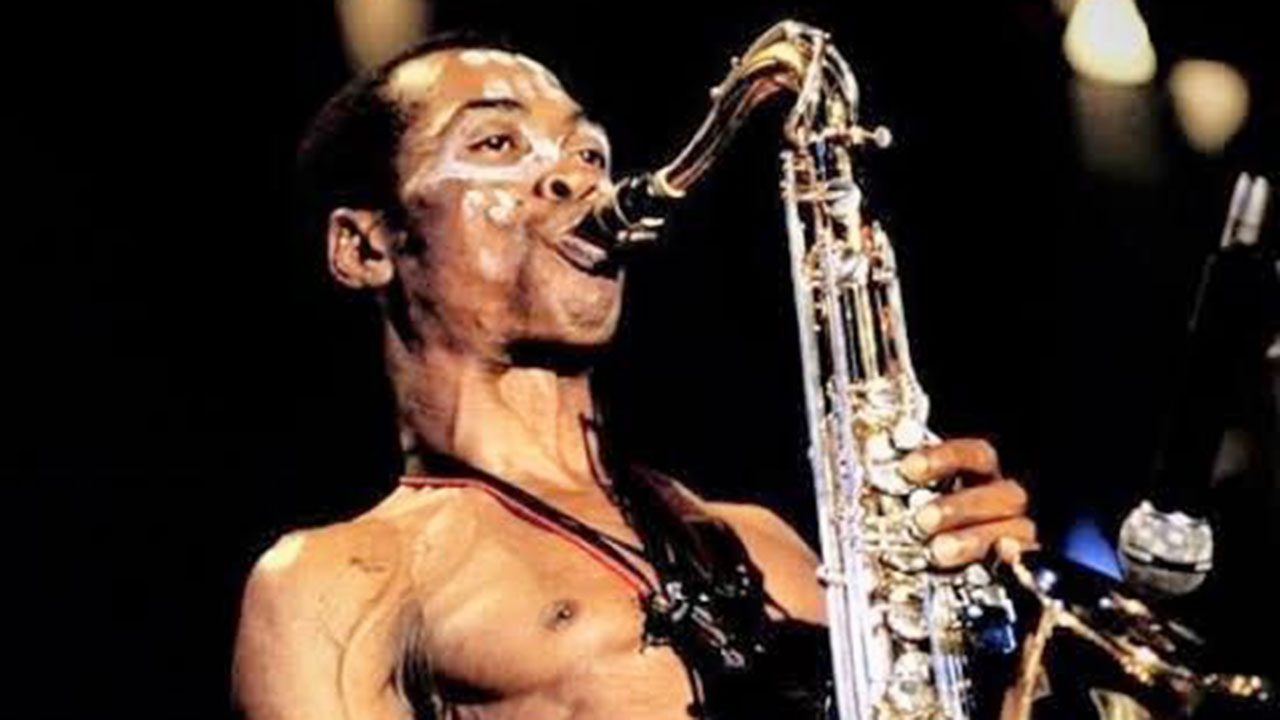
Barely over a month ago, news broke of Fela Anikulapo-Kuti’s latest induction into an international Hall of Fame. Nearly 30 years after the Afrobeat inventor’s demise, he became the first African artist to clinch the Grammy Lifetime Achievement award, a feat aimed at celebrating the icon’s legacy which has by far helmed an entire soundscape across West Africa.
Afrobeats, as we know it today, would probably have a different identity — and legacy — without the life and times of Fela Anikulapo Kuti. Decades after his passing in 1997, Fela remains one of the most consequential cultural figures of the 20th century, a rabidly brazen, doggedly focused, and culturally flamboyant thinker and artist. His catalogues amplified political thought, artistic rebellion, and African heritage. As his famous collaborator and key percussionist Tony Allen once described: ‘Fela’s legacy is that he used music as a weapon. He planted that idea to use music as a weapon, and the weapon is to wake people up’.
Born in 1938 to activist Funmilayo Ransome-Kuti and Reverend Israel Ransome-Kuti, Fela grew up in a politically conscious household, one that would etch that similar consciousness in his younger self as he studied abroad. He studied music at the Trinity College of Music, London, in the late 1950s, after initially travelling to study medicine. He ditched medicine for music, returning to Nigeria in 1963 after majoring in composition and trumpet performance.
When he returned, he formed the Koola Lobitos band, nitpicking his style — a fusion of calypso, salsa, jazz, highlife and native African rhythms — into what we all know as Afrobeat.
One funny step in Fela’s ascent as a superstar was going broke after self-funding some shows in California, in 1969, after show promoters fleeced him. There, he found respite performing with his band at a local hotel, under commission by a Black women’s social club called The Regalettes. It was during this time that he found Sandra Isidore, the Black Panther member who introduced him to the movement, and further radicalized him with literature like Alex Haley’s The Autobiography of Malcolm X. This era greatly radicalised Fela Kuti, flipping his political consciousness into a more geo-political purview, something we’d later experience in full form in his catalogues.
Kalakuta Republic: A Nation Within a Nation
After returning to Nigeria in 1970, Fela’s career began in full swing. At the heart of that movement stood Kalakuta Republic, which was at first his communal residence in Lagos. But it was more than that. It was a declaration of autonomy. Fela named it a republic to symbolically secede from what he saw as a corrupt Nigerian state. Artists, musicians, activists, and everyday people lived there. It was a creative lab of sorts and a political sanctuary.
Fela Kuti remained brazen with his music. He recorded dozens of albums, even earning the Guiness World Record for the solo artist with the most studio albums ever released. He released 46 records between 1969 and 1992. A lot of those songs, including the 1975 opus “Zombie”, and the 1977 “Sorrow, Tears and Blood” were direct confrontation at the oppressive military regimes at the time. He called out military brutality, government corruption, and postcolonial hypocrisy, without fear of vilification. He was indeed vilified endlessly by the military who arrested him, beat him up and even murdered his mother just to silence him.
But he never kept quiet. His voice was a tool of protest, and his music the soundtrack to this revolutionary movement. Rather than retreat, Fela turned tragedy into protest. He delivered his mother’s coffin to Dodan Barracks, the seat of military power at the time, and continued recording and performing.
The Shrine: Fela’s Holy Grail
If Kalakuta was the ideological headquarters, the Afrika Shrine was its main pulpit.
First established in the 1970s and later reborn as the New Afrika Shrine in Ikeja, the venue became the epicenter for Afrobeat lovers to commune. Fela performed there multiple nights a week, often stretching sets into marathon sessions of music, dance, and political oratory.
It was typical for him to pause mid-performance to criticise government policies or condemn state violence. In a country suffocated by military decrees, Fela created an alternative civic space powered by saxophones and percussion.
While his records circulated globally, his base remained Nigeria. He stayed, performed locally, and built a community around his art. That decision grounded Afrobeat in Nigerian soil even as it traveled the world. Till date, his estate also follows in this tradition, with Femi Kuti, Seun Kuti and Made Kuti frequently hosting shows at the New Afrika Shrine — a renovated edifice of the old Afrika Shrine — despite touring across the world yearly.
Fela’s clashes with successive military regimes became legend. Arrested severally on witch-hunted charges ranging from currency violations to alleged drug possession, his life was a nonstop situational comedy, only that this was hardly even comic; it was tragic. Yet, he defended himself, cross-examined witnesses, and he’d get back at the military rulers in the studio booth. Songs such as “Beasts of No Nation”, “International Thief Thief”, “Vagabonds In Power”, among others, are a good head start in catching up with the political tension Fela warped Nigeria in during his time.
He even formed a political party, the Movement of the People (MOP), and attempted to run for president in 1979. His candidacy was disqualified, but the symbolism was clear. Fela was not a clout chasing activist; he truly desired and fought for structural change. Sadly, it never happened. But the legacy he left behind in the music lives on after him.
Enduring Influence
Nearly three decades after his death, Fela’s presence is institutionalised. Felabration, the annual music festival held in his honour at the New Afrika Shrine, draws thousands from across the world. Scholars study him. Broadway staged “Fela!” to sold-out audiences. His catalog continues to be reissued and sampled.
More significantly, the DNA of modern Afrobeats carries his imprint. Today’s global stars — from Burna Boy to Wizkid to Seyi Vibez — operate in an ecosystem Fela helped imagine. Even the newer cats all hail Fela’s legacy as a generational muse.
Burna Boy’s Grammy-winning trajectory and political messaging often draw direct comparison. The use of pidgin as lingua franca in global hits traces back to Fela’s insistence on speaking to the streets first. Even the live-band renaissance in parts of the scene nods to his performance culture. Indeed, Fela Kuti was quite the stellar performer. He proved that African music could be intellectual, confrontational, and commercially viable without losing its soul.
And till date, the legacy endures. The Grammys recognising it only now does not mean it’s been non-existing. It only means the world has finally decided to call a spade a spade. However, none of that would have mattered to Fela Kuti. He never made music for charting feats or international awards. He made music, like Allen said, “as a weapon”, and it’s truly illuminating seeing it conquer territories across the globe in its offspring Afrobeats.
His life demonstrated that culture is not a glossy canvas of ideas and behaviour; it is infrastructure. It is a system. It is identity. Kalakuta was infrastructure. The Shrine was infrastructure. Afrobeat was infrastructure. And Fela was the soul of it all.
The current Afrobeats explosion did not emerge in a vacuum. It stands on the shoulders of a man who faced batons, jail cells, censorship, and exiled threats, a radicalist and pan-African sentimentalist who still chose to stay, play, and speak up against ills.
Fela Anikulapo-Kuti feared nothing. It was almost as if he knew that his music would live forever. His saxophone still charges the air whenever his music is played. His storytelling still grips the listener and induces consciousness. His catalogues are oral histories and objects of scholarly research. He never died. His music remained truly alive, and it’s up to the world to catch up.

