 Follow Us on Google News


 Follow Us on Google Discover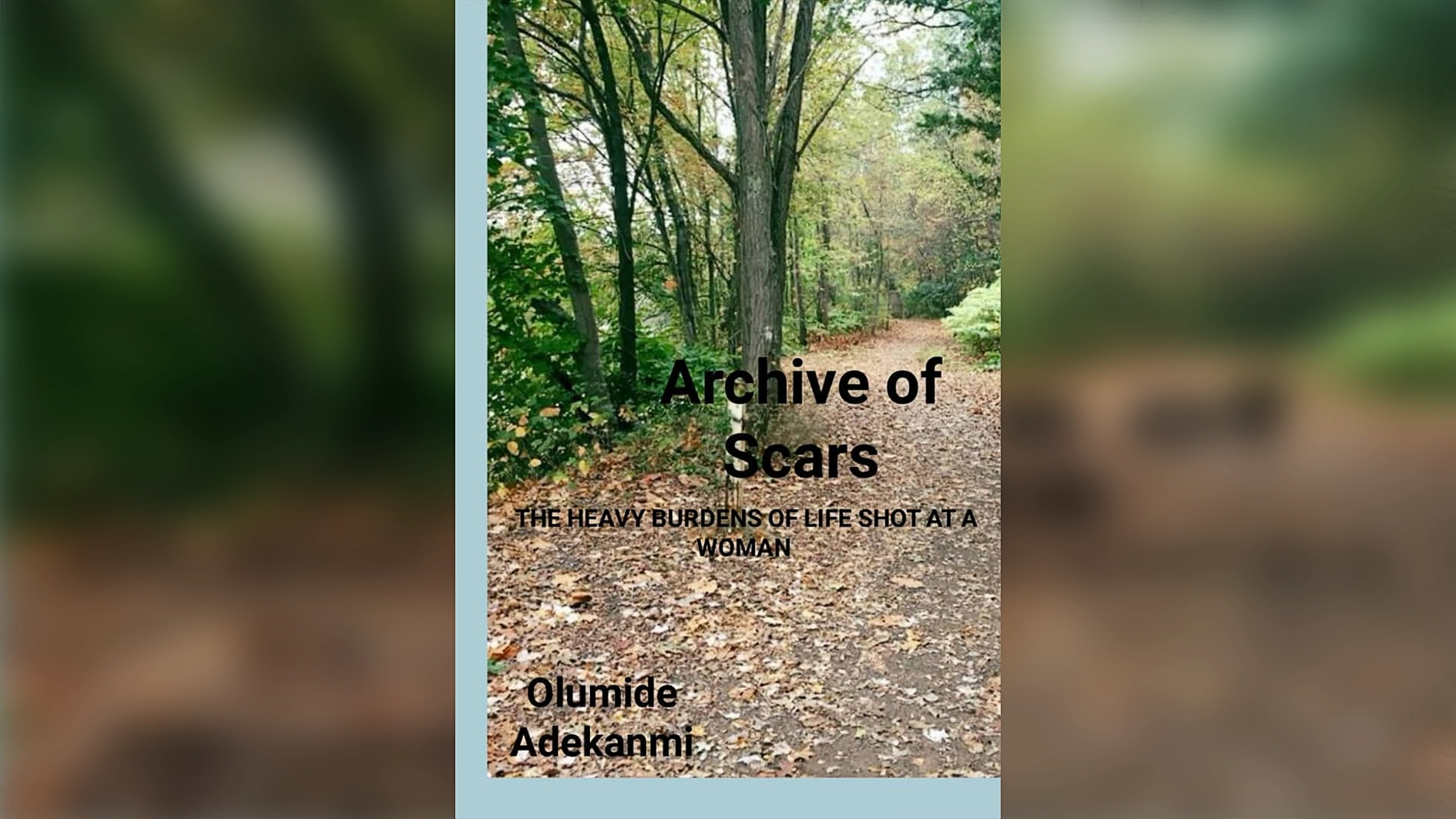
By Segun Durowaiye
Archive of Scars is a story that explores the everyday nitty-gritty of life, particularly of the single mothers who most times have no one to look unto or anything to rest upon whenever challenges invade their lives, except the pillar of hope which many of them do not have the willpower to erect.
From the very first chapter, the reader is taken on a journey into the hub of a society that is culturally endowed and traditionally organised. Then gradually, one is exposed to the frills and thrills that are associated with royalty, as exemplified through the reverential treatment accorded the paramount ruler and the crown prince during the yearly Carnival of the Tang people; while the twists and turns that come with love, marriage, social life, conflicts management, children upbringing and the potpourri of other issues that contribute in the shaping or shattering of the human world are systematically brought to the fore.
As one reads a bit further, the mile and jubilant atmosphere quietly fades into thin air, paving way for the underlying factor in the story to surface. The introduction of Jerry Skola and his heartthrob, Gracia, into the beginning and cheery part of the story, gives one a clear picture of how both of them found each other— while also laying the foundation upon which the major thematic preoccupation in the story would find expression.
Through the pages of this alluring venture, the author reveals some of the monsters that are tearing many marriages apart, and how insecurity or inferiority complex can destroy people and those around them. Jerry suffers from this nonexistent threat which his volatile mindset has created, as a result of his wife’s gradual financial emancipation.
His insecurity throws him into a life of pilfering of her money in order to sustain his newfound hobby of incessant gambling which only took from him, but never giving back a dime.

While trying to find a way to expand her business beyond the frontiers of the over congested kitchen of their single room apartment, in addition to managing her husband’s excesses which have culminated into an uncontrollable act of dishonesty and other social vices, Gracia is shattered by the news of her pregnancy for a set of twins— the least thing in the list of her wishes at that moment.
She’s devastated by this unexpected outcome, and would’ve aborted the pregnancy because to her, it would be impossible to successfully manage a home of six alongside her blooming business without hitting the rock. But her neighbors and some of her husband’s family members quickly intervened and talked her out of it. And with the hope that her husband will turn a new leaf, she carries on with the pregnancy. As Gracia’s stomach grew bigger by the day, her troubles also increased in volume and in dimension— while Jerry carried on with his nonchalant lifestyle as if nothing was at stake.
In this compelling narrative, the author, Olumide Adekanmi adequately deploys his literary skills to make a case for the women folks who in most cases are usually at the receiving end of whatever ills that the society throws up, even when they were not part of the process from the start. He graciously projects these harrowing circumstances through various themes such as: domestic violence, verbal and emotional abuse, single motherhood, intimidation, mental instability, depression, loneliness, the inner strength of a woman, abandonment and other unsettling issues which a huge proportion of women have to grapple with in every society, and on a daily basis.
Although the plot of the story revolves around at least six major characters, all of whom are within the same household, Gracia is used as a mirror to reflect each of the unsavoury concerns projected in this book, and how they could affect not just the women, but also those around them.
The most salient storyline is premised on the inner strength and quality embedded in women. The entire structure of the book showcases in no small measure that when occasion demands, women have an enduring mental capacity to weather many storms in a manner that would dismiss or invalidate the age-long notion which labels them as “the weaker vessels.”
Another issue worthy of mention in this exceptional literary craftsmanship is the subtle emphasis on the power of focus, determination, and perseverance. Dreams come alive, and vision becomes an appreciable tangible substance when the eyes are fixed on the ball, and when the mind settles on the goal without wavering. As echoed in the book on page 103: “The future belongs to the dedicated. Everyone who persevered through harsh weather conditions but resisted the temptation to give up or retreat always ended up smiling in the long run…”
These extraordinary attributes are not inherent; they’re acquired through deliberate actions and conscious efforts by individuals who want to make a mark. The author has superbly driven home these point(s) through the central character, Gracia, along with two of her daughters: Joyce and Janice who drew strength from their mother’s determination to cross the line of negative perception which the society have drawn for women, especially the single mothers who most times are unjustly condemned by those who judge them from a distance.
Gracia experienced virtually every negative thing which life has in its kitty. Married at 18, she went into the marital boat with anticipation of a smooth sail, but she was awfully wrong and grossly disappointed as fate repeatedly unleashed poisonous arrows against her home which the vows of ‘till death do us part’ could not withstand. She was abandoned and frequently abused— both verbally and emotionally by an unrepentantly unruly husband. In a bit not to lose her sanity, she left her husband and her antagonistic daughter, Tonia, who saw nothing wrong in her father’s nasty attitude. This decision brought upon her shoulders a lot of emotional weight which on the one hand was caused by the sadness of having to leave her daughter under the roof and care of an irresponsible man.
On the other hand, it was because she was confronted with the stack reality of having to cater for three young daughters all by herself. Although she bounced back financially, there was still a vacuum which success could not adequately fill. Tragedy kept visiting and occasionally knocking her off balance even as she did her best to put the past behind her. She lost one of her twins, a promising medical doctor, while her first daughter got impregnated by a street urchin with whom she eloped and was never heard from— kissing goodbye to her academic pursuit. Thus, it became as if Gracia was betrothed to different challenges which came one after another to claim their pound of flesh.
The author did a great job by exposing his audience to the different kinds of life; one of which is in the rural settlements where opportunities are limited, and the other in the cities where a breath of fresh air is assured for those who know their onions— and how this can make a world of difference. His chronological narrative technique and the simplicity with which he weaves the events together without missing out on any of the underlying factors with which an average single mother is confronted, underscores his story-telling prowess.
With this novel, Adekanmi has shown exactly what moving forward truly entails. This is depicted through the doggedness of Gracia who from when she left her husband’s house, had never looked back, although one of her daughters was still with him which would’ve made some women to be hypertensive. For someone who got married at a tender age armed with primary school certificate to end up at the Bench as a District Judge, is in no mistakable terms a proof of the true meaning of big dreams hatched through the force of relentless determination which can only be exhibited by someone who sees beyond the momentary setbacks and adversities.
In a nutshell, the novel is a woman’s personal documentation of her woes which turned her life upside down. It is about her trials and triumphs, with more focus on how not to throw in the towel when life picks up a fight with you. It is a statement which is meant to serve as an unending motivational sound-bite for women to dare to make a difference, and not to accommodate the things that make them feel inferior to their male counterparts. It is an account of a someone who although was accomplished, yet had more than enough scars to show that her victories were not achieved by mere wishes, but through a fierce battle fought with the intangible weapons of her conviction that dreams are not achieved by chance, but by chasing after the things that align with your purpose.
Hence, even though Gracia never remarried until her death, and in spite of the constant threats from the drugs barons and the assassination attempt on her life, she didn’t look back because she had long burned the bridges of her fears and perennial gender stereotypes…

