 Follow Us on Google News
 Follow Us on Google Discover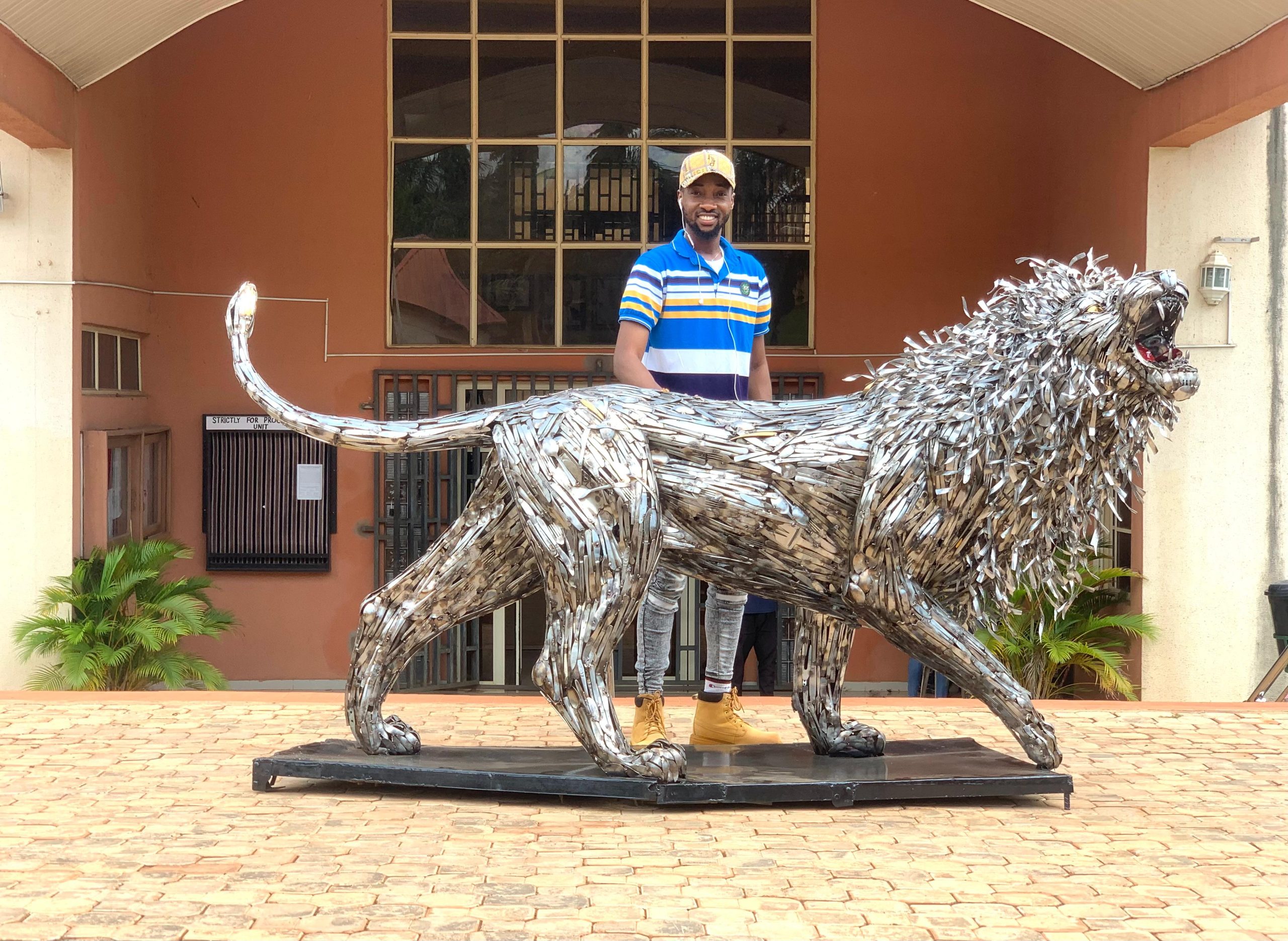
In the heart of Edo State, where the ancient, storied bronze-casting traditions of Benin City meet the radical avant-garde energy of the Auchi Art School, a new voice is emerging from the clatter of scrap metal and the primal pliability of earth. Precious Eboigbodin, a 2021 graduate of the prestigious Auchi Polytechnic, is not merely creating art; he is staging a quiet yet resolute revolution against the mounting debris of technological civilization.
[ad]
As the global conversation shifts with increasing urgency toward ecological preservation, Eboigbodin has positioned himself as a vanguard for environmental sustainability. He utilizes a rigorous technical mastery to prove that what the modern world hastily labels as “waste” is often just a latent treasure waiting for a visionary to reclaim and redefine its purpose.
Eboigbodin’s artistic identity is a complex, multi-layered tapestry woven from formal collegiate training and a deep-seated spiritual connection to his cultural heritage. Having bagged his Higher National Diploma in Sculpture at the top of his class during the 2021 academic session, he represents the promising next generation of the
“Auchi Art School” lineage, a lineage that has already gifted the international art world with luminaries such as Olu Amoda and Dotun Popoola.
His final year project, a monumental feat of both engineering and aesthetics that currently commands the entrance of the College, serves as a physical testament to his skill.
Dr. Kukoyi Ayodeji Olusola, a Professor of Art and Sculpture Practice, notes that this specific endeavor is a “testament to his excellent artistic endeavour, employing exploration of new media, executed in a unique dual approach of direct and cast welding.”
The thematic core of Eboigbodin’s practice is rooted in what contemporary critics classify as “Eco-Art” or “Upcycled Art.” In a world cluttered by industrial byproduct, he engages in a profound act of “Reimagining Waste.”
This approach has earned him high praise from Dr. Olusola, who describes Eboigbodin as a “new name in contemporary African art that traditional Africa has offered to the world.”
[ad]
The Professor further characterizes the work as a unique variant of creativity, “borne out of spirituality and cultural derivatives, though collective in concept but specific to diverse geo-cultural ecosystem, diligently transferred from generation to generations through informal apprenticeship system of education.”
According to Dr. Olusola, Eboigbodin’s focus on the appropriation of up-cycled materials brings a “new life of aesthetic functionality into hitherto object constituting nuisance in the environment in an age where environmental pollution has become the order of technological civilization.”

“With his artistic competence and zeal for environmental concern, there is no doubt that Sculptor Precious is made for the heights and definitely, a man to watch in the emerging dispensation of global accomplishments,” Dr. Olusola said.
Beyond the philosophy of the “found object,” Eboigbodin’s sheer versatility is a striking asset. While he is recognized for his “Assemblage,” his foundational skills in clay and terracotta allow him to maintain a classical standard of figurative excellence. His education at Auchi equipped him with a diverse toolkit; he is as adept at modeling with earth as he is at working with modern synthetics like fiberglass and resin.
Whether he is molding casting materials, working with bonded stone, or welding intricate metal forms, his work remains influenced by the natural world. This is art that does not just celebrate beauty but serves as an active commentary on the necessity of “Sustainable Sculpture.”
His peer and contemporary, the noted sculptor Kelly Omodamwen, recalls witnessing Eboigbodin’s genius early on when they were both students. Omodamwen, who himself works within the realms of environmental consciousness, remembers a distinct connection forming when he first observed Eboigbodin in the studio.
[ad]
“His genius was made known when he attempted to carve a niche for himself by exploring an unconventional method and material, using cutlery as a medium in sculpture,” Omodamwen observes.
He reflects that, even during their formative years, Eboigbodin’s “project was much needed as it suggests the need for sustainable and eco friendly sculpture.” For Omodamwen, Presley, as he is fondly known, is “one artist I look forward to seeing his body of work as he grows and evolves over time.”
As 2021 draws to a close, Eboigbodin stands at a significant threshold, poised between academic triumph and a burgeoning professional career. He is an artist of Nigerian descent whose creativity transcends national borders, focusing instead on the global space of sustainability.
[ad]
By meticulously turning “Waste to Treasure,” he challenges the viewer to reconsider their own relationship with the environment and the materials they discard. His journey is a potent reminder that the future of sculpture lies not just in what we create from scratch, but in what we have the vision to save and restore

