 Follow Us on Google News


 Follow Us on Google Discover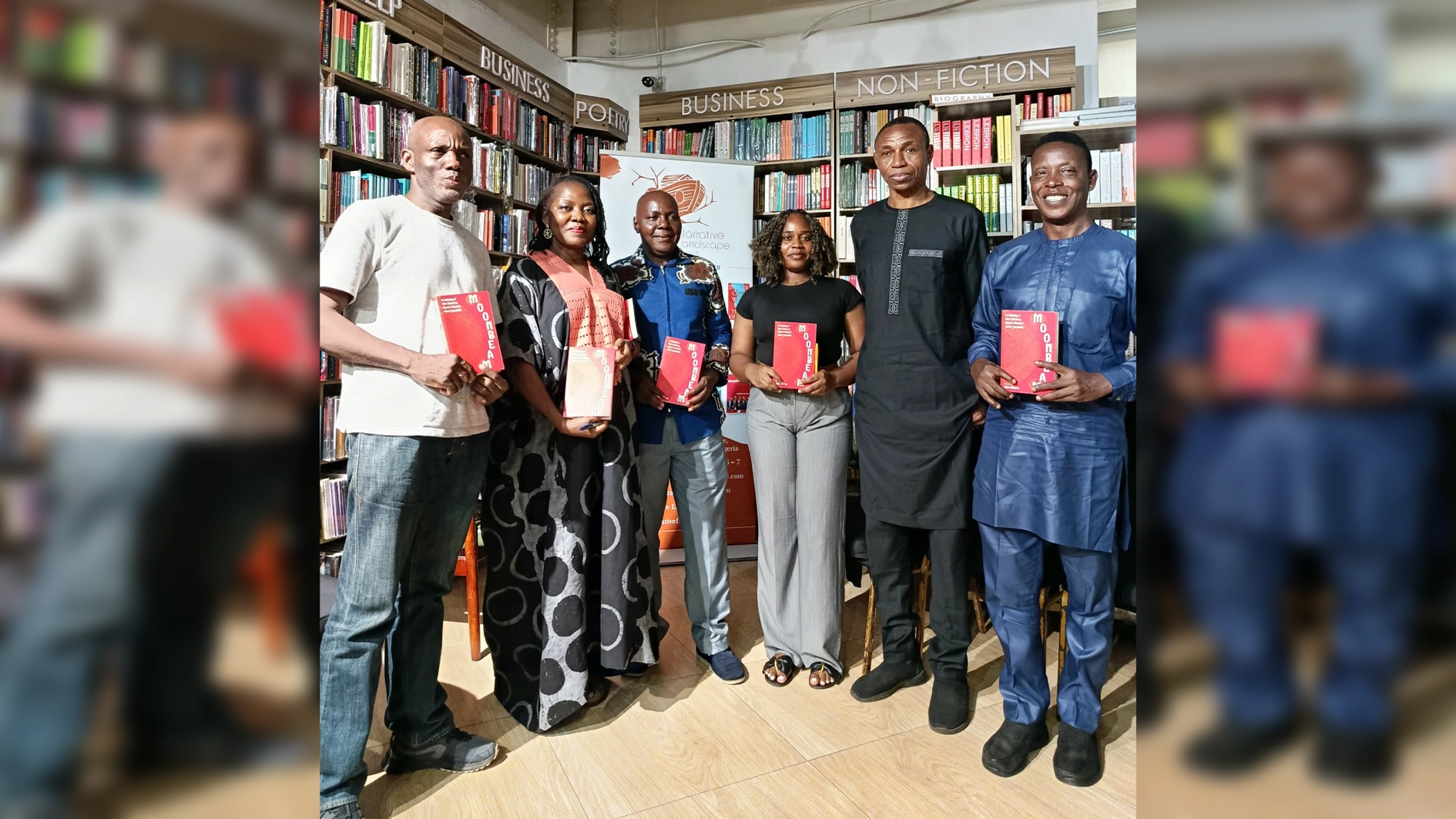
Saturday, April 11, 2026, Rovingheights Bookstore hosted six of the 15 culture journalists that contributed to Moonbeam: An Anthology of Short Stories by Nigeria’s Arts and Culture Journalists.
It was not just a reading session, the contributors used the platform to reflect on their creative journey, the challenges of publishing and the evolving nature of storytelling in Nigeria.
The eventwas organised by Moonbeam publishers, Narrative Landscape Press. It also doubled as a memorial for the late journalist, photographer, textile artist and performance poet, Evelyn Osagie, of The Nation newspaper, one of the contributors who died on August 17, 2025. Osagie passed away without setting eyes on the collection.
Editor of the collection, AnoteAjeluorou,said the idea behind Moonbeam was to create a unified body of creative work from arts journalists whose writings are often scattered across newspapers, magazines, blogs and social media platforms.
He noted that despite decades of documenting Nigeria’s cultural landscape, many of these writers rarely have the opportunity to present their creative voices in a single, cohesive format.
When a Sustainable Development Goal (SDG) expert and culture promoter Olatoun Gabs-Williams asked how he came about the title, Ajeluorou said growing up he’d consumed a lot of folktales both from his own mother,Obafaaruho, and other elders and playmates and thought to replicate same in modern formal media that a book presents.

He then explained that Moonbeam replicates moonlight tale village setting, where various persons tell tales to willing audience, noting that his colleagues on the project, a gathering of culture journalism playmates regalling each other with their various tales and the readers providing the willing audience listening to 15 voices telling tales in moonlight-tale-fashion in a modern medium.
Ajeluorou disclosed that an earlier attempt to publish the manuscript in 2017 stalled because of cost.
The breakthrough came in 2023 when he encountered a submission call from Narrative Landscape Press. Encouraged by fellow contributor Mr. Terh Agbedeh, he submitted the manuscript and received a positive response, although the publisher indicated a two-year production timeline.
Ajeluorou said the eventual release of the book marked the culmination of years of effort and collaboration.
Speaking on his contribution, Okechukwu Uwaezuoke said his story was inspired by his early professional experience in advertising, where he worked as a copywriter between 1992 and 1994 before transitioning into journalism. He described the advertising industry as one marked by urgency, creative intensity and, at times, frustration.
According to him, teams often worked under intense pressure, sacrificing sleep and personal time to develop ideas, only for clients to reject them—sometimes without fully engaging with the material. He recalled instances where completed presentations were dismissed or cancelled abruptly, including occasions when teams were informed via dispatch riders not to proceed after days of preparation.
Uwaezuoke said these experiences informed his story, All for Nothing, which explores the concept of effort and futility. By shifting perspective to the client’s side, he sought to examine the pressures faced by decision-makers as well, presenting a more nuanced view of the creative process. He added that while the story is rooted in past experiences, he introduced elements such as BlackBerry devices to bridge generational gaps, despite their absence in the period being depicted.
For Nehru Odeh, the anthology provided an opportunity to revisit and repurpose an existing body of work. He said his contribution, Not All Roads Lead Home,was drawn from a novel he had been developing over an extended period, describing the selected piece as an excerpt that stands independently while retaining connections to the larger narrative.
Odeh, who participated in a 2008 Creative Writing Workshop facilitated by Chimamanda Ngozi Adichie, said the experience influenced his approach to fiction and reinforced his commitment to storytelling.
He described his Moonbeam story as a commentary on Nigeria’s socio-political climate, addressing themes of governance, religion and freedom of expression.
Molara Wood said her involvement in the project stemmed from a long-standing interest in creative collaboration, as well as the desire to consolidate years of professional writing into a more enduring format. She noted that arts journalists often build extensive portfolios that remain fragmented, making anthology projects particularly significant.
Her story, The House Next Door, she explained, is grounded in close observation of society and employs subtle narrative techniques to explore complex issues. Rather than presenting events directly, the story hints at underlying tensions, incorporating elements of suspense, the supernatural and social critique.
Wood said the narrative interrogates assumptions about crime and morality within urban Nigeria, particularly in affluent communities where appearances often mask deeper realities.
She explained that the story challenges the notion that wrongdoing is confined to lower socio-economic groups, instead suggesting that wealth and respectability can coexist with hidden forms of criminality.
A major highlight of the event was the spontaneous tribute to Osagie (‘Big Brother of Zone Four’), whose literary aspirations were realised posthumously through her inclusion in the anthology. Her sister, Amy Osagie, who attended the event, described Evelyn as a passionate and dedicated writer who consistently shared her work with family members and nurtured ambitions of publishing both a novel and an autobiography.
She recounted conversations about these plans and expressed surprise upon learning, after Evelyn’s passing, that she had contributed to Moonbeam. She described the moment as both emotional and fulfilling, adding that a personal dream of the late writer had been realised.
The event concluded with a renewed emphasis on the importance of storytelling as a means of documenting, interpreting and challenging societal realities. Contributors highlighted the role of fiction in offering deeper insight into issues that may be constrained by the factual boundaries of journalism.

