 Follow Us on Google News
 Follow Us on Google Discover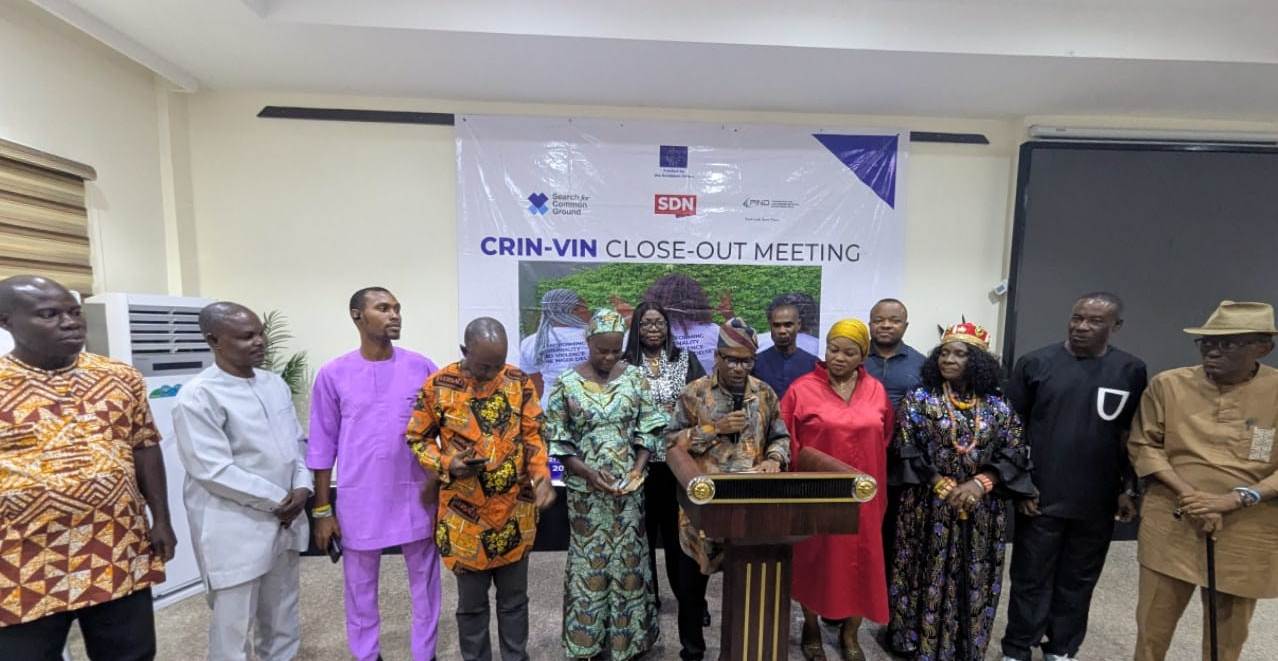
European Union (EU) funded organisation, Search for Common Ground (SFCG), has said that inclusive, community-driven security approaches deployed in the Niger Delta have contributed to a reduction in conflict across the region.
SFCG, in partnership with Stakeholder Democracy Network (SDN) and the Partnership Initiative for the Niger Delta (PIND), implemented a 30-month project titled Transforming Violence and Criminality in the Niger Delta, covering 66 communities in Rivers, Bayelsa and Delta states.
The organisation said the intervention focused on strengthening local conflict resolution mechanisms, rebuilding trust between communities and security agencies, and fostering collaboration with government and other stakeholders.
Speaking at the project close-out in Port Harcourt, SFCG Director of Programmes, Gift Omoniwa, noted that the initiative also leveraged art and culture to strengthen social cohesion, while influencing policy through multi-stakeholder dialogues at state, regional and national levels.
“Overall, we have recorded a reduction in conflict trends in the Niger Delta, which can be attributed to the success of this project. We also witnessed support from the governments of Rivers, Bayelsa and Delta states, which provided an enabling environment for the intervention to thrive,” she said.
Omoniwa commended the role of community, local government and state peace architecture platforms, noting that many of the structures were pre-existing but were strengthened and revitalised under the project to drive grassroots peace processes.

She acknowledged challenges encountered during implementation, including initial resistance from some communities, difficult access to riverine areas and periods of political instability.
“Some communities initially declined participation but later sought inclusion after observing the impact elsewhere. Despite access constraints and other challenges, targeted capacity building for both staff and community members helped to sustain implementation,” she added.
According to her, findings from an independent external evaluation indicate that the project largely achieved its objectives.
She described the intervention as a “proof of concept,” demonstrating that empowering communities and stakeholders can effectively address violence and criminality.
While noting that only a fraction of communities in the region were reached, she called on donors and development partners to scale up similar interventions.
“Our doors are open to partners. The evidence is clear that community-centred approaches can deliver sustainable peace outcomes,” she said.
Also speaking, a representative of the Rivers State Traditional Rulers Council, HRH King Temple Macdonald Jamala (JP), Paramount Ruler of Oduoha community, commended the peace architecture established by SFCG and urged expansion to more communities.
Similarly, Youth President of Budu-Ama community, Peter O. Alali, said the project had improved sanitation and reduced social vices in the area.
He noted that the intervention provided an eight-room toilet facility and a solar-powered water system, which helped curb open defecation, reduce communicable diseases and contribute to a decline in criminal activities.
Stakeholders at the event emphasised the need for sustained investment in community-led peacebuilding initiatives to consolidate gains recorded across the Niger Delta.

