 Follow Us on Google News


 Follow Us on Google Discover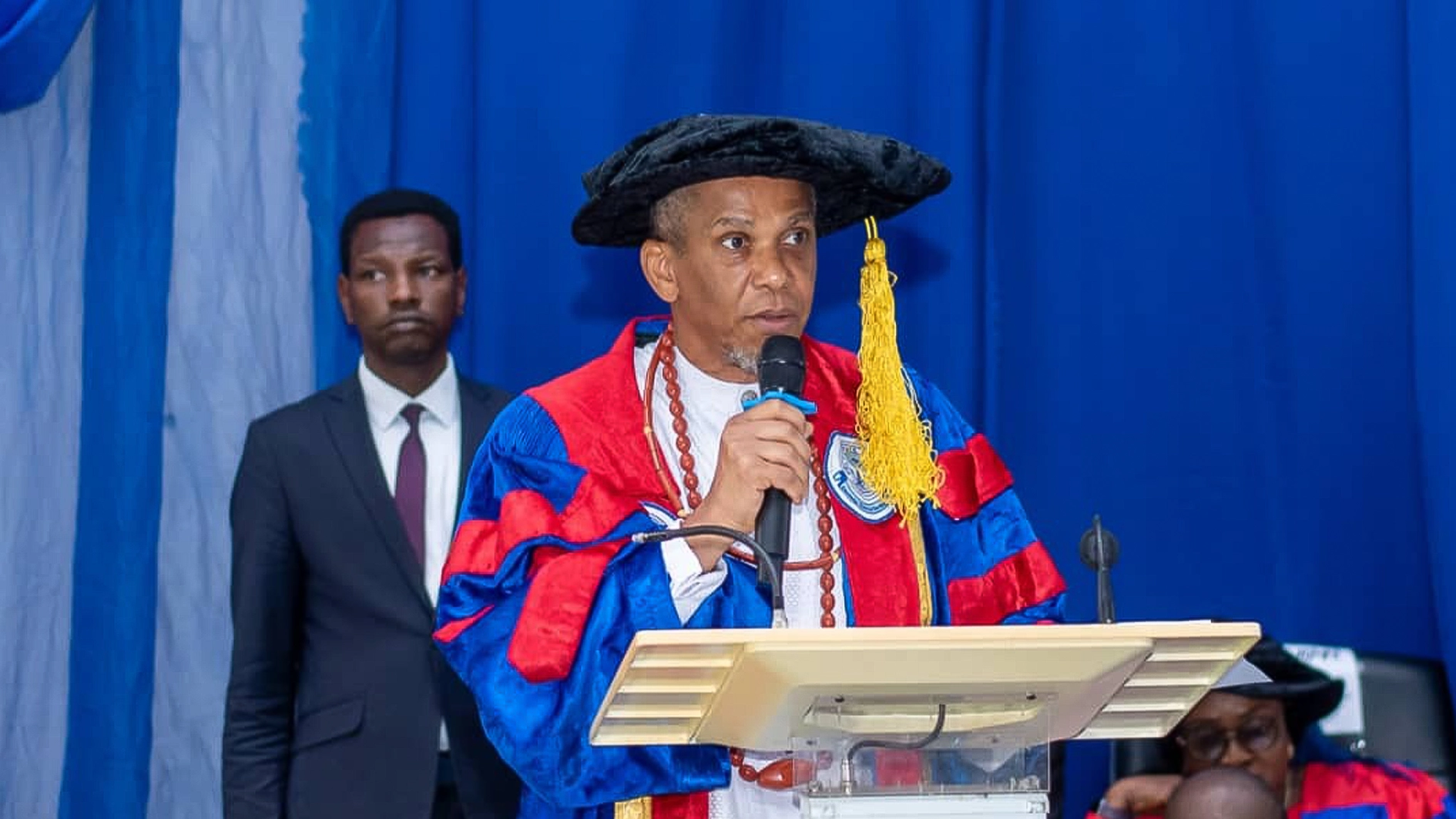
Senator representing Delta Central Senatorial District, Senator Ede Dafinone, has challenged Nigerian youths to embrace discipline, innovation and institution-building as critical tools for sustainable national development, warning that the country risks wasting its enormous potential if the present generation fails to transform capacity into productivity.
Dafinone gave the charge while delivering the 18th Convocation Ceremony of Delta State University (DELSU), Abraka titled ‘Harnessing Nigeria’s Potential: Strategies for Sustainable Development’.
Addressing the graduating class of 2026, the senator described Nigeria as “one of the most gifted nations on the face of the earth,” but lamented that despite its vast human and natural resources, the country continues to battle poverty, unemployment, weak institutions and infrastructure deficits.
Posing what he described as “the Nigerian question,” Dafinone asked: “Why does potential, so broadly distributed across the nations of the earth, translate into productivity so unevenly?” He argued that Nigeria’s challenge is not a lack of talent, but the failure to build systems capable of unlocking and sustaining productivity.
According to him, Nigeria possesses over 37 billion barrels of crude oil reserves, vast agricultural land, solid minerals and a youthful population with enormous intellectual capacity, yet millions remain trapped in extreme poverty while professionals continue to migrate abroad in search of opportunities.
He described the contradiction as “the Nigerian paradox,” warning that the country’s window for transformation is rapidly narrowing as other nations continue to advance technologically and economically.

“The question is not whether Nigeria will eventually develop,” Dafinone declared. “The question is whether this generation will be the one that turns our potential into productivity, the promise into performance, the abundance into prosperity.”
The lawmaker stressed that one of Nigeria’s biggest developmental errors is the confusion between “potential” and “productivity.”
“Potential speaks to capacity. Productivity is what you do with that capacity, consistently, over time, within a system that either amplifies or suppresses your effort,” he said, noting that many young Nigerians are trapped in dysfunctional systems characterised by prolonged admission delays, industrial strikes and weak professional structures.
He warned against what he termed a “dangerous narrative of inadequacy,” insisting that Nigeria’s developmental struggles should never be mistaken for a lack of ability among its citizens.
“The moment a people internalise a narrative of inadequacy, they stop doing the hard, unglamorous, patient work of building institutions and systems,” he stated.
Dafinone further argued that sustainable development cannot be achieved through slogans, policy announcements or ceremonial projects, but through disciplined institution-building sustained across generations.
“Sustainable development is not an event. It is not a policy announcement, a budget presentation, or a ribbon-cutting ceremony. It is repeated, disciplined, institutionally reinforced behaviour sustained across multiple administrations and generations,” he said.
Drawing lessons from countries such as South Korea, Singapore, Malaysia, Botswana and Rwanda, the senator maintained that their growth was driven by deliberate investments in human capital and institutional efficiency.
“Systems are more powerful than individuals,” he said, adding that “a talented person in a broken system will produce broken results.”
On the evolving global economy, Dafinone described artificial intelligence and the knowledge economy as a rare opportunity for Nigeria to leapfrog traditional barriers to development. He cited the global success stories of Nigerian entrepreneurs and entertainers including Shola Akinlade, Ezra Olubi, Davido, Wizkid, Tems and Burna Boy as proof that Nigerian talent can compete globally when supported with the right tools and opportunities.
“AI does not fix weak institutions. It does not pave roads,” he cautioned. “But for individuals, it is a genuine amplifier of capability.”
The senator advised graduates to prioritise critical thinking, intellectual depth and lifelong learning over mere mastery of digital tools, stressing that employers are increasingly shifting “from credential verification toward competence verification.”
“The graduates who will distinguish themselves in the next decade are those who understand that formal education was not the finish line but the starting block,” he said.
On the growing “japa” trend, Dafinone acknowledged the frustrations pushing many young Nigerians abroad but urged them not to completely abandon the country.
The senator urged the graduating students to cultivate discipline, protect their attention spans in the age of digital distractions, and commit themselves to continuous self-development, integrity and excellence.
“The potential is yours. It has always been yours — each of you individually, and all of us collectively as a nation,” he said. “The productivity — what you do with that potential, how consistently, how disciplined, how long — that is the decision still to be made.”
Vice-Chancellor of Delta State University, Abraka, Prof. Samuel Ogheneovo Asagba, commended Senator Dafinone for what he described as “a deeply insightful and thought-provoking lecture,” noting that the presentation reflected the realities of the Nigerian state and offered practical pathways for national transformation.
He urged the graduating students to reflect deeply on the lessons from the lecture and apply its principles as they move into the next phase of life.

