 Follow Us on Google News
 Follow Us on Google Discover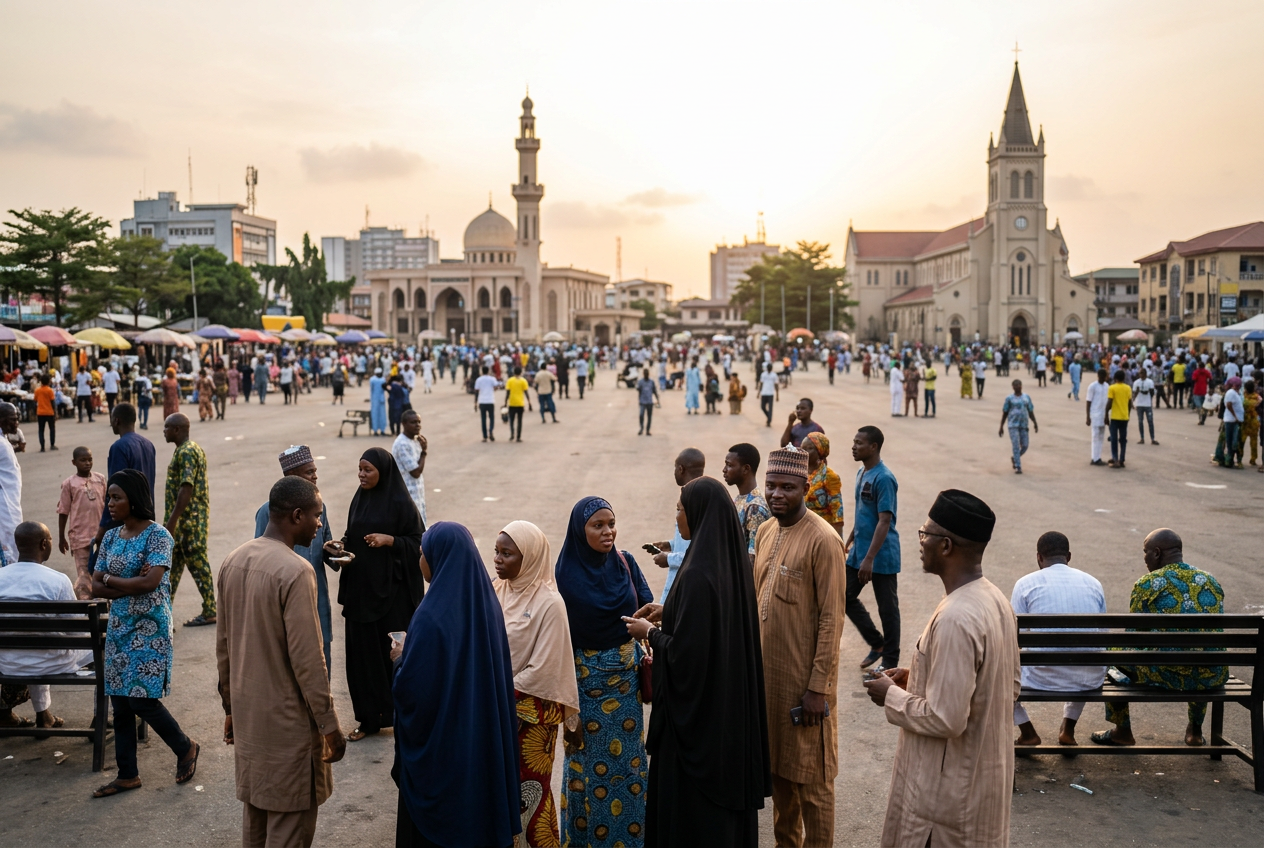
If there is one question I have been asked more than almost any other during my years covering Nigerian culture, society, and identity, it is this one. People want to understand the religious composition of Africa’s most populous nation: whether out of curiosity, a desire to understand the politics, or because they are planning to live, work, or do business here. After months of dedicated research into demographic data, historical records, and regional survey material: and drawing on years of writing about Nigerian society: I am confident this article gives you the clearest, most grounded answer available.
Religion in Nigeria is not a simple matter of picking a winner. It is a story of geography, ethnicity, history, and astonishing diversity: a nation where the mosque and the church often share the same street, and where faith runs deeper than almost any other aspect of public life.

Let us get into it properly.
The Three Major Religions That Shape Nigerian Society
Before we can answer what religion is more popular in Nigeria, we need to understand the starting point: Nigeria is a country of three dominant traditions. Islam, Christianity, and African Traditional Religion (ATR) have each shaped this nation in profound ways, and dismissing any one of them would give you an incomplete picture.
Islam entered Nigeria through the trans-Saharan trade routes from as early as the 11th century, taking particular root among the Hausa-Fulani peoples of the north. According to the Federal Ministry of Foreign Affairs, the Hausa have been Muslims for almost a thousand years, having first been converted by Arab traders and merchants from the 10th century onwards. That is not a recent adoption: it is a civilisation-deep integration of faith and culture.
Christianity, by contrast, arrived with European missionaries in the 19th century, taking strongest hold in the south. The Catholic Church, the Anglican Communion, and later Pentecostal movements all built educational institutions and hospitals that became woven into the social fabric of southern Nigeria. Today, names like RCCG (Redeemed Christian Church of God) and Winners’ Chapel have become globally recognised institutions with Nigerian roots.
African Traditional Religion, meanwhile, often goes uncounted and undercounted. Vodun in the southwest, Odinani among the Igbo, and similar systems across hundreds of ethnic groups still form the spiritual backbone of many communities: even among people who also identify as Christian or Muslim. This blending of faiths is actually one of the most distinctive features of Nigerian religious life, and I find it endlessly fascinating.
The National Bureau of Statistics catalogues religious affiliation data across Nigeria’s 36 states and the FCT, including registered membership of Christian denominations and mosques: a document that underlines just how seriously the Nigerian state takes the formal documentation of religious life.
What Are the Top Three Most Popular Religions in Nigeria?
Nigeria’s top three religions, ranked by number of adherents, are Islam, Christianity, and African Traditional Religion: in that order of formal institutional size, though the gap between the first two is razor-thin and contested.
Here is how each one breaks down in practical terms:
Islam claims approximately 50 to 53 per cent of Nigeria’s population according to various estimates, with its base concentrated heavily in the 19 northern states. The states of Sokoto, Kano, Katsina, Zamfara, Borno, and Yobe are overwhelmingly Muslim. In Zamfara State, for instance, the state government itself acknowledges that Islam is the major religion practised by the vast majority of residents.
Christianity accounts for roughly 45 to 48 per cent of the population, with strong concentrations in the southeast (predominantly Igbo communities), the south-south (Rivers, Delta, Cross River states), and the southwest: where the Yoruba are interestingly split fairly evenly between the two Abrahamic faiths. The growth of Pentecostalism since the 1970s has been particularly dramatic in cities like Lagos, Ibadan, and Port Harcourt.
African Traditional Religion is a formal third place but perhaps the most underestimated. Many Nigerians who attend church on Sunday or pray Jumat on Friday also maintain traditional spiritual practices: consulting diviners, honouring ancestral shrines, or observing traditional festivals. Conservative estimates put formal ATR adherents at between 2 and 10 per cent of the population, though the real cultural influence is far greater.
An important and often overlooked fourth category: a small but growing number of Nigerians identify with no religion at all. This is still socially uncommon and carries significant stigma, but it is increasing in urban, educated demographics.
Which Religion Is More in Nigeria: Christianity or Islam?
This is the heart of the question: and the honest answer is that it genuinely depends on the source and the methodology of counting.
Nigeria has not conducted a national census that officially breaks down the population by religion since 1963. Every figure you see today is derived from survey data, estimates from international bodies like the Pew Research Center, or self-reporting through demographic health surveys. This absence of hard official data is not accidental: it has been a deliberate political choice, because religion and ethnicity are so combustible as topics that successive governments have chosen to simply avoid the census question.
What the National Human Rights Commission confirms in its survey on freedom of religion and belief is that Nigeria has a significant Christian population in the south and predominant Muslim communities in the north: a straightforward geographic split that anyone who has travelled across the country can confirm with their own eyes.
The Pew Research Center, in its widely cited studies, estimates Muslims at approximately 50 per cent of Nigeria’s population and Christians at roughly 48 per cent. Given that Nigeria’s population is now estimated at over 220 million people, we are talking about one of the largest Muslim-majority nations on earth living next door to one of the largest Christian communities on earth: sharing the same passport, the same Naira, and often the same family compound.
The Federal Ministry of Foreign Affairs notes that in the 13 northern states, the vast majority of people are Muslim, while in the southern states, the majority of Nigerians are Christian, with some groups continuing to practise indigenous beliefs. This clean north-south split is the simplest way to visualise Nigeria’s religious geography, even if reality is messier at the edges: especially in Lagos, Abuja, and the middle-belt states.
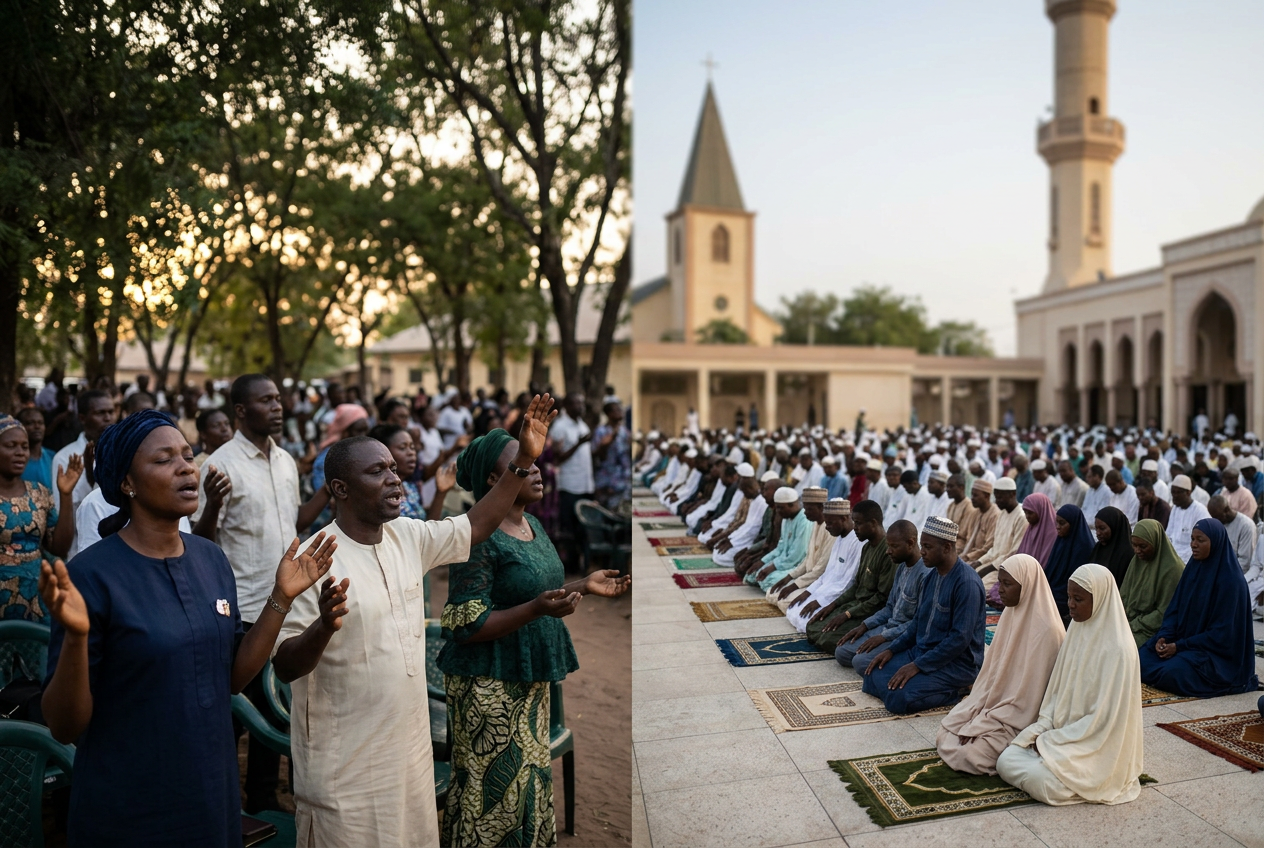
Among the Yoruba of the southwest, the split is particularly remarkable. A Yoruba family might have a Christian mother and a Muslim father, celebrate Eid and Christmas with equal enthusiasm, and attend both a mosque and a church for different family events. This is not hypocrisy: it is a distinct Yoruba approach to faith that has developed over centuries. Guardian Nigeria’s feature on why Nigerians must use Ramadan and Lenten seasons to consolidate harmonious co-existence captures exactly this spirit: religious leaders from both traditions calling for unity, not division.
So to answer directly: Islam is fractionally the more popular religion in Nigeria by most estimates, but the margin is so narrow that the two faiths are effectively co-dominant. Any claim that one is massively ahead of the other should be treated with scepticism.
Nigeria’s Religious Demographic Breakdown by Region
The table below draws on estimates from demographic surveys, the Pew Research Center, and regional government data to give a comparative picture of religious composition across Nigeria’s geopolitical zones.
| Geopolitical Zone | Dominant Religion | Est. Muslim % | Est. Christian % | Est. ATR/Other % |
|---|---|---|---|---|
| North-West (Kano, Sokoto, Katsina, etc.) | Islam | 95%+ | 1-3% | 1-3% |
| North-East (Borno, Adamawa, Gombe, etc.) | Islam | 90%+ | 5-8% | 2-4% |
| North-Central / Middle Belt | Mixed | 45-55% | 40-50% | 5-10% |
| South-West (Lagos, Oyo, Ogun, etc.) | Mixed (even split) | 40-45% | 45-50% | 5-10% |
| South-East (Anambra, Enugu, Imo, etc.) | Christianity | 1-3% | 95%+ | 1-3% |
| South-South (Rivers, Delta, Bayelsa, etc.) | Christianity | 5-10% | 85-90% | 5-8% |
The data confirms what seasoned observers of Nigerian life already know: religion in this country is as much a geographic reality as it is a personal one. The Middle Belt and the South-West are the zones where genuine religious pluralism plays out in daily life, with both faiths present in roughly equal measure and: more often than not: in peaceful coexistence.
Which Religion Is Richer in Nigeria?
This is a question I hear a great deal, and one that deserves an honest, nuanced response rather than a lazy generalisation.
The framing of “richer religion” in Nigeria tends to collapse two separate questions: which religious community has more wealthy members, and which religious institutions accumulate more wealth? They are not the same thing.
On institutional wealth, Nigeria’s Pentecostal Christian megachurches are genuinely remarkable economic engines. Institutions like Living Faith Church (Winners’ Chapel), RCCG, and Mountain of Fire and Miracles Ministries own universities, secondary schools, hospitals, estates, and aviation assets. The combined value of assets held by Nigeria’s top ten Pentecostal churches runs into hundreds of billions of Naira. This visibility gives the impression of Christianity as the wealthier tradition.
However, the Muslim north controls vast agricultural land, livestock wealth, and trading networks that have existed for centuries. The sultanate and emirate systems oversee significant communal resources. Islamic banking has grown rapidly in Nigeria, and the establishment of non-interest banks regulated by the Central Bank of Nigeria has channelled considerable capital into Muslim-oriented financial services.
The more accurate answer, then, is that neither religion is definitively “richer” in Nigeria: what differs is the form in which wealth is held and displayed. Pentecostal prosperity theology has made church wealth highly visible and media-friendly. Northern Islamic wealth tends to be held in land, livestock, trade networks, and family structures that are less photographed but equally substantial.
What both traditions share, somewhat ironically, is a crisis of converting institutional religious wealth into genuine poverty reduction for their communities. A thoughtful examination in Guardian Nigeria’s opinion section on whether religion has improved the growth and development of Nigeria raises precisely this question: noting that early education in Nigeria was deeply shaped by both faiths, yet persistent poverty remains across religious lines. The poor man in the mosque and the poor man in the church are equally poor.
What Is the Fastest Growing Religion in Nigeria?
By global and regional projections, Islam is currently the fastest growing religion in Nigeria.
The Pew Research Center’s demographic modelling projects that Nigeria’s Muslim population will grow significantly faster than its Christian population through 2060, driven by higher birth rates in predominantly Muslim northern states. The north has consistently had higher fertility rates: averaging 6 to 7 children per woman in some states compared to 3 to 4 in the predominantly Christian south: and this demographic difference compounds dramatically over decades.
However, within Christianity, Pentecostalism is the fastest-growing denomination by a wide margin. The number of Pentecostal and charismatic congregations in Nigeria has expanded at a pace that is genuinely staggering: from a handful of megachurches in the 1970s to thousands of congregations today, including churches that fill 50,000-seat auditoriums multiple times every weekend.
There is also an important counter-narrative: a growing number of Nigerians, particularly young, urban, educated Nigerians aged 18 to 35, are quietly moving away from organised religion altogether. This is not yet reflected in large-scale survey data: the social pressure to identify with a faith community remains intense: but conversations in Lagos, Abuja, and Port Harcourt coffee shops suggest a generational drift that demographers will be tracking closely over the coming decades.
A note that is worth making clearly: even as Islam is projected to grow faster demographically, this does not translate into political dominance or suppression of Christianity. As Guardian Nigeria’s piece on religious intolerance in Nigeria observes, Nigeria’s constitution under Section 38(1) guarantees freedom of religion, and the vast majority of Nigerians: Muslim, Christian, and traditionalist alike: practise their faith without interference from or confrontation with their neighbours.
A Seven-Step Guide to Understanding Nigeria’s Religious Geography
For those trying to navigate Nigerian religious diversity: whether for research, work, or daily life: here is a practical framework I have developed through years of engagement with this topic:
- Start with the geopolitical zone. The north-south split is the most reliable first indicator of religious majority in any given area. If you are in the North-West or North-East, you are in a predominantly Muslim environment. If you are in the South-East or South-South, you are in a predominantly Christian one.
- Study the ethnic group. Religion in Nigeria often follows ethnicity. Hausa-Fulani people are almost universally Muslim. Igbo people are almost universally Christian. Yoruba people are split, so look deeper before making assumptions.
- Recognise the Middle Belt complexity. States like Plateau, Kaduna, Benue, and Kogi contain both Muslim and Christian communities in roughly equal measure, with a long and sometimes painful history of tension between them. Approach these areas with particular nuance.
- Do not conflate frequency of worship with depth of belief. Nigeria ranks among the world’s most religious countries by almost every measure of attendance and practice. But as analysis in Guardian Nigeria has pointed out, attendance at a mosque or church does not always translate into the ethical values those institutions teach.
- Understand that traditional religion is everywhere beneath the surface. Even the most devout Christian or Muslim Nigerian family may observe traditional practices at naming ceremonies, marriages, and burials. This is not inconsistency: it is a distinctively Nigerian synthesis.
- Follow the calendar. Christmas, Eid-el-Fitr, Eid-el-Kabir, Easter, and traditional festival seasons all shape the rhythm of business, travel, and social life. Understanding the religious calendar is essential for doing business in Nigeria effectively.
- Never make assumptions about an individual. Nigeria has 220 million people and astonishing internal diversity. A Muslim surname does not guarantee Muslim practice; a Christian given name does not mean regular church attendance. Always let people tell you about their own faith on their own terms.
Related Articles
If you found this article useful, you may also enjoy these pieces from my archive:
- What Is the Biggest Culture in Nigeria?: an exploration of Nigeria’s dominant cultural traditions and how they shape national identity.
- What Are the Characteristics of a Nigerian Person?: a deep look at the values, attitudes, and behavioural traits that define Nigerian identity across the country.
Key Takeaways
- Islam is fractionally the most popular religion in Nigeria by most estimates at approximately 50 to 53 per cent, with Christianity closely behind at 45 to 48 per cent: but the two faiths are effectively co-dominant, with the gap too narrow for confident certainty.
- Nigeria’s religious geography maps almost cleanly onto its geography: the north is predominantly Muslim, the south is predominantly Christian, with the Middle Belt and South-West as the zones of genuine pluralism.
- Islam is currently the fastest-growing religion in Nigeria by demographic projection, driven by higher birth rates in the north; within Christianity, Pentecostalism is the fastest-growing denomination by congregation count.
What Religion Is More Popular in Nigeria? A Final Thought
Nigeria’s religious story is not a competition with a clean winner. It is one of the most extraordinary examples of large-scale religious coexistence anywhere on earth: two of the world’s largest Abrahamic faiths, each with tens of millions of adherents, sharing a country with a long pre-existing tradition of indigenous spirituality beneath both.
The next time someone asks you what religion is more popular in Nigeria, you now have the full picture: Islam has a narrow statistical edge, Christianity is right behind it, and both traditions are so deeply woven into Nigerian life that separating religious identity from national identity is almost impossible. What matters more than which faith “wins” is the reality that Nigerians of different faiths have, for generations, built schools together, shared markets, celebrated each other’s festivals, and raised families in mixed-faith homes.
That is something worth knowing. And worth celebrating.
Frequently Asked Questions About What Religion Is More Popular in Nigeria
What religion is more popular in Nigeria overall?
Islam is the most popular religion in Nigeria by most estimates, accounting for approximately 50 to 53 per cent of the population, with Christianity a very close second at 45 to 48 per cent. The two faiths are so closely matched that many demographers describe Nigeria as a co-dominant Christian-Muslim nation rather than a clearly majority-Muslim one.
How many Christians are there in Nigeria?
Estimates put the Christian population of Nigeria at between 90 and 110 million people, depending on the source and the year of the estimate. This makes Nigeria home to one of the largest Christian communities in the entire world, surpassing many European countries combined.
How many Muslims are there in Nigeria?
Nigeria is estimated to have between 100 and 115 million Muslim citizens, making it one of the largest Muslim-majority nations on earth by population. This figure is expected to grow significantly over coming decades due to higher birth rates in predominantly Muslim northern states.
Which ethnic group in Nigeria is mostly Christian?
The Igbo of the south-east are the most predominantly Christian major ethnic group in Nigeria, with Christianity having taken very deep root following 19th-century missionary activity in the region. The Efik, Ibibio, and Ijaw peoples of the South-South are also overwhelmingly Christian.
Which ethnic group in Nigeria is mostly Muslim?
The Hausa-Fulani of the north are the most predominantly Muslim major ethnic group in Nigeria, with Islam having been practised in the region for nearly a thousand years. The Kanuri and Nupe peoples of the north are also largely Muslim in religious identification.
Are the Yoruba more Christian or Muslim?
The Yoruba of south-western Nigeria are uniquely divided almost equally between Christianity and Islam, making them the most religiously diverse of Nigeria’s three major ethnic groups. It is genuinely common to find Yoruba families with both Muslim and Christian members observing both sets of religious festivals together.
Does Nigeria have a state religion?
Nigeria does not have a state religion. Section 10 of the 1999 Constitution explicitly states that neither the federal government nor any state government shall adopt any religion as a state religion. Nigeria is constitutionally a multi-religious secular state, though this is sometimes contested in practice.
What is African Traditional Religion in Nigeria?
African Traditional Religion (ATR) in Nigeria encompasses a wide range of indigenous spiritual systems practised across hundreds of ethnic groups, including Yoruba Ifa divination, Igbo Odinani, and many other localised traditions centred on ancestral veneration and nature spirits. It is formally practised by an estimated 2 to 10 per cent of Nigerians, though its cultural influence: even among declared Christians and Muslims: is considerably wider.
Is Nigeria’s north fully Muslim?
The north of Nigeria is overwhelmingly Muslim, particularly in the North-West and North-East geopolitical zones, but the Middle Belt states: including Plateau, Kaduna, Benue, and Kogi: have substantial Christian minorities that have lived alongside Muslim communities for generations. Describing the entire north as uniformly Muslim is an oversimplification that obscures significant internal diversity.
Is Pentecostalism growing in Nigeria?
Pentecostalism is among the fastest-growing religious movements in Nigeria, with thousands of Pentecostal and charismatic congregations expanding rapidly in cities and towns across the south, and increasingly in northern urban centres as well. Megachurches like RCCG and Living Faith Church have tens of millions of members and significant international presence.
What role does religion play in Nigerian politics?
Religion plays an enormous role in Nigerian politics, influencing presidential ticket balancing (the informal convention of pairing a Christian with a Muslim candidate), voting patterns, policy debates, and appointment decisions at federal and state levels. Religious identity is one of the most powerful mobilising forces in Nigerian electoral politics, often cutting across ethnic lines.
Can Nigerians change their religion freely?
Under Nigerian constitutional law, every citizen has the right to change their religion and to practise whatever faith they choose without government coercion. In practice, converting away from Islam in northern Nigeria can carry significant social consequences within families and communities, while converting away from Christianity in southern Nigeria similarly attracts social pressure: though state enforcement of religion is constitutionally prohibited.

