 Follow Us on Google News
 Follow Us on Google Discover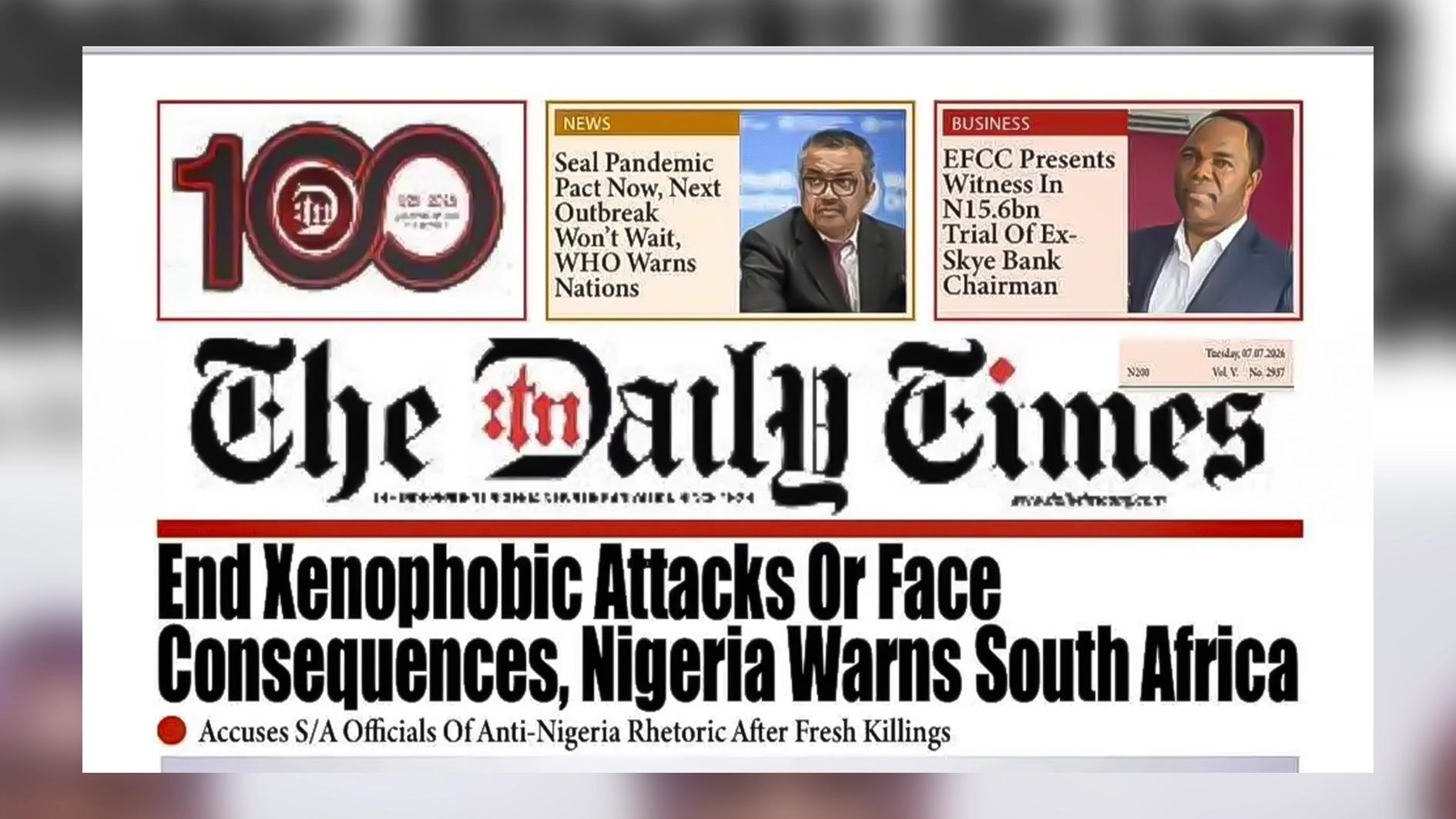
As one of the most resilient newspapers in Nigeria’s history, the Daily Times deserves to be celebrated in attaining 100 years. First published on June 1, 1926, it is a newspaper of record that has seen it all, from nationalism campaigns, independence of the country, military rule and coups, civil war, civilian administration and high level political economy. In the process, it has carved an indelible name for itself, scored record goals in the journalism profession, trained reporters, produced the finest of editors and writers and, above all, gave vent to newer newspapers through transfer of personnel in virtually all departments of newspapering.
To mark the centenary celebrations, the Management of DTN held a press conference in Abuja, with a theme: “Daily Times is 100 years tomorrow—celebrating 100 years of fearless journalism, championing the future 1926-2026.” This is in addition to a year-long calendar of activities featuring public lectures, exhibitions of archival front pages, and a digital archive project to put 100 years of Daily Times editions online for researchers and the public. The banner read: “100 years honouring the past, shaping the future. 1926-2026: practicing journalism for the people.”

For more than a decade through the 1970s and 80s, Daily Times was unbeatable in circulation in West Africa. It was much sought after, and for many people ranging from top civil servants, captains of industry, military institutions, teachers, students and the ordinary Nigerian, the day was not complete without the newspaper. Daily Times was the medium of credible news on politics, government policies, sports and entertainment among others. Its contents were a major molder of public opinion.
For Daily Times , as with other newspapers and magazines, the last 25 years have been very testy. The paper was particularly affected by market volatility, changes in ownership, economic instability, and sharp intrusion of digital production. These caused a marked reduction in the newspaper’s print run, and ultimately forced it to settle mainly on online editions.
Speaking on “Why 100 Years Matters?” the Publisher/Editor in Chief of the Daily Times Fidelis Anosike explained that: “Centenaries are rare in African media. Few newspapers reach 100 years, and fewer still are still publishing. For Nigeria, Daily Times at 100 is a living archive. It carried headlines on independence, on July 29 and January 15, 1966, on June 12, 1993, and on May 29, 1999. It also recorded quieter stories: a new bridge, a market fire, a university admission list…”
Clearly, the 100 years history of Daily Times is epochal, and presents myriad of lessons in newspaper journalism, media professionalism, management and coping with the vagaries of a turbulent economy.
Daily Times was started by Richard Barrow and Ernest Ikoli as a four-page daily in colonial Lagos. From that small start, it grew into the nation’s newspaper of record; a Nigerian newspaper with headquarters in Lagos. In the 1970s, it was one of the most successful locally owned businesses in Africa. However, the paper went into decline after it was purchased by the government in 1975. What was left was sold to a private investor, Fidelis Anosike, in 2004. Folio Communications Limited officially assumed the ownership of the Daily Times of Nigeria Plc on September 3, 2004. Today, Daily Times publishes in print and online, still holding to its founding mission of journalism for the people.
Incorporated on June 6, 1925 as the Nigerian Printing and Publishing Company by Richard Barrow, Adeyemo Alakija, V.R. Osborne and others, the paper printed its first copy as The Nigerian Daily Times on June 1, 1926. The paper aimed to create a news medium free from corporate and political influence. Known for its politically independent reporting and global perspective, the paper’s readership was on the liberal leaning. From that small start, it grew into the nation’s newspaper of record.
In 1928, the new publication began to gain advertising income from foreign firms operating within the country, and in the next 10 years arose to dominate advertising by expatriate firms. The Daily Times became a popular voice of the nationalist movement. Education was one of the first issues. In a 1934 editorial, the paper opposed Native Authority schools, which they saw as controlled by stooges of the colonial administration, and advocated independent mission schools.
R. B. Paul, a Liverpool businessman, who had interest in West Africa magazine and later the West African Review bought the paper in 1935. When Nnamdi Azikiwe (“Zik”) launched his West African Pilot in 1937, dedicated to fighting for independence from British colonial rule, many established papers lost a large part of their audience. The Daily Times responded by raising foreign capital and injecting fresh blood into the editorial team.
The paper’s circulation rose from 25,000 daily in 1950 to 95,000 in 1959.
Starting in 1963, ownership of the paper was gradually transferred to Nigerians, a process that was completed by March 31, 1974. On September 1, 1975, the Federal Government of Nigeria acquired 60% of the Daily Times and its main rival, the New Nigerian Newspaper.
Daily Times had the good fortune of having Ismail Babatunde Jose who joined the paper in 1941 as a technical trainee. He was soon promoted to reporter, then regional correspondent and eventually assistant editor. Cecil King appointed him editor in 1957. Jose became managing director in 1962 and chairman in 1968. He changed the name of the flagship newspaper to its present Daily Times Nigeria on May 30, 1963. Jose was in charge at a time when the oil boom was starting in Nigeria and advertising revenue was plentiful. Jose hired young graduates and trained them to become self-confident, independent reporters and columnists. In 1965, he established the Times Journalism Institute, which was still training journalists forty years later.
Before Jose was forced out of his position in March 1976, he had mentored and nurtured many journalism greats including Tony Momoh, Patrick Dele Cole, Stanley Macebuh, Alade Odunewu, Segun Osoba, Tola Adeniyi, Gbolabo Ogunsanwo, Dele Giwa, Ray Ekpu, Lade Bonuola and a host of others. In 1977, the government assumed total ownership and control.
In 1957, the newspaper had organised the first beauty pageant in Nigeria, Miss Nigeria, and ran the pageant without competition for many years. Rosemary Anieze, Miss Nigeria 1960, was renamed Miss Independence, and one of the most publicized beauty queens in the history of Nigeria.

