 Follow Us on Google News
 Follow Us on Google Discover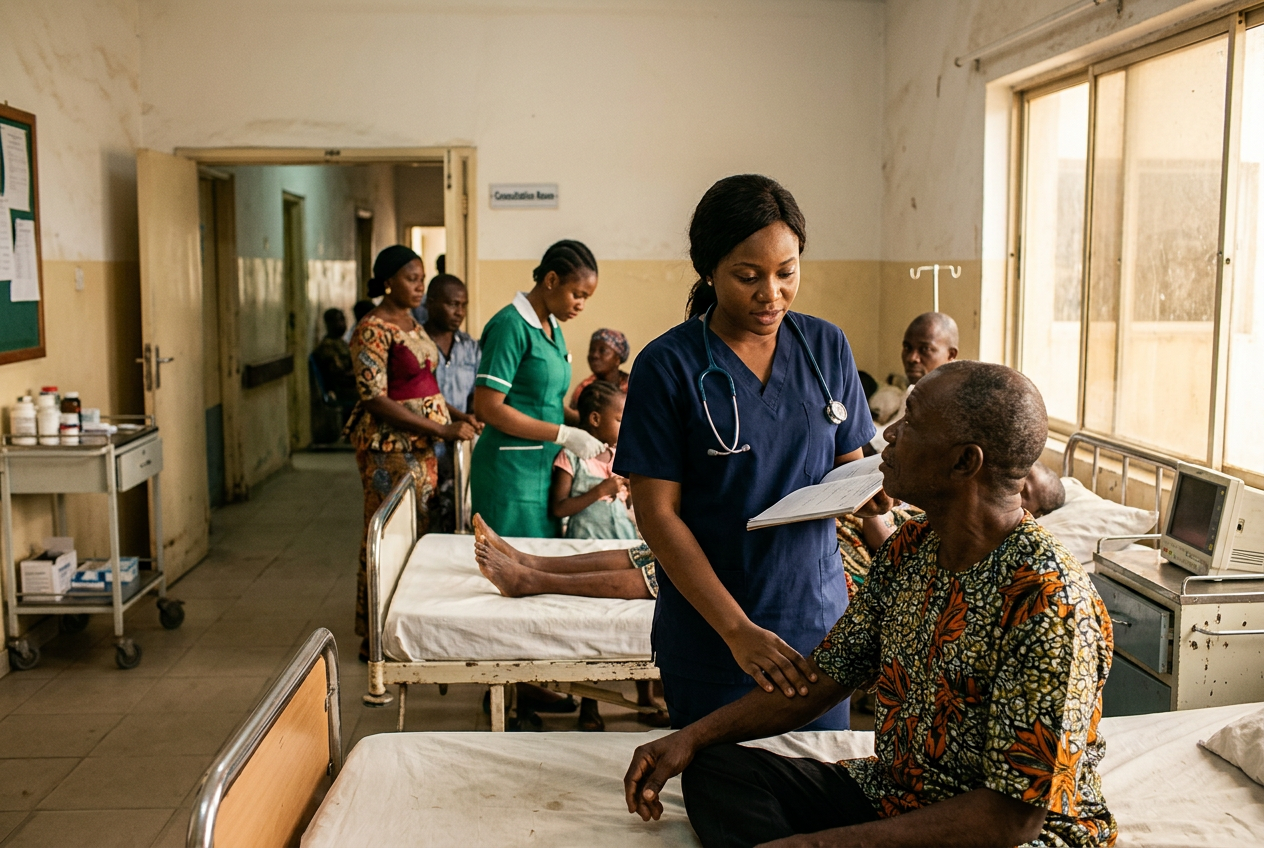
Hello, and thank you for stopping by. If you have ever tried to make sense of how care actually works across this country, whether as a patient, a carer, or simply a curious reader, then this piece is for you. What follows is the conclusion of months of research and years of paying close attention to how ordinary Nigerians get seen, treated, and sent home, and I have tried to write the guide I wish I had years ago.
So let us answer it plainly. How is the healthcare system in Nigeria? In short, it is a three-tier structure run across federal, state, and local government, sitting alongside a large private and informal sector, and it is best understood as a system of real talent working under real strain. If you want the textbook version of how medical care is organised here, the encyclopaedia entry lays out the tiers neatly. My job today is to tell you how it feels on the ground, backed by the numbers.
Grab a cup of something warm. We have a fair bit to cover, and I promise to keep the jargon to a minimum.
How good is the healthcare in Nigeria really?
Here is the honest answer: it depends enormously on where you stand and what you can pay.
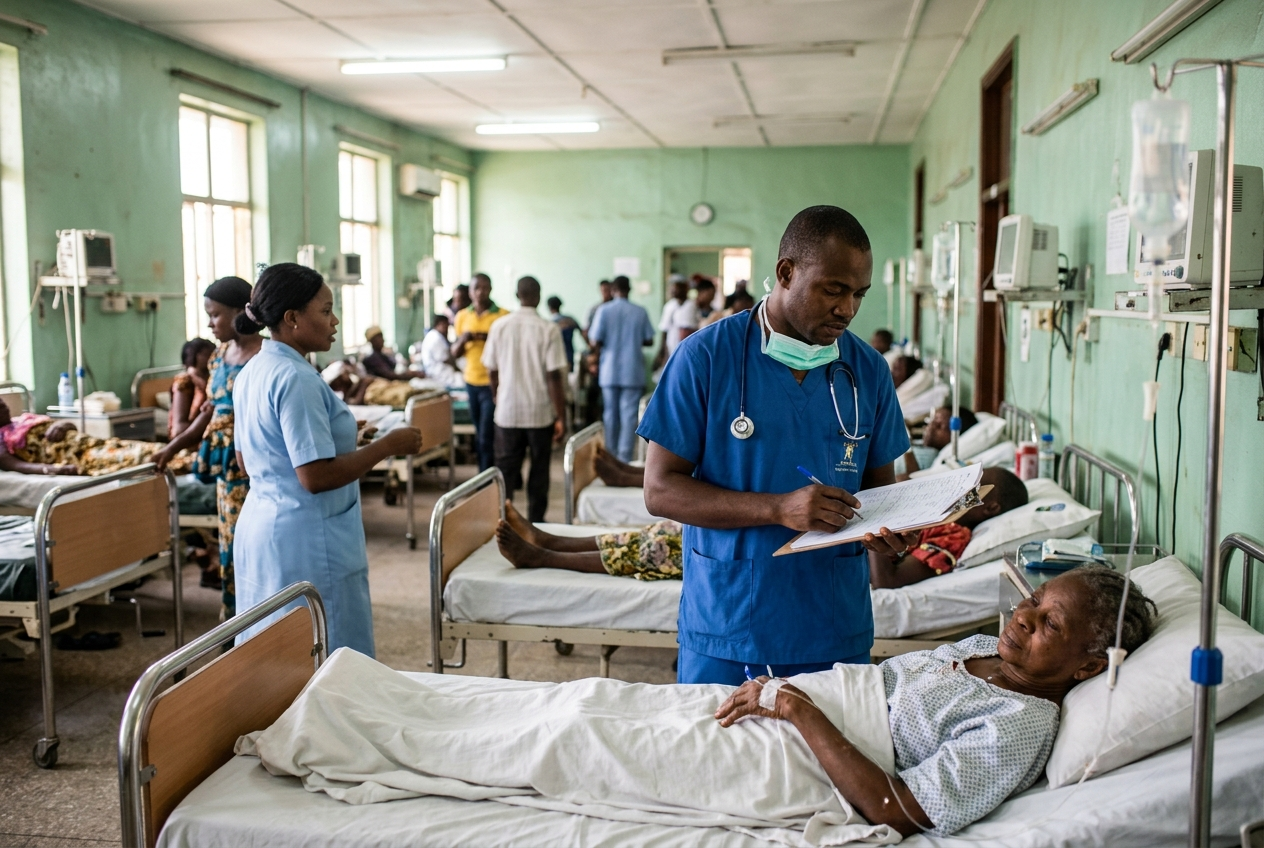
At the top end, Nigeria has teaching hospitals and specialist centres that can hold their own regionally, staffed by clinicians who trained at some of the finest institutions in the world. At the bottom end, a rural primary health centre might have one nurse, intermittent power, and a queue that starts before dawn. Both realities are true at once, which is why any single verdict tends to mislead.
The government frames its ambition clearly. The Federal Ministry of Health sets out its mandate as strengthening the national system to deliver effective and affordable care for every citizen. That is the aspiration, and it is a fine one.

The lived experience is more uneven. A recent Guardian feature on public hospitals captured it well, describing patients waiting hours on wooden benches for a single available doctor, which is the sort of detail no ranking table ever quite conveys.
Rather like a football club with a few world-class players and a threadbare bench, the quality is genuinely there, but the depth is not. When you get seen by the right specialist, the care can be excellent. Getting to that point, though, is where most of the friction lives.
Where does care actually happen? More often than you might think, not in a hospital at all. National survey data shows that the single most common first port of call for a health complaint is the local chemist shop, used by roughly four in ten Nigerians, ahead of hospitals themselves. That tells you something important about access, cost, and habit all at once.
What is Nigeria’s ranking in the healthcare system?
Now to the number everyone quotes.
In the World Health Organisation’s landmark assessment of health systems, Nigeria placed 187th out of 191 countries, sitting near the very bottom of the table. That figure is old now, dating from the turn of the century, yet it has stuck in the national conversation like a stubborn stain.
The more encouraging news is that the picture has shifted. Pharmacists visiting this very newspaper reported that Nigeria had moved up to around 163rd of 191 countries two decades on, which, while hardly a podium finish, is real movement in the right direction.
Other measures tell a similar story. On broader indices of quality and access, Nigeria continues to rank low among African peers, and life expectancy hovers around 54 to 55 years, below the continental average of roughly 62. The Ministry’s public health department exists precisely to close gaps like these, and it publishes the guidelines that shape frontline services.
Key health indicators for Nigeria at a glance
| Indicator | Figure | Context |
|---|---|---|
| WHO health system rank (2000) | 187th of 191 | Later cited as improving toward 163rd |
| Life expectancy (2025 estimate) | About 54 to 55 years | Below the African average of roughly 62 |
| Public health spend per person (2024) | About ₦6,361 | Around 0.6% of GDP, below the WHO 6% guide |
| Out-of-pocket share of total spending | Over 70% | Among the highest anywhere in the world |
| Average paid per clinic visit | ₦2,473 | National Bureau of Statistics, 2024 |
| Average out-of-pocket hospitalisation | ₦44,189 | National Bureau of Statistics, 2024 |
The numbers point to one clear conclusion: rankings are improving slowly, but Nigerians still shoulder far too much of the cost themselves. When more than seven Naira in ten spent on health comes straight from a family’s own pocket, a serious illness can tip a household into hardship overnight.
So, how is the healthcare system in Nigeria structured?
Right, this is the heart of the matter, so let us answer the primary question head on.
The healthcare system in Nigeria is organised into three tiers of public provision, wrapped around by a very large private and informal sector. Primary care sits with local governments and is coordinated nationally through the primary health care agency, handling immunisation, maternal care, and everyday complaints. Secondary care lives in state-run general hospitals for referrals and more involved treatment. Tertiary care is delivered by federal teaching hospitals and medical centres, which handle specialist and complex cases. Financing is meant to flow partly through the National Health Insurance Authority, whose 2022 Act aims to bring coverage to every Nigerian, though enrolment still lags well behind that goal.
If you are trying to actually use the system, here is the order of play I recommend:
- Register with the nearest primary health centre or a trusted general practice before you ever fall ill, so you have a first point of contact.
- Sort out health insurance early, whether through an employer scheme or the individual and family plan, rather than waiting for a crisis.
- For anything beyond a minor complaint, ask for a proper referral letter, as it smooths your path to the next tier and often to a better price.
- Keep your own records, since continuity between facilities is patchy and a folder of past results saves repeated tests.
- For genuine emergencies, head straight to a secondary or tertiary facility, because primary centres are rarely equipped for acute crises.
- Budget realistically in Naira for consultations, tests, and medicines, and confirm what your insurance covers before treatment begins.
Follow that sequence and you sidestep a surprising share of the frustration. Most of the horror stories I hear start with someone arriving at the wrong tier for their problem, then losing precious hours being redirected.
What are the main problems with healthcare in Nigeria?
Let us not sugar-coat this. The challenges are structural, and they are stubborn.
The biggest, by common agreement, is the exodus of trained staff. Nigerians affectionately call it “Japa,” the great leaving, and it has hollowed out wards across the country. Researchers studying the trend note that Nigeria already carries one of the lowest doctor-to-patient ratios in the world, and every departing consultant widens that gap.
Money is the second wound. Public health spending has long sat below the levels the country itself signed up to, and the shortfall lands squarely on patients through out-of-pocket payments.
Then there is the geography of inequality. A well-resourced Lagos clinic and a remote centre in the north-east may as well be in different countries when it comes to what they can offer. Infrastructure, from steady electricity to working imaging machines, is unevenly spread and often unreliable.
Insurance coverage, though improving, remains thin. For years fewer than one in ten Nigerians held any health cover at all, which is exactly the problem the newer insurance law is trying to fix.
And finally, there is medical tourism at the top. When even senior officials fly abroad for treatment, it drains both money and confidence from the domestic system, a quiet vote of no confidence that discourages the very investment the sector needs.
None of these is beyond fixing. But they are tangled together, and pulling on one thread tugs at the rest.
Which African country has the best healthcare?
A fair question, and one Nigerians ask often, usually with a rueful sigh.
By the most widely cited quality index, South Africa consistently comes out on top on the continent, powered largely by an advanced private sector and world-class hospitals in its major cities. Kenya and Tunisia typically follow, the former anchored by strong private facilities in Nairobi and the latter a hub for medical tourism across North Africa.
Measured a little differently, small island and North African nations shine. On one global health-systems ranking, Seychelles placed highest of all African countries, with Algeria, Cabo Verde, Tunisia, and Mauritius all ahead of the continent’s larger economies. Mauritius in particular earns praise for offering free public healthcare to all its citizens alongside a thriving private tier.
So the honest answer is that it depends on your yardstick. For sheer top-end capability, South Africa leads; for broad, equitable access relative to size, the smaller nations quietly outperform. Nigeria, for now, features in neither club, though the raw talent to change that is unquestionably present.
Final thoughts on how the healthcare system in Nigeria works
So where does all this leave us?
The healthcare system in Nigeria is a study in contrasts: brilliant clinicians and strained wards, real reform on paper and slow change in practice, a rising insurance ambition set against families still paying dearly at the point of care. It is neither the disaster its harshest critics claim nor the success its planners hope for. It is, in truth, a system in the middle of a long climb.
The encouraging part is that the direction is upward. Rankings have improved, the insurance framework has been rebuilt, and the conversation about retaining doctors has never been louder.
If you take practical steps from this, let them be these. Register with a primary centre before you need one, sort your insurance early, insist on referrals, and keep your own records. Those four habits will not fix the national picture, but they will make your own journey through it far smoother.
And keep paying attention. A system improves fastest when the people it serves refuse to look away.
Related Articles
If you found this useful, you might enjoy some of my related work for this newspaper. For the bigger picture on why the country’s scale shapes everything from budgets to hospital queues, have a read of my piece on which country is the giant of Africa. And because where people live directly affects who can reach a clinic in time, my article on where most people live in Nigeria makes a fitting companion to this one.
Key Takeaways
- Nigeria runs a three-tier public system (primary, secondary, tertiary) alongside a large private and informal sector, with talented staff working under heavy strain.
- Global rankings have improved from 187th toward 163rd of 191, yet over 70% of health spending still comes straight from patients’ pockets.
- Register early with a primary centre, arrange insurance before a crisis, and always ask for referrals to get the most from the system.
Frequently Asked Questions About How the Healthcare System in Nigeria Works
How is the healthcare system in Nigeria organised?
It is arranged into three public tiers: primary care through local governments, secondary care through state general hospitals, and tertiary care through federal teaching hospitals. A large private and informal sector, including chemist shops, sits alongside these public tiers and often serves as the first point of contact.
Is healthcare free in Nigeria?
Public healthcare is heavily subsidised rather than fully free, and most Nigerians still pay significant sums out of their own pockets. The National Health Insurance Authority aims to reduce this burden, but coverage remains limited for now.
What is Nigeria’s WHO health system ranking?
Nigeria placed 187th out of 191 countries in the World Health Organisation’s turn-of-the-century assessment. More recent commentary suggests it has improved to around 163rd, which is progress though still low by global standards.
How much does a hospital visit cost in Nigeria?
National survey data puts the average out-of-pocket payment at roughly ₦2,473 per clinic visit. A hospitalisation averages around ₦44,189 per person, though costs vary widely by facility and condition.
Why are so many Nigerian doctors leaving the country?
Doctors emigrate mainly for better pay, working conditions, and equipment, a trend Nigerians nickname “Japa.” This exodus has left the country with one of the lowest doctor-to-patient ratios in the world.
Does Nigeria have good hospitals?
Yes, its leading federal teaching hospitals and private specialist centres can deliver genuinely excellent care. The difficulty is uneven access, as the quality drops sharply once you move away from major urban facilities.
What is the National Health Insurance Authority?
It is the body created by the 2022 NHIA Act to regulate health insurance and push Nigeria toward universal coverage. Its plans are designed to cover formal workers, informal earners, the elderly, and vulnerable groups alike.
Which African country has the best healthcare?
By the most widely cited quality index, South Africa leads the continent, followed by Kenya and Tunisia. On other measures, smaller nations such as Seychelles and Mauritius rank higher for equitable, accessible care.
How much does Nigeria spend on healthcare?
Public spending per person sat around ₦6,361 in 2024, roughly 0.6% of GDP and well below the WHO’s 6% guideline. This underfunding is a major reason patients bear so much of the cost themselves.
What is life expectancy like in Nigeria?
Recent estimates place life expectancy at about 54 to 55 years, below the African average of roughly 62. Improving primary care, maternal health, and disease prevention are seen as the fastest routes to raising it.
Where do most Nigerians go first when they feel ill?
Survey data shows the local chemist shop is the single most common first stop, used by around four in ten people. Hospitals come next, while traditional and faith-based healers are consulted far less often.
How can I get the most out of the healthcare system in Nigeria?
Register with a primary health centre before you fall ill, arrange insurance early, and always request a referral letter for anything serious. Keeping your own copies of results also saves time and money as you move between facilities.

