 Follow Us on Google News
 Follow Us on Google Discover
Welcome, and thank you for pulling up a chair. If you have found yourself wondering why is Nigeria booming, then you and I have been asking the very same question, because it is the puzzle I have spent the better part of a year picking apart. This piece is the tidy conclusion of months of research, dozens of reports and a good few late nights, laid on top of years spent watching one of the continent’s largest and most closely watched economies shift into a higher gear.
Here is the honest bit first: “booming” is a slippery word. Nigeria is not booming the way a lottery winner booms, all at once and overnight. It is booming more like a stubborn engine that has finally caught, coughing a little, but pulling forward.
Let me walk you through what is actually happening, why the numbers have turned, and what it all means for the naira in your pocket.
Why Nigeria is growing so fast
The short version? A very young country is finally starting to count itself properly.
Nigeria is home to roughly 224 million people, and the median age sits at around eighteen. That is an astonishing amount of energy, ambition and appetite packed into one place. When a population that large is also that young, you get a workforce and a consumer market that simply keeps expanding, rather like a kitchen that never stops needing more chairs at the table.
The growth figures back this up. According to data published by the National Bureau of Statistics, real gross domestic product grew by 3.87 per cent across 2025, up from 3.38 per cent the year before, with the final quarter of the year clocking in above four per cent. You can browse the underlying releases yourself through the official national statistics agency, which is where most of these headline figures originate.

What makes this genuinely eye-catching is the international comparison. The International Monetary Fund projected that the country would expand faster than several wealthy economies, a point the paper covered in its report on how Nigeria was set to outpace the UK and other advanced economies. When a lower-middle-income nation grows quicker than Britain or Germany, people abroad start paying attention.
Services are doing much of the heavy lifting here. Finance, telecoms, transport and the fast-growing creative and tech sectors now make up more than half of the entire economy.
What is really causing the economic growth in Nigeria
Now we get to the interesting part, because growth does not happen by accident.
Three big, and frankly painful, reforms sit underneath the current momentum. Fuel subsidies were removed, the multiple exchange-rate windows were unified, and the way the economy is measured was updated for the first time in over a decade. None of these were comfortable, and I will not pretend otherwise, but together they reset the foundations.
The Federal Government has been vocal about the turnaround, celebrating the moment quarterly growth pushed past the four per cent mark as evidence that the reform programme was bearing fruit. Whether you credit the government or the sheer resilience of ordinary traders, the direction of travel changed.
Here is roughly how the sequence unfolded, if you like your history in order:
- Petrol subsidies were scrapped in mid-2023, freeing up enormous sums that had been draining the treasury for years.
- The Central Bank collapsed the tangle of exchange rates into a single, market-driven window, which slowly rebuilt investor trust.
- The National Bureau of Statistics rebased the economy, shifting the reference year from 2010 to 2019 and capturing modern sectors like fintech and Nollywood that the old figures had missed.
- Inflation, having spiked cruelly, began easing as the Central Bank held interest rates high and the naira steadied.
- Non-oil sectors, especially services and agriculture, started carrying more of the load, making the growth broader and less dependent on crude.
That easing of inflation matters more than any single statistic. Prices that were rising at more than thirty per cent began cooling toward the low twenties, and analysts now expect the economy to grow even faster, with one firm forecasting that steadier foreign exchange and softer inflation would lift GDP above four per cent again. When the naira stops lurching about, businesses can actually plan, and planning is where real growth begins.
Which country does Nigeria owe the most?
You cannot talk about a boom without talking about the bill, so let us be grown-ups about the debt.
A lot of people assume China holds the whip hand over Nigeria’s finances. It is a reasonable guess, given the headlines, but the records tell a slightly different story. According to figures from the Debt Management Office, Nigeria’s external debt stood at roughly 51 billion US dollars at the end of 2025, and the single largest creditor is not a country at all.
That title belongs to the World Bank Group, largely through its concessional lending arm, which alone accounts for well over 17 billion dollars of what the country owes. These are the cheap, long-term loans that governments rather like, because the interest is gentle and the repayment window is generous.
China does sit at the top of the bilateral pile, meaning it is the largest single foreign government Nigeria borrows from, mostly to fund railways, roads and power projects. But bilateral loans are a smaller slice of the whole than most people imagine, dwarfed by both the multilateral lenders and the Eurobonds sold to international investors.
Debt is not automatically a villain, mind you. The trouble comes when servicing it eats too much of your revenue, which is exactly the worry some commentators raised in a thoughtful piece on the gains, losses and fresh challenges of the rebased economy. A bigger measured economy makes the debt look more manageable on paper, but the naira still has to be found to pay it.
So, why is Nigeria booming?
Right, let us answer the question head on, in one honest paragraph.
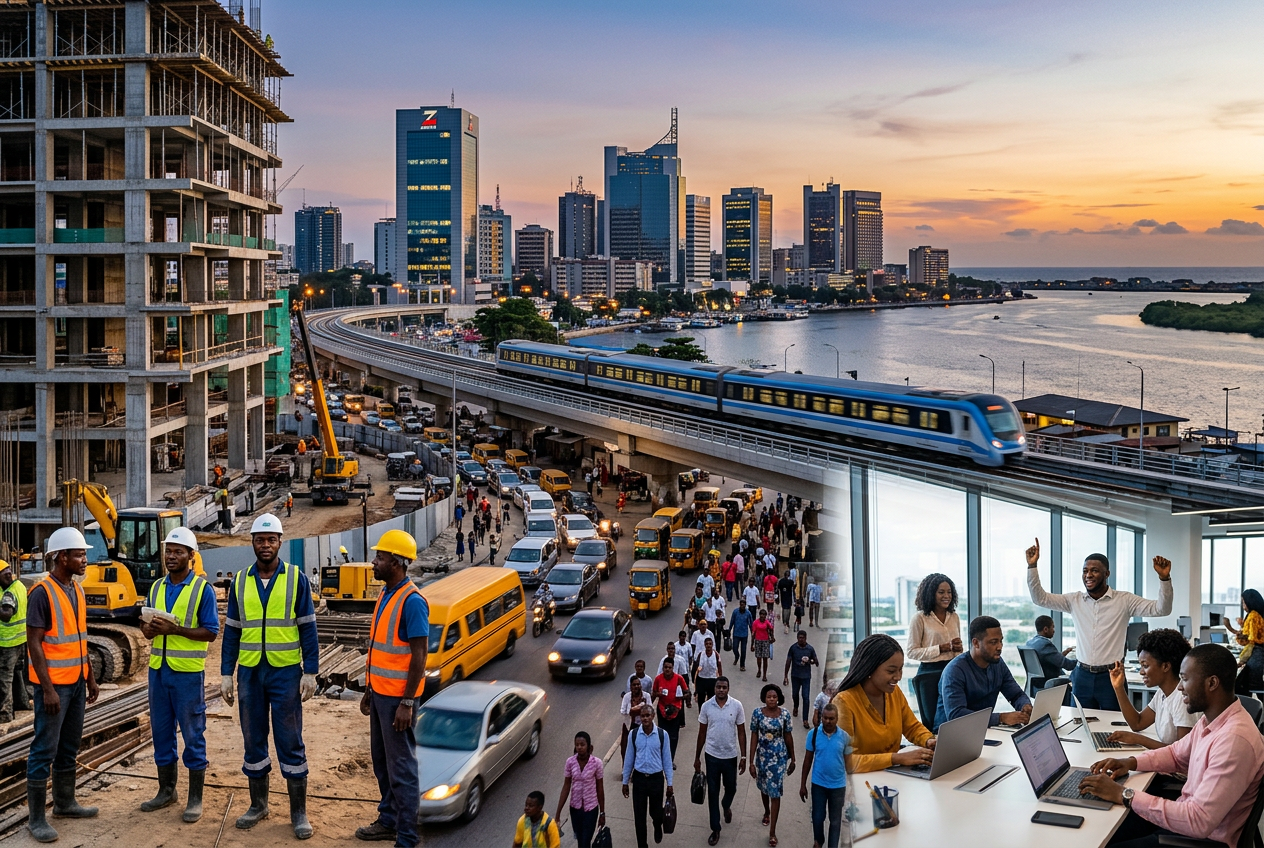
Nigeria is booming because a very large, very young population is being met, for the first time in years, by reforms that reward productivity rather than punish it. The removal of costly subsidies and the unification of the exchange rate steadied the fundamentals, a long-overdue statistical rebasing revealed sectors that had been quietly thriving all along, and services like fintech, telecoms and entertainment surged forward. Add cooling inflation, a firmer naira and growing foreign interest, and you get an economy expanding faster than most of the wealthy world. The boom is real, but it is a reform-driven, services-led boom, not a sudden rain of oil money, and its benefits are still spreading unevenly across the country.
Nigeria’s growth story in numbers, 2024 to 2026
The table below gathers the headline figures in one place so you can see the trend rather than just the noise.
| Indicator | Figure | What it tells us |
|---|---|---|
| Real GDP growth, 2024 | 3.38% | The starting point before reforms fully bit |
| Real GDP growth, 2025 | 3.87% | Clear acceleration across the year |
| Growth, final quarter of 2025 | 4.07% | Momentum building into the new year |
| Growth forecast, 2026 | around 4.12% | Analysts expect the climb to continue |
| Size of the economy, 2025 | around ₦441.5 trillion | A larger base after rebasing |
| Inflation, 2025 | eased toward the low 20s% | Down sharply from above 30% |
| Services share of GDP | more than half | The real engine of the boom |
| Population | around 224 million | The demand and labour behind it all |
Taken together, these numbers show an economy that is not merely surviving but steadily gaining pace, with the sharpest improvement coming from cooling inflation and quickening quarterly growth.
Is Nigeria a poor or a rich country?
This is where nuance earns its keep, because the honest answer is “both, at the same time”.
By total output, Nigeria is one of the biggest economies in Africa and sits comfortably among the continent’s leaders. There is genuine wealth here, thriving banks, a globally famous film industry, a tech scene minting new companies, and some of the most enterprising traders you will ever meet.
Yet measured per person, the picture softens considerably. When you divide that large economy across 224 million people, income per head is modest, and a significant share of the population still lives on very little each day. Roughly three in ten Nigerians remain in extreme poverty, and rising living costs have squeezed households hard.
So is it poor or rich? I would say Nigeria is a wealthy country that has not yet spread its wealth widely, rather like a family with a valuable house but not much cash in the current account. The boom is closing that gap slowly, and the pace at which it does so will define the next decade.
For anyone watching from the outside, the practical takeaway is simple: judge Nigeria by its direction, not just its current position. The trajectory is what has changed.
Related articles worth your time
If this has whetted your appetite, I have explored neighbouring corners of this story before. My look at which country truly deserves the title of Giant of Africa unpacks how Nigeria’s scale stacks up against the rest of the continent, and it pairs neatly with everything we have covered here.
For a closer, ground-level view of where the money is actually made, my breakdown of the main industries powering Lagos shows how a single city has become the beating heart of this economic story.
Final thoughts on why Nigeria is booming
So, why is Nigeria booming? Because a young, hungry, resourceful nation finally got a set of reforms that worked with its energy rather than against it, and the numbers have followed.
The boom is real, but it is early, and it is uneven. The reforms were painful, inflation has bruised ordinary families, and the debt still needs careful handling. None of that cancels the progress; it simply keeps us honest about it.
If you want to act on any of this, keep three things in view. Watch the quarterly growth figures and the inflation rate, because they tell you whether the momentum is holding. Follow the naira, since a stable currency is the surest sign that confidence is returning. And look past the national averages to the sectors, because services, tech and agriculture are where the real opportunities are opening up.
Nigeria has turned a corner. The road ahead is long, but for the first time in a while, it is pointing uphill in a good way.
- Nigeria’s boom is powered by a young 224-million-strong population meeting reforms that reward productivity, with growth reaching 3.87 per cent in 2025 and above four per cent by year end.
- The three big drivers are subsidy removal, a unified exchange rate and a statistical rebasing that revealed thriving services, tech and creative sectors, all helped along by cooling inflation.
- Nigeria is wealthy in total output yet modest per person, so judge it by its rising trajectory rather than its current average income, and keep an eye on growth, inflation and the naira.
Frequently asked questions about why Nigeria is booming
Why is Nigeria booming right now?
Nigeria is booming because major reforms, including subsidy removal and a unified exchange rate, steadied the economy just as its young population and services sector surged. Growth reached 3.87 per cent in 2025 and climbed above four per cent by the final quarter.
Is the Nigerian economy actually growing or just being measured differently?
It is genuinely growing, with real GDP expanding 3.87 per cent in 2025, but the 2025 rebasing also revealed sectors the old figures had missed. Both things are true at once, so the economy is both larger on paper and expanding in reality.
What is GDP rebasing and why did it matter?
Rebasing updates the reference year used to calculate the economy, and Nigeria moved its base year from 2010 to 2019. This captured modern industries like fintech and Nollywood, giving a fuller and more accurate picture of national output.
Which country does Nigeria owe the most money to?
China is the single largest foreign government Nigeria borrows from, but the biggest overall creditor is the World Bank Group through its concessional lending. Multilateral lenders and Eurobond investors together dwarf what is owed to any one country.
How much external debt does Nigeria have?
Nigeria’s external debt stood at roughly 51 billion US dollars at the end of 2025, according to the Debt Management Office. Multilateral loans make up the largest share, followed by commercial Eurobonds and then bilateral lenders.
Is Nigeria a rich country or a poor country?
Nigeria has one of Africa’s largest total economies, so in aggregate it is wealthy, yet income per person is modest across its 224 million people. Around three in ten Nigerians still live in extreme poverty, so wealth and hardship sit side by side.
What sectors are driving Nigeria’s growth?
Services lead the way, now accounting for more than half of the entire economy, with finance, telecoms, transport and the creative industries especially strong. Agriculture and industry also contribute, making the recent growth broad rather than reliant on oil alone.
Did removing the fuel subsidy help the economy?
Removing the subsidy in 2023 freed up enormous sums that had drained the treasury for years, improving the government’s finances. It was painful for households in the short term, but it is widely seen as a foundation for the current growth.
Is inflation still a problem in Nigeria?
Inflation spiked painfully above thirty per cent but has since cooled toward the low twenties as the Central Bank held rates high and the naira steadied. It remains higher than anyone would like, though the downward trend is encouraging.
Will Nigeria’s economy keep growing in 2026?
Analysts expect growth to continue, with forecasts pointing to around 4.12 per cent in 2026 on the back of steadier foreign exchange and softer inflation. The momentum looks set to hold, provided the reforms stay on course.
Is Nigeria still the biggest economy in Africa?
After the 2025 rebasing, Nigeria sits among the continent’s largest economies but no longer clearly holds the top spot on nominal figures. It does, however, remain Africa’s most populous nation and one of its most dynamic markets.
What does the boom mean for ordinary Nigerians?
The benefits are spreading unevenly, so many families still feel squeezed by high living costs despite the strong national figures. Over time, sustained growth in services, tech and agriculture should widen opportunity, but the gains have yet to reach everyone equally.

