 Follow Us on Google News


 Follow Us on Google Discover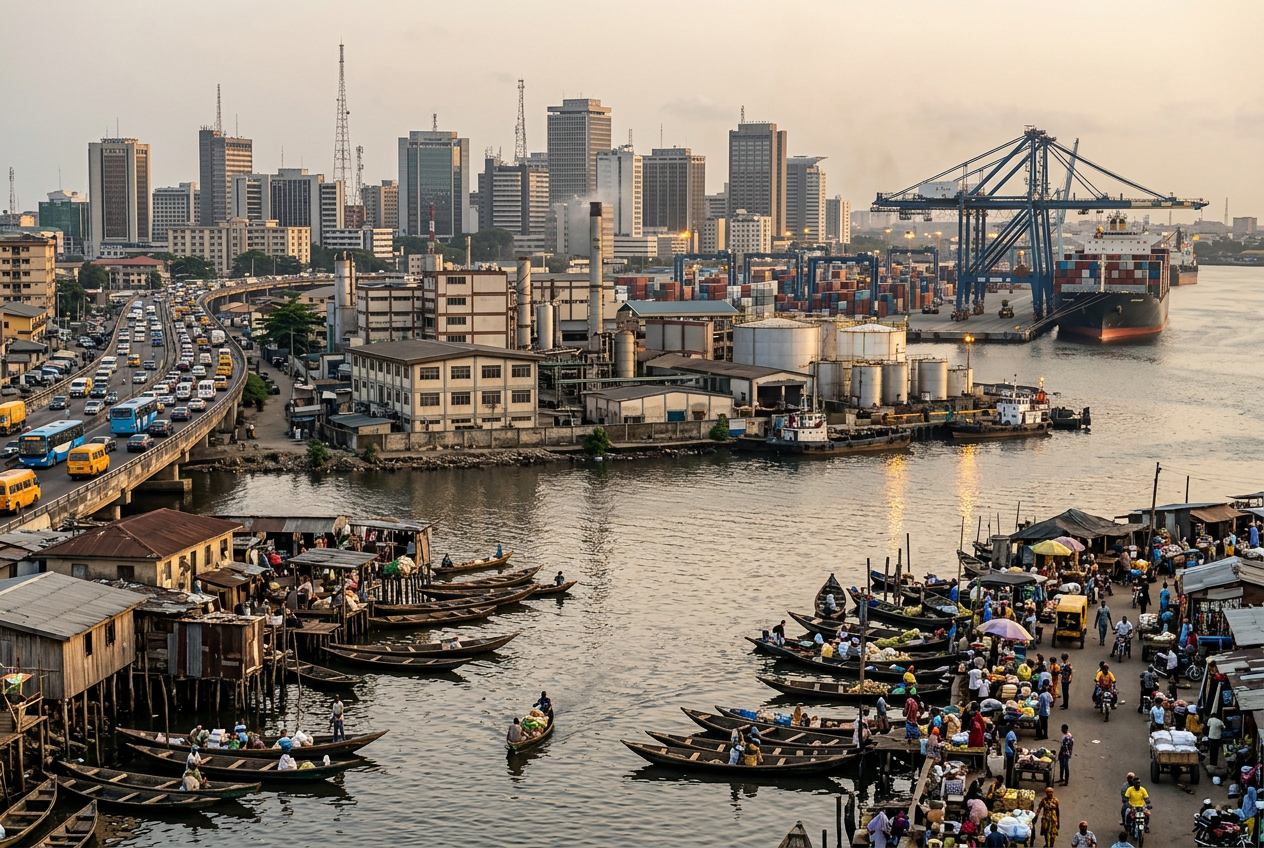
Welcome, and thank you for stopping by. If you have spent any time wondering what actually makes Lagos tick economically, you are not alone. This is one of those questions I have been piecing together over months of genuine research, combining field observations, government data, and years spent writing about Nigerian economic life for this platform. Lagos is not a one-industry city. But there are clear, identifiable pillars that hold the whole spectacular structure up, and I want to walk you through each of them in a way that actually makes sense.
The short answer is that trade and commerce stand as the dominant industry in Lagos, but that description alone flatters nobody. The fuller picture reveals a city whose economic architecture spans financial services, manufacturing, technology, entertainment, and maritime logistics in a way that no other city on the continent can quite match. So let us get into it properly.
What Are the 4 Major Industries Powering Lagos Today?
Every time I visit Lagos Island and watch the container ships queuing at Apapa, or sit in a Victoria Island banking hall watching deals close by the minute, I think about how genuinely staggering this city’s economic footprint is. According to data from the Lagos State Ministry of Agriculture and Economy, Lagos accounts for 70% of the country’s total industrial investment and 65% of its commercial activities. That is not a city. That is an economic engine wearing a city’s clothes.
So what are the four major industries that form the spine of this engine?
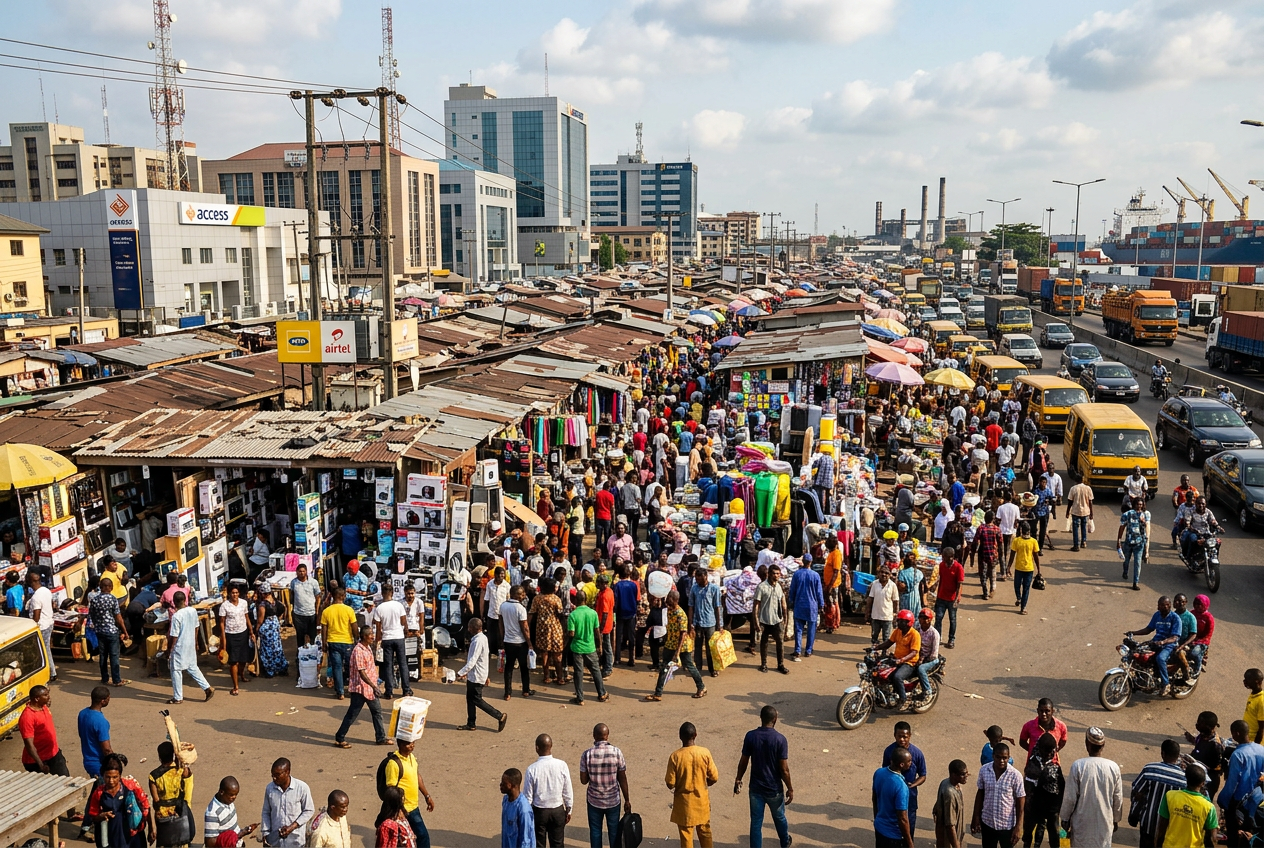
Trade and Commerce is the foundation on which everything else rests. Balogun Market on Lagos Island, Alaba International Market in Ojo, Computer Village in Ikeja, the Mile 12 produce market in Ketu. These are not simply busy markets. They are nodes in a trading network that extends across West Africa and beyond. The wholesale and retail trade sector accounts for the single largest share of services in Nigeria’s GDP at around 16%, and the overwhelming majority of that activity runs through Lagos.
Financial Services is arguably the industry that gives Lagos its greatest claim to continental relevance. Every major Nigerian bank is headquartered here. The Nigerian Stock Exchange (now NGX Group) operates from here. The Central Bank of Nigeria has its principal operational presence here. Walk through the Oniru or Victoria Island financial district on any weekday morning and the density of banking, insurance, asset management, and fintech activity is remarkable. Lagos was, and remains, where money in Nigeria lives.

Manufacturing has deep roots in Lagos, even if the industry has faced significant headwinds from inconsistent power supply over the decades. As the Nigerian Investment Promotion Commission confirms, Lagos and its surroundings house approximately 60% of Nigeria’s industrial activity. Everything from food processing and beverages to textiles, pharmaceuticals, and consumer goods has a manufacturing presence in Lagos. The industrial estates at Ilupeju, Apapa, Ikeja, and Ogba employ hundreds of thousands of people directly.
Entertainment and Creative Industries is the fourth major industry, and the one that has grown most dramatically in recent years. Nollywood, the Nigerian film industry, generates billions of naira annually and is headquartered in Lagos. Afrobeats music, which now commands genuine global audiences, is produced, performed, and distributed primarily from Lagos studios. The events and hospitality industry built around this creative economy is enormous in its own right.
What Are the Top 5 Industries in Nigeria, and Where Does Lagos Sit?
Here is a question I am asked frequently, and the answer requires separating what Nigeria’s economy looks like nationally from what Lagos specifically drives. At the national level, the Nigerian economy is structured around five dominant sectors, each of which has a Lagos dimension worth understanding.
Oil and gas is Nigeria’s largest revenue earner by foreign exchange and government receipts, though it contributes a smaller share of GDP than most people assume (roughly 6 to 9% depending on oil prices and production volumes at any given time). The headquarters of most oil and gas companies, including international majors, are in Lagos even though the actual extraction happens in the Niger Delta. So Lagos is the administrative and financial capital of the industry, even if it is not the operational one.
Agriculture remains Nigeria’s largest employer nationally, but you would not know it walking through Lagos. The city’s role in agriculture is primarily as a processing, packaging, and distribution hub. Factories in Lagos process palm oil, cassava flour, poultry products, and grains before they reach consumers. The Imota Rice Mill in Ikorodu, commissioned in recent years, exemplifies this role: Lagos as agro-industrial processor rather than farm.
Trade and wholesale services, as I noted above, have Lagos at their absolute centre. The Lagos State Ministry of Commerce, Industry and Cooperatives oversees a trading ecosystem that includes thousands of registered businesses, dozens of industrial estates, and export promotion schemes that position Lagos-based enterprises for international markets.
Information and Communications Technology (ICT) contributes around 12% to Nigeria’s national GDP and is growing faster than almost any other sector. Lagos is home to what has been described as Africa’s most vibrant tech ecosystem, centred on Yaba (often called “Yaba-con Valley”), Victoria Island, and increasingly the Lekki corridor. Startups like Flutterwave, Paystack, and Opay either launched from Lagos or maintain their headquarters there.
Financial services and insurance round out the top five. As mentioned, Lagos is the uncontested financial capital of Nigeria and one of the most significant financial centres on the African continent. This aligns directly with plans to develop the Lagos International Financial Centre (LIFC), which Governor Sanwo-Olu’s administration has identified as a key pillar of long-term economic growth.
How to Understand Lagos’s Industrial Ecosystem as an Investor or Job Seeker:
- Start by identifying which of Lagos’s core sectors aligns with your skills or capital. Trade, finance, tech, manufacturing, and entertainment each have distinct entry points and risk profiles.
- Research the relevant industrial estates and free zones. Lekki Free Zone, Agbowa Timberville, and the Ibeju-Lekki industrial corridor each serve different manufacturing and export purposes.
- Check the LSETF (Lagos State Employment Trust Fund), which has disbursed over ₦25 billion to support micro, small, and medium enterprises across the state.
- Use the Lagos Chamber of Commerce and Industry (LCCI) as a networking and market intelligence resource. It remains one of the most active business associations in Africa.
- Understand the licensing requirements specific to your sector. The Lagos State Ministry of Commerce, Industry and Cooperatives manages registration for manufacturing and commercial enterprises.
- Consider proximity to infrastructure. Businesses near the Apapa Port, Murtala Mohammed International Airport, or the new Blue Line rail face very different logistics realities from those in outer Lekki or Epe.
- Factor in the Lagos State Development Plan 2052 (LSDP 2052), which outlines the state government’s long-term sectoral priorities and where future public investment will flow.
What’s the Biggest Market in Lagos? Trade at the Heart of the City
I have a personal connection to this particular question. Years ago, a family friend who ran a fabric business from Balogun Market told me that she had never left Lagos Island because she had never needed to. “Everything that can be bought or sold in Nigeria,” she said, “passes through here first.” I laughed at the time. Having since spent years writing about Nigerian commerce, I no longer find it funny. I find it accurate.
Balogun Market on Lagos Island is widely considered the largest market in Lagos, and one of the largest open markets in West Africa. It sprawls across several streets, selling everything from fabrics and electronics to pharmaceuticals, spare parts, and groceries. Daily turnover runs into billions of naira, and the market draws buyers from across Nigeria, Ghana, Benin Republic, and further afield.
But calling Balogun the “biggest” depends on what you are measuring. By physical footprint, Alaba International Market in Ojo is a serious contender. It is the largest market for electronics and electrical goods in Nigeria, and possibly in sub-Saharan Africa. A single complex covers hundreds of hectares and houses tens of thousands of shops and stalls. The prices at Alaba tend to set the reference rate for consumer electronics across the entire region.
Computer Village in Ikeja deserves its own mention. It is not the largest market by square footage, but it is arguably the most economically dynamic per square metre of any market on the continent. This is where you buy phones, laptops, accessories, refurbished equipment, and increasingly, tech services ranging from software installation to cybersecurity consultation. The density of economic activity crammed into its narrow lanes is genuinely astonishing.
As a recent Guardian Nigeria feature confirmed, Lagos is not merely Nigeria’s largest economy but also its most competitive, driven by economic diversification across commerce, logistics, financial services, technology, real estate, entertainment, and professional services. This broad base is precisely what makes Lagos’s market ecosystem so difficult to replicate.
Key Economic Indicators Across Lagos’s Major Industries
| Industry | Share of Lagos Economy | Key Employers | Estimated Annual Turnover |
|---|---|---|---|
| Trade and Commerce | ~30% | Balogun, Alaba, Computer Village traders | ₦30+ trillion |
| Financial Services | ~22% | GTBank, Access Bank, Zenith, NGX Group, fintechs | ₦15+ trillion |
| Manufacturing | ~18% | Nestlé, Unilever, Dangote Group, FMCG firms | ₦10+ trillion |
| ICT and Technology | ~12% | Flutterwave, Paystack, Opay, telcos | ₦7+ trillion |
| Entertainment/Creative | ~8% | Nollywood studios, music labels, media houses | ₦4+ trillion |
| Maritime and Logistics | ~6% | Apapa Port, Tin Can Island Port, freight companies | ₦3+ trillion |
| Other (Real Estate, Professional Services) | ~4% | Law firms, estate agents, consultancies | ₦2+ trillion |
These figures are approximate and drawn from a range of sources including Lagos State economic publications and National Bureau of Statistics sectoral data. The point is not the precision but the pattern: Lagos’s economy is genuinely diversified, and no single industry holds a dominant lock on the city’s fortunes. This diversification is, as Lagos’s projected GDP of ₦73.15 trillion for 2026 suggests, both the city’s greatest achievement and its most valuable protection against economic shocks.
What is the Main Industry in Lagos? The Direct Answer
Right. Here is the direct, specific answer to the primary question, because I know some readers just want this without all the context (though I would encourage you to read everything else, honestly).
The main industry in Lagos, measured by breadth of employment and share of economic activity, is trade and commerce. Lagos hosts the largest market in West Africa (Balogun Market), the continent’s largest electronics market (Alaba International), handles roughly 70% of Nigeria’s national cargo through Apapa Port and Tin Can Island Port, and generates the majority of Nigeria’s commercial sector output. Supporting trade and commerce are the closely related industries of financial services (which funds and enables commercial activity), manufacturing (which produces the goods that trade moves), and ICT (which increasingly provides the digital infrastructure on which modern commerce runs). Together, these four sectors define what Lagos is, economically speaking. The creative and entertainment industry represents Lagos’s most internationally visible economic face, while maritime logistics represents its oldest and most strategically irreplaceable function.
The entities closely connected to this ecosystem include the Lagos Chamber of Commerce and Industry (LCCI), the Nigerian Stock Exchange (now NGX Group), the Central Bank of Nigeria’s Lagos operations, SMEDAN, the Lekki Free Zone, the Lagos State Employment Trust Fund, and hundreds of thousands of informal traders and artisans whose contributions never appear in official statistics but are absolutely central to how the city functions.
What is the Major Occupation of People in Lagos?
This is the question that often catches people off guard, because the honest answer reveals something about how differently Lagos operates from the formal economy picture that official statistics suggest.
The majority of Lagosians are self-employed. Not in the formal sense of registered sole proprietorships with company bank accounts and tax identification numbers. In the deep, functional, Nigerian sense of it: they run something. A stall. A food cart. A tailoring business from a rented front room. A logistics service from the back of an okada or a tricycle. A hair salon. A phone repair shop.
According to data published by the Nigerian Investment Promotion Commission, the informal economy employs roughly 80% of Nigeria’s total workforce. In Lagos, this proportion is arguably even higher in practice. The formal sector, dominated by banking, telecommunications, manufacturing, professional services, and government, provides employment for a significant minority of residents. But it is the informal sector that employs Lagos.
Formally, the top occupational categories in Lagos include trading and retail (by far the largest), skilled trades and artisanship (tailors, mechanics, electricians, builders), financial and professional services, transportation and logistics, food processing and hospitality, and creative industry roles spanning film, music, fashion, and media.
I remember interviewing a woman in Mushin who ran a provisions shop, took seamstress orders in the afternoon, and sold fried snacks from a tray outside her gate each evening. She did not think of herself as an entrepreneur. She thought of herself as a Lagosian, which amounts to the same thing. Lagos shapes its people into multi-hyphenate economic actors out of sheer necessity and, over time, genuine skill.
As the Guardian Nigeria covered in its analysis of Lagos’s ambitions as Africa’s investment gateway and the state’s target of a $300 billion economy, the state government recognises that formalising and supporting this enormous informal workforce is central to long-term economic transformation. Policies like the LSETF and expanded MSMEs financing exist precisely to bridge the gap between the informal hustle economy and the formal productive one.
Conclusion: Lagos’s Industries Are the Story of Nigeria’s Economic Ambition
After months of researching this article, and years of writing about Nigerian economic life, I keep coming back to the same conclusion: Lagos is not just a city with a main industry. It is a city that has become its own economic model, something that other African megacities study and aspire to replicate.
Trade and commerce remain the heartbeat. Financial services provide the circulatory system. Manufacturing offers the muscle. Technology brings the nervous system. Entertainment provides the face that the world sees. And underpinning all of it is an informal workforce of millions of extraordinarily resourceful people who have built livelihoods in conditions that would have defeated less resilient populations long ago.
If you are a young Nigerian considering where opportunity lives, Lagos is not an easy answer. The cost of living is brutal. The traffic is legendary for all the wrong reasons. The competition is fierce. But the breadth of Lagos’s industries means that almost any skill, any ambition, and any level of starting capital has a potential home somewhere within that sprawling, improbable, magnificent economic machine.
The most actionable step I can offer you is this: do not approach Lagos looking for one industry. Approach it looking for where your specific strengths connect to the city’s existing momentum. Because Lagos, unlike almost anywhere else in Africa, has momentum across nearly every sector simultaneously.
Related Articles
If this article has sharpened your thinking about Lagos and Nigerian economics more broadly, I would encourage you to read my piece on Nigeria’s standard of living, which explores how economic activity in Lagos compares to the lived realities of people across different states. I have also written at length about whether Nigeria is a rich or poor country, a question that becomes considerably more interesting once you understand how much of Nigeria’s wealth generation is concentrated in Lagos.
Key Takeaways
- Trade and commerce is the main industry in Lagos by employment and economic activity, underpinned by markets like Balogun, Alaba International, and Computer Village, and anchored by Lagos’s position as handler of 70% of Nigeria’s total cargo freight.
- Financial services, manufacturing, and technology are equally critical pillars of the Lagos economy, with the state generating roughly 30% of Nigeria’s national GDP from just 0.4% of the country’s land area.
- The majority of Lagosians work in the informal economy as traders, artisans, and self-employed service providers, making personal economic diversification and hustle culture the defining occupational reality of life in the city.
Frequently Asked Questions About the Main Industry in Lagos
What is the main industry in Lagos?
Trade and commerce is the main industry in Lagos, supported closely by financial services, manufacturing, and technology. The city accounts for approximately 65% of Nigeria’s total commercial activity and handles roughly 70% of the country’s cargo freight through Apapa and Tin Can Island ports.
What are the 4 major industries in Lagos?
The four major industries in Lagos are trade and commerce, financial services, manufacturing, and entertainment and creative industries. Together, these sectors employ the vast majority of the city’s formal workforce and generate the bulk of Lagos State’s internally generated revenue.
What are the top 5 industries in Nigeria as a whole?
Nigeria’s top five industries are oil and gas, agriculture, trade and wholesale services, information and communications technology, and financial and insurance services. Lagos plays a significant role in all five, either as the administrative headquarters, financial hub, or primary distribution centre for each sector.
What is the biggest market in Lagos?
Balogun Market on Lagos Island is widely regarded as the largest market in Lagos and one of the largest open markets in West Africa. Alaba International Market in Ojo is the largest electronics market in the country and possibly in all of sub-Saharan Africa.
What is the major occupation of people in Lagos?
The majority of Lagosians are engaged in trading and self-employment within the informal economy. Formal sector occupations including banking, telecommunications, manufacturing, and professional services employ a significant minority of residents, but the informal trader and artisan represents the most common economic identity in the city.
How much does Lagos contribute to Nigeria’s GDP?
Lagos generates approximately 25% to 30% of Nigeria’s total GDP, according to various economic reports, despite comprising less than 1% of the country’s geographic area. The state’s nominal GDP was estimated at ₦62.66 trillion in 2025 and is projected to reach ₦73.15 trillion in 2026.
What is Lagos’s role in Nigeria’s financial sector?
Lagos is the uncontested financial capital of Nigeria, hosting every major commercial bank, the Nigerian Exchange Group (NGX), insurance companies, asset managers, and a rapidly growing fintech sector. The city’s financial services industry manages trillions of naira in transactions annually and is the primary channel for foreign capital entering Nigeria.
Is technology a major industry in Lagos?
Technology is one of Lagos’s fastest-growing industries, centred on the Yaba district (often called “Yaba-con Valley”), Victoria Island, and the Lekki corridor. Companies like Flutterwave, Paystack, and Opay have their roots in Lagos and have gone on to become internationally recognised fintech brands.
What is Nollywood’s contribution to Lagos’s economy?
Nollywood, headquartered primarily in Lagos, is one of the world’s largest film industries by volume of output and contributes billions of naira annually to the state’s creative economy. The industry creates employment across acting, directing, technical production, distribution, and a wide range of ancillary services.
Why does Lagos have so much industrial activity compared to other Nigerian states?
Lagos’s position as a port city, its concentration of skilled labour, its established infrastructure, and decades of commercial momentum have made it the natural home for industrial investment. According to the Nigerian Investment Promotion Commission, roughly 60% of Nigeria’s industrial activity is located in Lagos and its immediate surroundings.
What is the Lekki Free Zone and why does it matter?
The Lekki Economic Zone (LEZ) is a special economic zone in Lagos that has attracted over $25 billion in investment from international companies. It represents Lagos’s most visible attempt to build a dedicated industrial and export-processing corridor capable of competing with free zones in other African countries.
How can someone start a business connected to Lagos’s main industries?
The Lagos State Employment Trust Fund (LSETF) provides low-interest financing to entrepreneurs across all key sectors, and the Lagos State Ministry of Commerce, Industry and Cooperatives manages registration, estate allocation, and business support programmes for new enterprises. Connecting with the Lagos Chamber of Commerce and Industry (LCCI) is also a practical first step for networking and market intelligence.

