 Follow Us on Google News
 Follow Us on Google Discover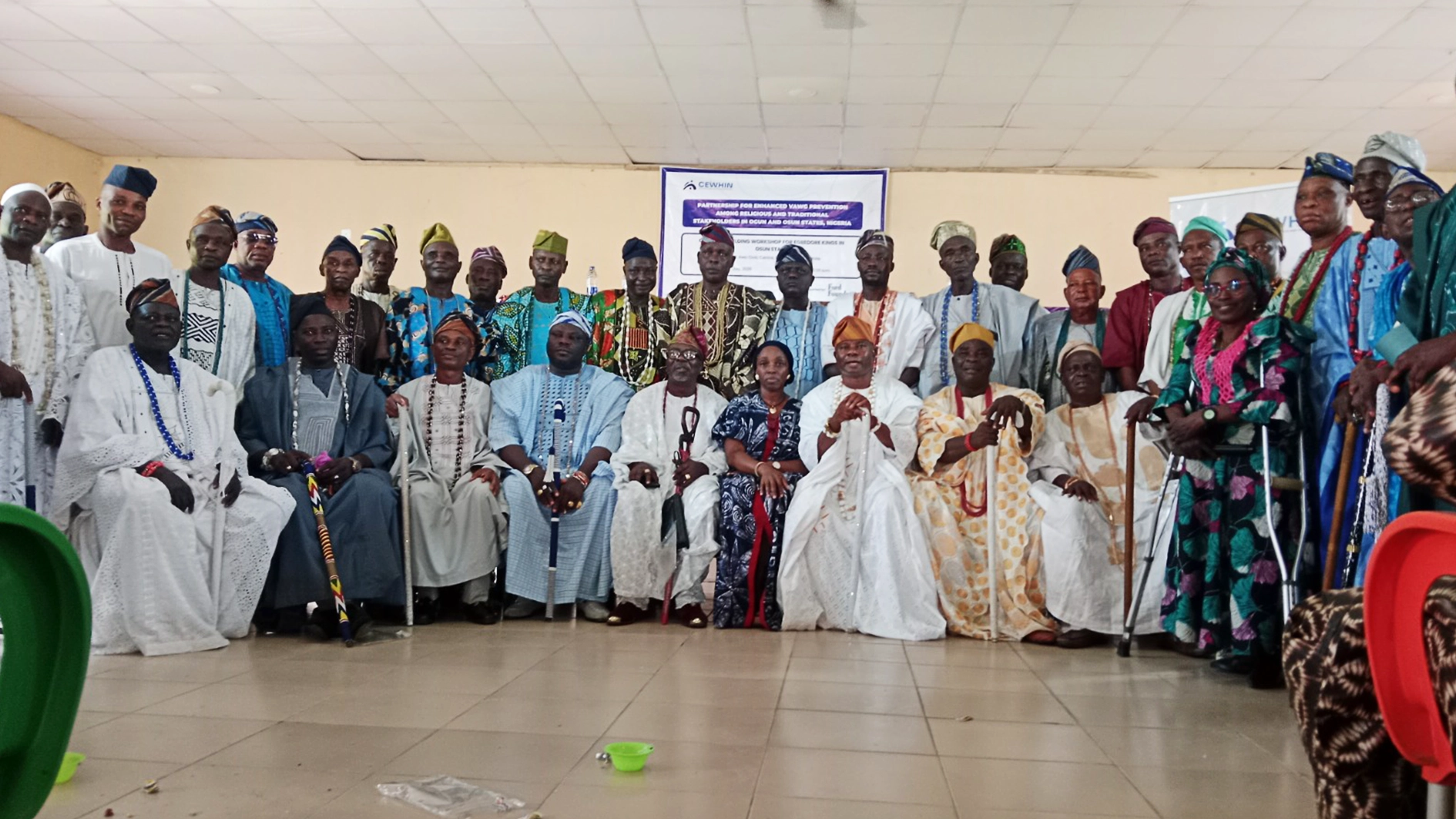
Associate Christian and Islamic religious leaders in Osun State have expressed renewed vigour to prevent sexual and gender-based violence against women and girls by feeding their congregations with faith-based teachings.
The faith teachers made this commitment at a capacity-building session and a consultative forum for associate Christian and Islamic religious leaders in Osun State under the Ford PVP (Partnership for Violence Prevention) Project.
The workshop was organised by the Centre for Women’s Health and Information (CEWHIN) with support from Ford Foundation.
The activity followed earlier engagements with religious and traditional leaders in Ogun and Osun States by CEWHIN, where stakeholders identified harmful social norms that enable violence against women and girls and co-developed community-based prevention mechanisms.
The session introduced participants to practical knowledge products developed through the project, including study guides on violence prevention and a code of conduct for religious leaders on gender-based violence prevention. It also deepened participants’ understanding of the dynamics of violence and the role of faith-based interpretation in promoting safety, dignity, and justice for women and girls.
The session, held in Osogbo, capital of Osun State, helped faith leaders understand violence against women and girls, including its root causes and its impact on individuals, families, and communities. Participants discussed how faith teachings can promote dignity, justice, compassion, and respect while challenging harmful beliefs and practices that enable violence.

They also reviewed practical resources, including faith-based study guides and a Code of Conduct for Religious Leaders, to strengthen prevention efforts and guide appropriate responses to gender-based violence.
Through group discussions and shared learning, participants identified practical ways to use their platforms to raise awareness, support survivors, promote healthy relationships, and build safer communities.
Atinuke Odukoya, the Executive Director of CEWHIN, said associates of religious leaders are critical to prevention of violence against women and girls, having discovered increased cases of SGBV in the state.
“We have been having increased reportage of issues of sexual and gender based violence, particularly violence against women and girls. And so, we are looking at prevention. How do we prevent these occurrences. We have talked about response, we have talked about protection over the years and we are looking at how to prevent a number of these things because they are preventable. You will find out that the root causes of these things are within our social norms, our cultural beliefs and practices.
So, we realised that within the Nigerian society, people are very religious, respect their religious leaders a lot and what is taught within the religious setting has a way of shaping and forming the attitudes, behaviour and what is acceptable to people within their communities,” Odukoya said.
She expressed belief that within the religious tenets, whether it is Christianity or Islam, “it is very clear that violence of any form is not acceptable and what we are trying to do is to get them (faith leaders’ associates) to use the scriptures to prevent issues of Sexual and Gender-Based Violence, first of all the religious settings and the wider community.”
“As you are teaching, whether in your children’s church, ensure you’re pushing for prevention of these violence. Also, using the Quran, what does the hadiths say? We have study guides, we have previously engaged with them in consultative sessions, townhall meetings and pulled out the code of conducts as far as this gender based violence is concerned,” Odukoya noted.
In her remarks, Faith Isiramen, Senior Programme Officer of CEWHIN, explained that the capacity building training for Christian and Islamic religion leaders included Sunday School teachers, Children Ministry teachers, choir coordinators and all those who support in different parts of the Church and Mosque activities.
She said, “From our findings from consultative fora we have had, we found that if we really want this issue of gender based violence to be prevented, we have to ensure that everyone is speaking the same language.
We have been training the leaders but we don’t know if they are stepping down to people working with them and their church/mosque members. So, for us to have a grounded community, we felt it is necessary for us to bring those assisting religious leaders together and train them on prevention.
Speaking, Rev. Adedapo Adedayo, a cleric from Methodist Church Nigeria, Osogbo, called for urgent need for stakeholders to take collaborative step to stem the tide of SGBV. He promised to step the training down through marriage counseling for intending couples, saying, “once we are able to catch them young from that level, it will be easier for us to tackle sexual and gender-based violence in our society.”
Also Imam Abdulsalam Akinwunmi, Special Assistant to the Grand Imam of Osun State, declared that violence against women and girls is rampant especially in the Islamic religion and vowed to tame it.
“I want to be frank, violence against women and girls, especially in the Islamic fold is so rampant. And we as religious leaders are doing everything to curb it. Allah forbids all sorts of violence against women and girl child. Everybody should go and enlighten their followers,” he said.
In another separate activity held in Awo community in the state, CEWHIN, with support from the Ford Foundation, organised a capacity-building workshop for the Council of Kings in Egbedore Local Government Area of Osun.
The engagement gave traditional leaders a platform to discuss harmful cultural norms and practices identified in the state that affect the safety, dignity, and wellbeing of women and girls.
Through open discussions, the leaders examined practices that contribute to violence and discrimination. They also reviewed and adopted a Code of Conduct that outlines values that uphold the rights and dignity of women and girls and explored practical ways to use their influence to challenge harmful social norms and encourage positive behaviour.
They reaffirmed their commitment to speak out against harmful practices, lead community-level prevention efforts, and promote norms that protect women and girls from violence.
In his remarks, Oba Abdulrazak Ajibade, the Alawo of Awo land, the paramount ruler, Egbedore Local Government Area of Osun State, said rising SGBV could be traced to indiscipline. “Indiscipline is the main cause. There is no serious discipline in the school system. There is no religious studies again.
We need to start to do the right thing. All what we are doing is community engagement. We talk to the male gender who in most cases violate our women and girls. We also use our traditional will to prevent this violence. If we are able to trace the root causes and work towards it, all these problems will end,” the monarch stated.
For the Oluwoye of Iwoye Land, Oba Adekoyi Oyebanji, “Our girls and women must be protected, there must be a strong legislation, there must be positive culture, we shouldn’t embrace retrogressive culture. Any culture that infringes on the liberty and rights of girls and women should be discarded.”
One of the resource persons, Dr Eni-Ayeni Oluropo, a Board of Director at Community Advancement Initiative for Self-Reliance, urged the traditional rulers to be more proactive in preventing sexual and gender-based violence in their domains. “They stand at advantage position, even when violence happens, the first point of calls are the traditional rulers, so, we expect that they step this capacity building training down to their chiefs and other community leaders.”

