 Follow Us on Google News
 Follow Us on Google Discover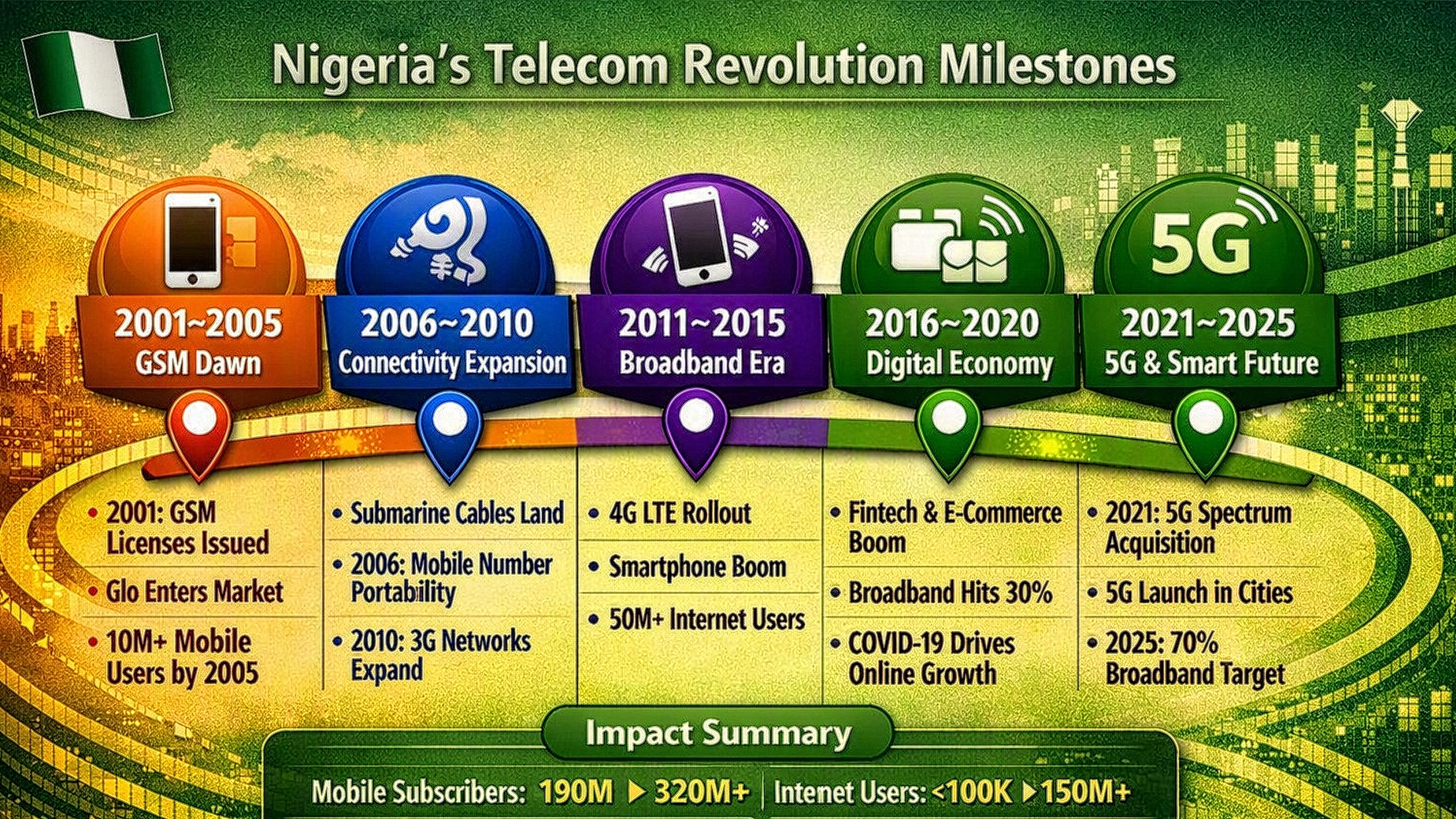
Over two decades ago, the first GSM beep brought loved ones closer and gave millions of Nigerians a voice. That single spark didn’t just build an industry; it unlocked human potential across the country. Today, GSM@25 is not about counting towers; it is about empowering people, ADEYEMI ADEPETUN reports
Twenty-five years ago, Nigerians queued in droves to buy subscriber identification module (SIM) cards that cost as much as N30, 000 each. Owning a mobile phone was a status symbol, and making a call felt like a luxury. Fast forward to today, mobile phones are not just communication tools; they are lifelines, wallets, classrooms and marketplaces.
The GSM revolution has been one of Nigeria’s most profound transformations since independence. It democratised access to communication, collapsed distances and opened doors to new industries. At 25, the sector is both a success story and a work in progress.
From scarcity to saturation
WHEN GSM licences were issued in 2001 under President Olusegun Obasanjo’s administration, and licensees paid about $285 million, Nigeria had fewer than half a million fixed telephone lines, controlled by defunct Nigerian Telecommunications Limited (NITEL).
Within four years, under the supervision of the Dr Ernest Ndukwe-led Nigerian Communications Commission (NCC), mobile subscriptions had crossed 20 million. By 2010, the figure had soared past 80 million. And today, Nigeria boasts of over 320 million connected lines, of which 189 million were active as of May.
Today, families stay connected across cities and villages. Businesses thrive with instant communication. Politics and governance shifted, as leaders could no longer ignore the torrents of public opinion. Mobile phones have become the great equaliser, bridging class divides and giving voice to millions.

The economic engine
TELECOMMUNICATIONS now contributes more than 12 per cent to Nigeria’s GDP. The sector, at over $76 billion, has created millions of jobs, from engineers and customer service agents to roadside recharge card vendors and mobile money agents.
Players, including MTN, Airtel, Globacom, 9mobile, MainOne, Spectranet, IHS, ipNX, ntel, ATC, Mobitel and Broadbased Communications have shaped the sector significantly.
The telecom sector has also catalysed other industries: fintech, e-commerce, entertainment, and logistics, all of which ride on the backbone of GSM. Without mobile connectivity, Nigeria’s fintech boom, valued at billions of dollars, would not exist.
Today, technologies including 4G (54.30 per cent); 2G (36.12 per cent); 5G (4.49 per cent) and fading 3G (5.10 per cent) have enabled data consumption to over 15 million terabytes in the last 17 months in the country.
Nigeria currently has over 145,141 telecom base stations across 2G, 3G, 4G, and 5G networks, and has deployed 101,000km of fibre to service the growing population.
The pain points
BENEATH the success lies a set of stubborn challenges.
Today, there is patchy infrastructure. Rural communities remain underserved, with weak signals and poor broadband. An estimated 21 million Nigerians across 4,834 communities, mostly in rural areas, lack access to basic mobile connectivity. The Minister of Communications, Innovation and Digital Economy, Bosun Tijani, stated this in February 2025.
In April 2025, the Universal Service Provision Fund (USPF) reported that in 2013, the number of people living in unserved and underserved areas was 36.8 million and fell to 23 million by 2024.
Secretary of USPF, Yomi Arowosafe, said the 23 million unserved/underserved people are housed in over 3000 communities, predominantly in rural areas and still lack basic mobile connectivity.
Amid the gaps, operators spend heavily on diesel to power base stations, while multiple taxes erode margins.
Service quality has not been stable, even after 25 years. Call drops, slow Internet, and congestion frustrate consumers. The sector battles overlapping rules and inconsistent policies, which discourage investment.
The sector is hugely under threat from hackers. Operators continued to battle SIM fraud and cybercrime, which undermine trust in digital services.
These issues must be tackled if GSM is to power Nigeria’s next phase of growth.
5G, broadband and digital inclusion
Nigeria’s 5G rollout began in 2022, but adoption is still modest. NCC statistics put penetration at 4.49 per cent. The promise of 5G goes beyond faster downloads; it’s about enabling smart cities, telemedicine, autonomous vehicles, and advanced manufacturing. For Nigeria, 5G could be the backbone of a truly digital economy.
The National Broadband Plan, 2020-2025, failed to hit 70 per cent penetration in 2025. As of May 2026, some 121 million Nigerians are enjoying the service, whose penetration is 56.11 per cent.
Scaling this figure, surpassing 70 per cent, will require harmonised right-of-way charges, incentives for fibre deployment, and partnerships to reach rural areas. Analysts submitted that broadband is no longer a luxury; it is the oxygen of modern economies.
Further, smartphones remain out of reach for many low-income Nigerians. Affordable devices, community Internet hubs, and digital literacy programmes are essential to ensure no one is left behind.
Local innovation needs attention. Nigeria must move from being a consumer of imported technology to a producer of local solutions. Encouraging indigenous software, hardware assembly, and homegrown platforms will create jobs and reduce dependency.
Opportunities abound
THERE is no gainsaying the fact that opportunities are immense in the telecom sector, but seizing them remains a huge challenge.
For instance, there is a need for fintech deepening. Mobile penetration will drive cashless transactions further into rural Nigeria. It is also a fact that telecoms can enable efficient delivery of public services, from health records to digital IDs. It can enable Agritech. Farmers can access market prices, weather forecasts, and financial services via mobile platforms.
Already, Nigeria’s young population is building startups in entertainment, logistics, and education. With its scale, Nigeria can position itself as West Africa’s digital hub.
Stakeholders’ equation
ANALYSTS have submitted that government must provide clear, consistent policies and invest in enabling infrastructure.
Chief Financial Officer, MTN, Modupe Kadri, during an interaction with journalists, said MTN and indeed, the telecom sector is not insulated from challenges confronting Nigeria.
As such, Kadri called on regulators and policymakers to foster a more enabling operating environment, devoid of perennial challenges, including insecurity, vandalism, fibre cuts, multiple taxation, costly Right of Way levies, among others.
While it is also important that operators must prioritise customer experience, sustainability, and next-generation networks, investors would need confidence in Nigeria’s regulatory environment to commit long-term capital.
By demanding better services and embracing digital tools, customers too will push the sector forward.
Revolution as a symbol of possibility
THE first 25 years of GSM were about connectivity. The next 25, according to Telecom Expert and former NITEL staff, Kehinde Aluko, must be about empowerment. He said Nigeria’s telecom sector has proven its resilience and transformative power. “Now, the challenge is to evolve from voice and data into a platform for innovation, inclusion, and prosperity.”
To MTN’s Kadiri, “I think it’s very important to point out that for us at MTN, when we talk about 25 years and maybe the future, we don’t see it from the MTN perspective. We are driven by the desires and ambitions of our customers. What that means is that because, as we’ve already pointed out, Nigerians are very ambitious people, very tech-savvy people, always seeking the best, what we have to do is ensure that we enable the ecosystem that will allow them to have the best expressions of themselves, either as individuals or businesses.
“So, this is one of the areas that for us is critical. And so now when you have the advent of AI, it’s important for us as MTN that we look inward to understand how we can actually leverage this platform to drive efficiencies in our operations, in our understanding of the customer, in our ability to target, segment, and provide the right solutions, and understand the types of behaviors that are required to drive initiatives such as our device strategy for the future.”
Indeed, the story of GSM in Nigeria is ultimately the story of possibility, how technology can reshape a nation’s destiny. As Nigeria prepares for new growth, the sector must embrace bold investments, visionary policies, and inclusive strategies.
GSM@25 is not just a celebration of the past; it is a call to action for the future. The revolution that began with a SIM card in 2001 must now mature into a digital ecosystem that powers Nigeria’s ambitions in the 21st century.

