 Follow Us on Google News


 Follow Us on Google Discover
For a generation of creatives navigating the complex currents of a globalised world, identity is not a fixed point but a fluid narrative woven from multiple threads of culture, memory, and experience.
Angela Akporoh, the founder and creative director of the contemporary fashion brand Nojolie, is channelling this very narrative into her work. She translates the intimate, and often fragmented, stories of migration and belonging into striking garments that are as much about personal history as they are about modern design.
Born in Newham, London, to Delta and Yoruba parents, and raised in Surulere, Lagos, Akporoh’s life has been a literal journey between continents, an experience that forms the very fabric of her brand. As she reflects on the duality that defines her perspective, she describes being shaped by the distance between two places that both became part of her identity.
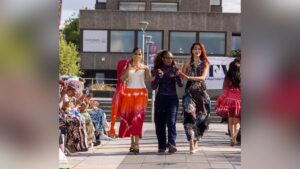
Akporoh’s path to fashion was paved with the kind of hands-on, practical training that cannot be learned in a classroom alone. Her journey began with a menswear apprenticeship in Ajah, Lagos, where she learned the discipline and precision of garment construction, often remaking pieces from scratch to perfect her skill.
Through observation, repeated correction of mistakes, and a commitment to understanding each process, she developed the patience and responsibility that would become foundational to her practice. This was followed by a stint as a store manager for the brand Design for Love in Ikoyi, before she formally studied Industrial Fashion Design at Yaba College of Technology.

This foundation in technical making, combined with her lived experience of moving between Nigeria and the UK, has given her a unique perspective. She is currently expanding her knowledge by studying Fashion and Fashion Business at the University of Hertfordshire, bridging the gap between master craftsperson and strategic brand builder.
This convergence of technical skill and personal narrative is most powerfully realised in Nojolie’s recent collections, such as the pivotal Void Paths AW26.
The collection, which marks a new chapter for the brand, sees Akporoh moving beyond simply creating garments inspired by her background. Instead, she embeds the story directly into the textiles themselves. Working with materials like 100% linen and cotton, she employs a batik-inspired, hand-dyeing process to create pieces that are not just worn but felt.
At the heart of this collection is a powerful visual motif: the white line, which represents the routes of migration, borders crossed, and the emotional maps people carry with them. They are not literal maps but emotional ones, she explains.
In a deeply personal touch, the batik stamps used in the collection were inspired by the cancellation vignettes on her own passport, transforming a bureaucratic document into a site of profound storytelling and making the garment a literal archive of her journey.
Akporoh’s work is also a deliberate response to a gap she identified in the fashion industry. Rather than treating African craftsmanship and the diaspora experience as mere visual references or cultural signifiers, Nojolie uses them as a genuine source of design language.
The aim is not to reproduce traditional clothing but to translate elements of African craft—like the Akwocha textile from her Urhobo heritage—through contemporary silhouettes and styling. Her approach creates pieces that are globally resonant, speaking to universal experiences of family, memory, and the quest for belonging, while remaining rooted in a specific cultural identity.
Her philosophy is simple yet profound: she learned that the material must support the story rather than define it, a guiding principle that ensures every garment carries its weight in meaning.
Building a brand that bridges cultures, however, is not without its challenges. Akporoh candidly speaks of the hustle behind the glamour, balancing her creative work with education and a part-time job, managing everything from sourcing and production to marketing and social media.
The financial reality of an independent designer, she notes, requires immense patience and a focus on building a solid foundation over expecting immediate returns. Yet, she remains unwavering in her vision, building Nojolie sustainably and understanding what works before scaling too quickly. In five years, she hopes Nojolie will be recognised not just for beautiful garments but for its meaningful diasporic storytelling.
She wants people to understand that their experiences matter and that everyone has a story worth telling, even when it does not initially seem extraordinary. More than that, she hopes her journey encourages other creatives to begin their work, to trust their own narratives, and to create first, before waiting for perfection.
For Angela Akporoh, Nojolie is more than a fashion label; it is a way of giving form to experiences that might otherwise remain intangible. By bringing together memory, heritage and contemporary design, she is creating garments that carry traces of where people come from while leaving room for where they are going.

