 Follow Us on Google News


 Follow Us on Google Discover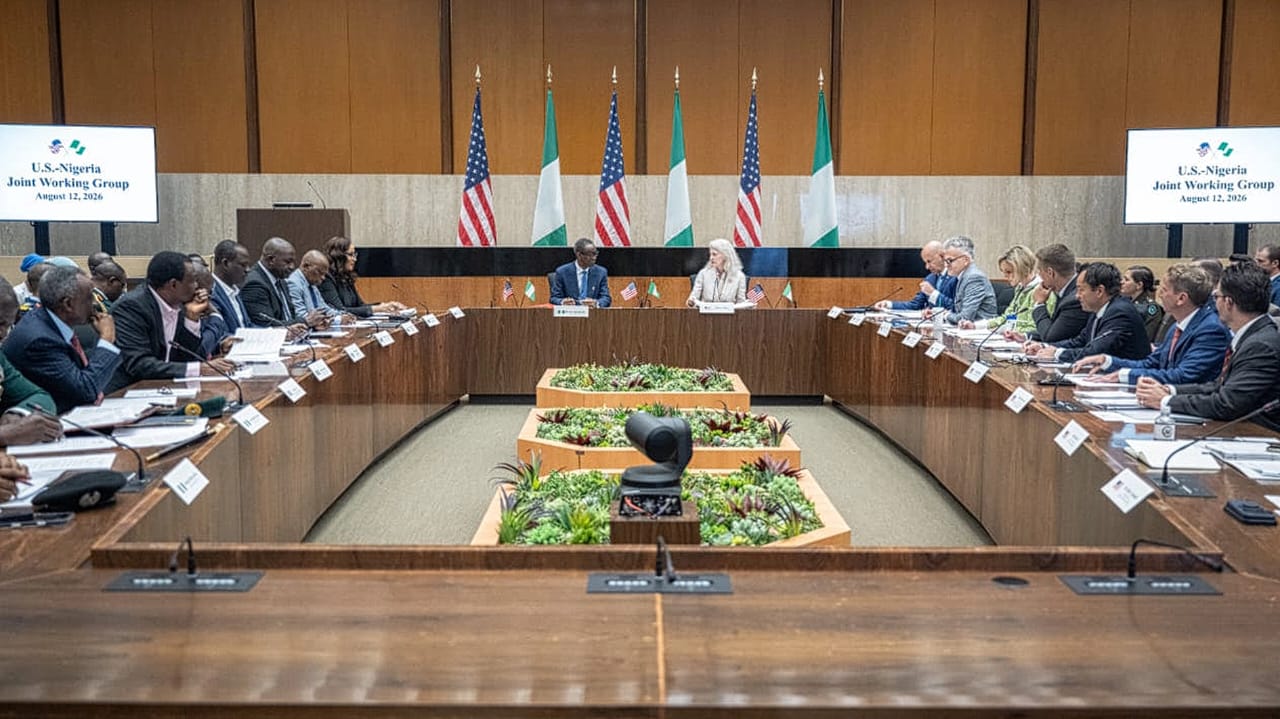
The United States and Nigeria have deepened discussions on security cooperation, with Washington reiterating its commitment to protecting Christian communities facing violence in Nigeria and calling for continued progress on measures agreed by both countries.
The latest engagement took place in Washington, D.C., where United States Under Secretary of State for Political Affairs Allison M. Hooker hosted Nigeria’s National Security Adviser, Mallam Nuhu Ribadu, and a Nigerian delegation for the second U.S.–Nigeria Joint Working Group on August 12, 2026.
Allison M. Hooker disclosed the development in a post on X, explaining that the meeting built on discussions from the first session of the Joint Working Group, held in Abuja on January 22, 2026.
According to her, the United States remains committed to safeguarding Christian communities and expects continued progress on measures to protect Christians facing violence in Nigeria.
“Last week, I welcomed National Security Adviser Ribadu to Washington, D.C. for the second U.S.–Nigeria Joint Working Group. The United States remains steadfastly committed to safeguarding Christian communities. Throughout our discussions, we identified concrete steps to protect Christians facing violence in Nigeria, which we expect to see continued progress on. The United States will hold all countries accountable for ensuring that Christians can live out their faith free of threat or persecution,” Hooker wrote.
The discussions focused on three priority areas: protecting Christian communities in Nigeria’s Middle Belt, strengthening judicial and security institutions to ensure perpetrators of violence are held accountable, and deepening military-to-military cooperation between both countries.

The two sides also reviewed Nigeria’s progress in returning internally displaced persons (IDPs) to their ancestral homes, counterterrorism prosecutions and efforts to combat the financing of terrorism.
However, the meeting also highlighted areas where further work is required.
The United States and Nigerian delegations considered continuing challenges, including reports of civilian fatalities and gaps in transparency surrounding humanitarian expenditure.
Military-to-military discussions were also scheduled to continue at the Pentagon as part of the broader security engagement.
Washington also acknowledged measures Nigeria has taken so far in its fight against terrorism. These include the prosecution of hundreds of Boko Haram and Islamic State-West Africa (ISIS-WA) suspects, the expansion of judicial capacity, as well as the recruitment and training of an additional 50,000 police officers.
Despite those efforts, both sides acknowledged that more work remains, particularly in supporting internally displaced persons and facilitating their return to their ancestral communities.
The Joint Working Group further examined continued cooperation on countering terrorism financing, biometric information sharing to support accountability measures and law enforcement capacity building.
Such capacity-building efforts will continue through the Department of State’s Bureau of International Narcotics and Law Enforcement Affairs (INL) and Bureau of Counterterrorism (CT).
Beyond the Joint Working Group, Hooker separately met with Ribadu to advance other bilateral priorities and reaffirm Washington’s commitment to working with Nigeria to protect Christian communities and deepen joint security cooperation.
The Washington engagement marks another step in the security partnership between both countries, with discussions focusing on practical measures around counterterrorism, accountability, displacement and the protection of vulnerable communities.
For Nigeria, the engagement comes as the government continues to confront terrorism and insecurity, while the United States has signalled that protecting Christian communities, strengthening institutions and improving security cooperation will remain key areas of its engagement with the country.

