 Follow Us on Google News


 Follow Us on Google Discover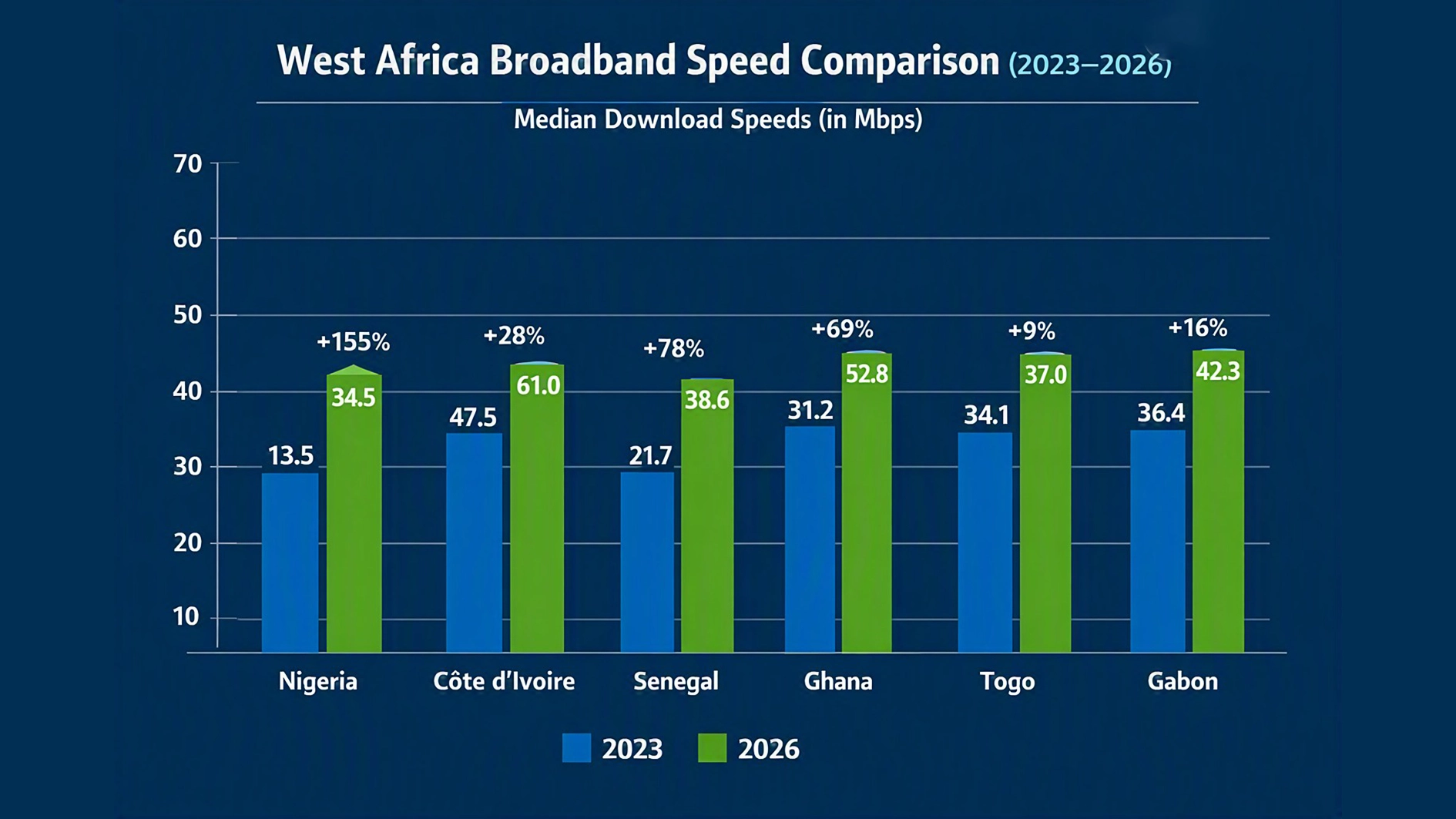
Fibre deployment in West Africa is accelerating, reshaping the fixed broadband market and raising users’ expectations for speed. While Côte d’Ivoire, Ghana, Nigeria and Senegal have led the way in adoption, Togo and Gabon are emerging as rapid-growth fibre markets thanks to favourable regulatory policies and operators’ investments.
According to Ookla Speedtest Insight, titled: ‘The Uneven Path to High-Speed Connectivity in West Africa’, authored by Karim Yaici, it examined how fibre development translates into improved network quality across the region and identifies where the next opportunities for market development lie.
Already, the Nigerian Communications Commission (NCC) announced some weeks ago that Fibre-to-the-Home (FTTH) subscribers had tripled in just 18 months, overtaking fixed wireless access (FWA) for the first time; it marked a turning point in Nigeria’s digital journey. From modest beginnings, the country is now leading a broadband revolution that is reshaping how citizens, businesses, and institutions connect to the world.
According to NCC EVC, Dr Aminu Maida, the country is witnessing a structural shift in Nigeria’s connectivity landscape, noting that fibre is no longer a luxury; ‘it’s becoming the backbone of the country’s digital economy.’
Nigeria has deployed 101,000km fibre already and is on the verge of deploying another 90, 000km fibre in phases, championed by the Federal Ministry of Communications, Innovation and Digital Economy.
The Ookla report observed that Nigeria’s broadband performance tells a story of steady, reliable progress. Median download speeds rose from 13.50Mbps in 2023 to 34.47Mbps in H1 2026, while upload speeds nearly matched downloads, climbing from 11Mbps to 25.17 Mbps. Latency improved from 47.9 ms to 35.8 ms, making cloud services, video conferencing, and gaming far more responsive.
Unlike some of its neighbours, Nigeria’s growth has been quarter-on-quarter, consistent, and broad-based. Even underserved households saw improvements, with P10 speeds (the slowest 10 per cent) rising from 2.24 Mbps to 6.04 Mbps.
“The fact that lower-tier users are seeing faster speeds is critical,” noted Lagos-based telecom analyst Chinedu Okafor.
Cote d’Ivoire boasted the region’s fastest speeds, with median download reaching 60.99Mbps in H1 2026. Yet growth has slowed at the high end, with P90 speeds rising only modestly.
“Fibre has uplifted underserved users here, but the challenge is unlocking its full potential,” explained ARTCI’s Director of Digital Transition.
Nigeria’s trajectory contrasts sharply: while Côte d’Ivoire shines in peak performance, Nigeria’s strength lies in consistency and inclusivity.
Ookla noted that Senegal’s fibre market is the most mature in Francophone West Africa, with coverage reaching up to 40 per cent of premises. The big leap came in February 2026, when Sonatel simplified tariffs and boosted speeds. Median download speeds rose 78 per cent to 38.55 Mbps, with both P10 and P90 speeds doubling. Latency fell by 16.3 per cent.
“We wanted to democratise fibre access. By lowering prices and simplifying packages, we ensured that more households could benefit,” said Sonatel CEO, Sékou Diop.
Ookla, however, noted that Nigeria’s growth has been more gradual and sustained, driven by regulatory foresight rather than sudden operator reforms.
Ghana’s broadband sector saw dramatic improvements in Q3 2025, when the Meta-backed 2Africa subsea cable landed in Accra. Upload speeds surged from 22.60Mbps to 49.16 Mbps, and latency dropped from 34.6 ms to 12.6 ms.
Yet, fibre penetration remains below one per cent of the population, concentrated in urban areas.
“The subsea cable gave us capacity, but the challenge is distribution,” admitted a senior official at Ghana’s National Communications Authority. “We need to extend fibre beyond Accra and Kumasi.”

Nigeria’s progress, by contrast, is driven by domestic rollout and adoption, not external infrastructure.
Togo’s regulator ARCEP intervened aggressively, slashing wholesale fibre prices by 60 per cent and revising tariffs. Median download speeds rose to 34.49 Mbps in early 2025, but then plateaued.
“We succeeded in raising the minimum speed tiers,” said ARCEP Chair, Kossi Agbeko.
“But sustaining growth at the high end remains a challenge,” he added.
Based on Ookla findings, Nigeria’s fibre adoption, supported by NCC’s open-access push, has avoided this plateau, delivering steady improvements across all tiers.
Gabon lagged, with median download speeds rising just 15.9 per cent to 42.25 Mbps between 2023 and 2026. Latency remains the poorest in the region at 179.8 ms, and entry-level packages cost more than $40 per month.
“Affordability is our biggest barrier,” admitted a Moov Africa Gabon Telecom executive.
Nigeria’s affordability challenge is real too, but its regulatory framework, encouraging infrastructure sharing and cutting right-of-way charges, has kept costs more manageable.
The report noted that Nigeria’s broadband revolution stands out for its scale, consistency, and foresight. While Côte d’Ivoire and Ghana boasted higher peak speeds, their progress is uneven. Senegal’s leap was operator-driven, Togo’s gains plateaued and Gabon remained sluggish.
“Nigeria is setting the pace for West Africa. It is not just about speed; it is about sustainability, inclusivity, and regulatory clarity,” said telecom consultant Fatima Bello.
Nigeria’s challenge now is to extend fibre beyond urban centres, ensure affordability and modernise customer equipment to unlock gigabit speeds. If successful, the country could become West Africa’s digital hub, enabling e-government, telemedicine, online education, and business innovation at scale.
“Fibre is the foundation of Nigeria’s digital future. Our goal is simple: every Nigerian household should have access to world-class broadband,” declared NCC Maida.
Ookla noted that Nigeria’s broadband story is one of resilience and foresight. From modest wireless beginnings to a fibre-led future, the country has shown that with the right mix of policy and investment, digital infrastructure can evolve rapidly.
The report noted that the numbers speak for themselves, noting a 2.55x increase in download speeds, a threefold rise in fibre subscribers, and latency improvements that make advanced digital services possible.
Nigeria is not just catching up; it is setting the pace. And as fibre continues to spread, the promise of a truly connected Nigeria is becoming a reality.

