 Follow Us on Google News


 Follow Us on Google Discover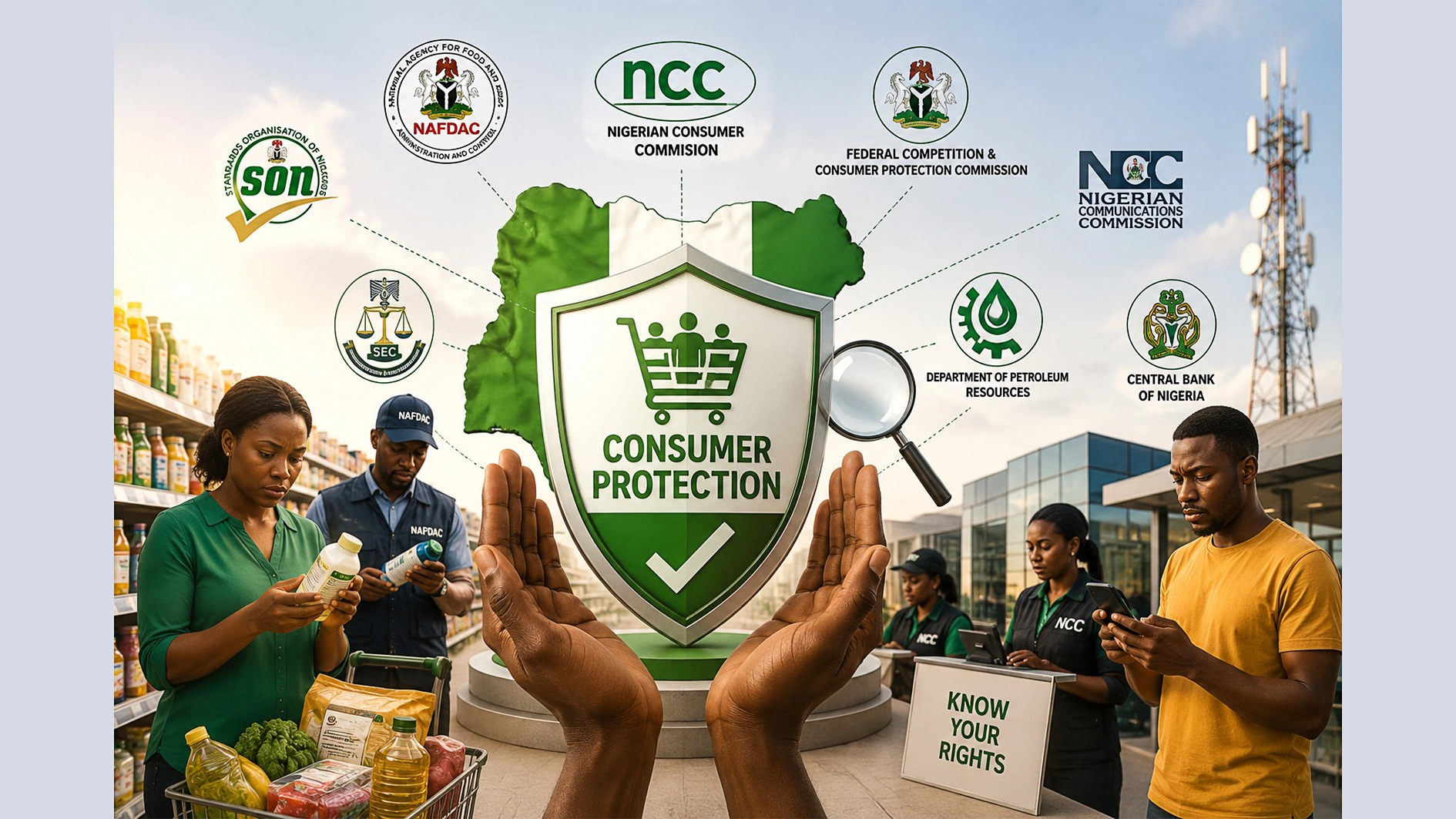
By Oluwafemi Adekoya
Every day, the Internet is awash with videos and other information about consumer complaints. Many of these concerns involve malpractice by unscrupulous market traders seeking to maximise profit through dangerous food-preservation methods or by circulating fake goods in open markets. We have seen the National Agency for Food and Drug Administration and Control (NAFDAC) alert us to counterfeit medicines or condemn certain actions.
However, what is at stake requires far more than warnings; it requires serious sanctions. The overarching consumer regulator — the Federal Competition and Consumer Protection Commission (FCCPC) — is equally overwhelmed, dealing with complaints about the terrible services offered to consumers by ‘big, untouchable businesses.’ It’s evident that while the Nigerian consumer is protected by law, in practice the consumer is left exposed by weak enforcement, fragmented regulation, and a culture that prioritises revenue over safety. From fake drugs and adulterated foods to data breaches and indifferent hospital administrators, the average Nigerian faces daily risks that would be unacceptable in most jurisdictions.
Every day, millions of Nigerians unknowingly consume food laced with industrial chemicals, detergents, and banned pesticides—a fast-rising public health crisis driven by profit maximisation and regulatory failure. From palm oil dyed with carcinogenic Sudan IV to fufu fermented with detergent, the adulteration of staple foods has become endemic, with devastating consequences for kidney and liver health across the country.
Recently, the Federal Competition and Consumer Protection Commission (FCCPC) repeatedly warned of a surge in unsafe products, from fake cosmetics to adulterated foods and medicines. Despite inaugurating joint market monitoring task forces, the commission admits that harmful items continue to circulate with impunity. The consequences are measurable: poisoning, treatment failure, and preventable deaths—especially among the poor who cannot afford to verify authenticity. The truth is that the consumer protection architecture is failing—not because it lacks laws, but because it lacks coordination and consequences.
Yesterday, the FCCPC stated that its three-month investigation uncovered possible price manipulation and anti-competitive practices among major cement manufacturers in Nigeria. The Guardian had recently published most of its observations in an exclusive report a month ago. While the FCCPC claimed to have issued formal summonses and investigation notices to key industry players, demanding data on production levels, pricing methods, and capacity usage to check if current high prices are fair, Nigerians await the next line of action if it finds the operators culpable. FCCPC Chief Executive Tunji Bello stated the goal is to protect genuine market competition, not to stop companies from making lawful profits. What hope is there for the consumer in a market driven by oligopoly?

Patient safety in the healthcare sector is perhaps the most sensitive consumer domain that illustrates systemic failure. A 2025 study found that nearly 60 per cent of health facilities in some regions lack reliable electricity, compromising basic care. More broadly, poor regulation has enabled the proliferation of quacks and substandard practices, with patients having little recourse when harmed.
Although a 2026 Federal High Court ruling affirmed the FCCPC’s power to investigate patient complaints and treat healthcare as a consumer service, this precedent is yet to translate into routine protection.
Presently, award-winning author Chimamanda Ngozi Adichie is locked in a public and legal dispute with Euracare Multispecialist Hospital following the tragic death of her 21-month-old son, Nkanu, on January 7, 2026. While Adichie might have the voice and financial capacity to seek justice, not many Nigerians have the luxury and have been forced to resign to fate and faith.
Yusuph Olaniyonu, who recently celebrated his 60th birthday, had recounted how he went from seeking an elective prostate surgery, originally meant to last a few minutes, to end up going in and out of the surgical theatre nine times. He had six major operations and three minor procedures following a major mistake from the first surgery, which culminated in several other medical conditions and nearly cost him his life. Olaniyonu, who was eventually flown out of the country, returned with a successful surgery, and he’s alive to tell the story. Not many enjoyed the same fate.
The Medical and Dental Council of Nigeria (MDCN) serves as the primary statutory regulatory agency tasked with setting professional standards, investigating medical negligence, and disciplining erring medical and dental practitioners in Nigeria. One is left to wonder how many sanctions it has imposed on erring medical personnel. Does it name the culprits and publish these sanctions to protect Nigerians from the dangers of unprofessional personnel bearing the scalpel or those in diagnostic centres? The WHO estimates that about 16 per cent of preventable patient harm is caused by diagnostic errors, with almost all adults likely to experience such harm in their lifetime. How much of this can be prevented in Nigeria?
Beyond food and drugs, data protection is another frontier of neglect. Although the Nigeria Data Protection Act (NDPA) 2023 established the Nigeria Data Protection Commission (NDPC) with powers to audit, investigate, and fine violators, enforcement remains sporadic. Many organisations still treat personal data as a free resource: selling phone numbers, sharing medical records without consent, and exposing customers to fraud. Civil society organisations recently warned that Nigerians’ personal information remains vulnerable to abuse despite existing data protection laws. The CSOs argued that Nigeria developed one of Africa’s largest digital identity databases but failed to adequately protect the information it collects.
Citing reports bordering on the disclosure of voter registration information from the Independent National Electoral Commission (INEC) database and investigations that uncovered the online sale of sensitive identity records, including National Identification Numbers (NINs), for as little as N100, the CSOs, comprising Media Rights Agenda (MRA), Paradigm Initiative (PIN), Digital Rights Lawyers Initiative (DRLI), Accountability Lab Nigeria, PROMAD Foundation, DigiCivic Initiative and others, decried how NDPC safeguards have failed to translate into meaningful protection for citizens. Though the NDPC’s compliance audits probed these incidents, without publicised sanctions and a culture of accountability, the law remains a paper tiger.
Nigeria does not lack agencies or laws; it appears to lack the will to protect its own under a fragmented consumer protection system. Multiple agencies overlap in mandate, leading to turf wars, duplication, and gaps. A fake drug may be NAFDAC’s concern, but if it harms a consumer, FCCPC also has a role; if personal data is breached in the process, NDPC is involved. Without a unified command structure, consumers are shuffled between bureaucracies while violators exploit the confusion.
In the United States, the Consumer Product Safety Commission (CPSC) operates with statutory independence, mandatory recall powers, and public databases of unsafe products. Crucially, it is funded by Congress, not fines, insulating it from revenue-driven conflicts. In the European Union, the General Data Protection Regulation (GDPR) empowers national authorities to levy fines up to four per cent of global turnover for data breaches, creating a strong deterrent. Evidence abounds of the GDPR holding big techs accountable. Nigeria’s NDPA mirrors some GDPR provisions but lacks comparable enforcement visibility.
From the above, there is a common denominator across climes: independence from revenue generation, transparent enforcement, strong penalties, and public accessibility. Nigeria can do better by decoupling regulation from revenue. Agencies should be funded through direct budgetary allocations, not fines. Penalties should go to a consumer compensation fund, not agency budgets.
Also, transparency should be mandatory, penalties strengthened, and a unified command for consumer safety adopted. Citizens should be empowered and enlightened about their rights. No citizen should complain about a product and be hounded by security agencies under the guise of harassing a business or abusing the Cybercrimes Act. We can do better as a nation.
Many Nigerians are suffering and dying from avoidable and treatable ailments. Until regulators are insulated from revenue pressures, penalties are meaningful, and citizens can easily report and track complaints, the Nigerian consumer will remain unprotected.

