 Follow Us on Google News


 Follow Us on Google Discover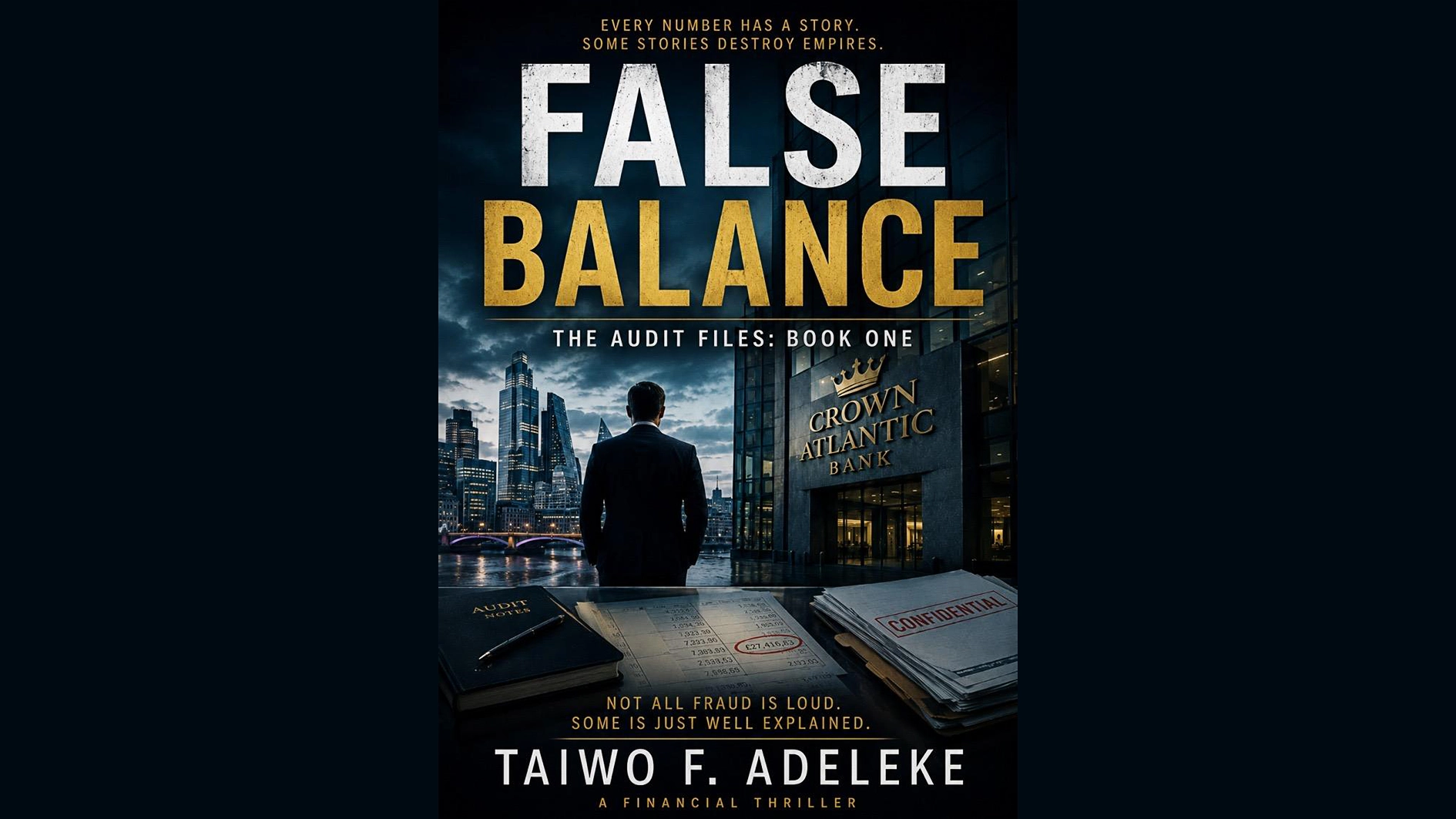
Corporate thrillers have long relied on financial scandal, conspiracy and fraud to generate suspense.
In False Balance, Taiwo F. Adeleke takes a more ambitious approach. Set within the disciplined world of internal audit and organisational decision making, her debut novel builds tension from evidence, institutional memory and professional judgment, demonstrating that the greatest organisational risks emerge not through dramatic wrongdoing but through ordinary decisions left unquestioned over time.
There are relatively few contemporary novels that treat the modern organisation as serious literary territory. While banks, boardrooms and regulatory institutions frequently appear in fiction, they often provide little more than the backdrop for stories of fraud, corruption or corporate intrigue. False Balance takes a different path. Rather than using finance as a setting for crime, Adeleke places governance at the centre of the narrative, exploring how institutional risk can emerge through ordinary decisions that gradually escape scrutiny. It is a confident premise that immediately distinguishes the novel within contemporary thriller fiction.
The story follows Daniel Cole, an experienced Internal Audit Manager assigned to what appears to be a routine review at Crown Atlantic Bank, a respected financial institution whose reputation rests on stability and public confidence. The investigation begins not with a dramatic scandal but with the unexplained disappearance of a single reconciliation transaction—an anomaly so minor it could easily have been dismissed as administrative error. Instead, it becomes the first indication that something more fundamental may be hidden beneath years of accepted practice.
From this modest beginning, False Balance expands beyond procedural investigation into a thoughtful examination of organisational memory, accountability and professional judgment. Daniel’s enquiry evolves from tracing a missing transaction to understanding how institutions preserve knowledge, interpret evidence and respond when long-held assumptions are challenged. The central mystery becomes less about exposing individual wrongdoing than about understanding how trusted organisations construct and occasionally misreadtheir own histories.
In doing so, Adeleke establishes a distinctive foundation for a novel whose ambitions extend well beyond the conventions of the corporate thriller.

One of False Balance’s most original qualities is its refusal to follow the conventions of the modern thriller. Instead of relying on powerful villains, elaborate conspiracies or escalating violence, Adeleke builds suspense through the gradual discovery that institutions themselves can become the source of uncertainty. The novel’s central conflict emerges not from a criminal mastermind but from accumulated decisions, fragmented responsibility and organisational habits left unquestioned over time.
This approach reshapes the investigation. Cole is neither a maverick detective nor an action hero; he succeeds through disciplined observation, professional scepticism and an unwavering commitment to evidence. His enquiry unfolds with the measured pace of internal audit, where documents, committee papers and historical records prove as revealing as witnesses or suspects, and organisational culture becomes the investigation’s most elusive adversary.
The result is a thriller that rewards careful reading rather than spectacle.
Adeleke demonstrates that institutional failures rarely begin with dramatic misconduct but with accepted practices and assumptions that gradually escape scrutiny. By locating suspense within governance itself, False Balance expands the possibilities of corporate fiction, showing that boardrooms, audit files and organisational memory can generate psychological tension as compelling as any conventional crime narrative.
The novel’s most original achievement is its treatment of Crown Atlantic Bank as a character in its own right. The institution possesses a history, memory and internal logic that shape the actions of everyone within it. As Daniel reconstructs forgotten decisions and fragmented records, it becomes clear that his investigation is directed as much at the organisation itself as at the individuals who inhabit it.
This emphasis creates a quieter emotional register than many thrillers, but it is central to the novel’s purpose. False Balance is ultimately less interested in individual psychology than in the psychology of institutions, giving the narrative a distinctive and intellectually satisfying perspective.
The real achievement of False Balance lies not in the mechanics of its investigation but in the questions it raises about how institutions think, remember and sometimes forget. The missing reconciliation that initiates Daniel Cole’s enquiry is merely the starting point for a broader exploration of organisational memory and the consequences of decisions whose original purpose has gradually been lost.
Adeleke writes with clarity, precision and restraint, allowing suspense to emerge through observation rather than spectacle. Her prose mirrors the professional world she depicts: measured, disciplined and quietly assured. Dialogue feels authentic, with conversations driven by analysis and competing interpretations rather than theatrical confrontation, reinforcing the credibility of both the characters and the institutional setting.

