 Follow Us on Google News
 Follow Us on Google Discover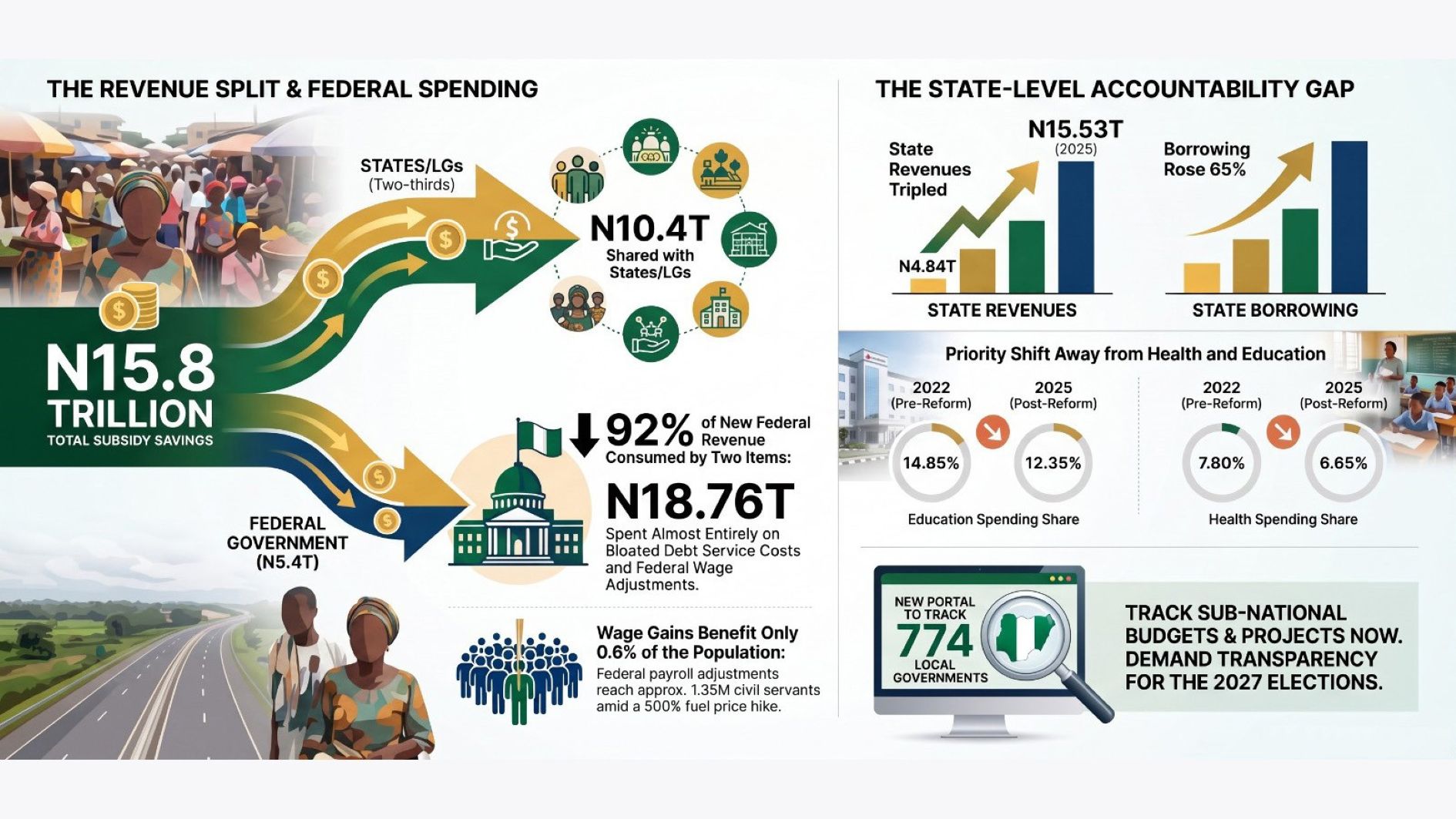
• 350% of FG’s share spent on wage adjustment, debt service cost increase
• Nigerians, civil society members demand dividend, accountability
• FG plans portal to track states, LGs’ allocations, projects
• Poverty remains unfinished business, says Oyedele
• BudgIT raises transparency questions about states’ spending
The long-suppressed confrontation between the government and Nigerians as well as between the Federal Government and sub-nationals over fuel subsidy removal savings is gradually finding an expression as the 2027 campaign imposes a burden on those saddled with its management.
As promised, the Minister of Finance and Coordinating Minister of the Economy, Taiwo Oyedele, yesterday, gave a breakdown of how the proceeds were disbursed among the three tiers of government at a media conference on the scorecard of Nigerian reforms from 2023 when the current administration assumed office.
He put the total incremental resources from subsidy savings from June 2023 and December 2025 at N15.8 trillion. From the figure, N5.4 trillion went to the Federal Government while N10.4 trillion or 66 per cent, was shared among states and local governments.
Besides subsidies, the Federal Government’s total incremental resources from subsidy savings, independent revenue and borrowings in the period were N20.4 trillion, out of which N9.39 trillion went into wage adjustments following the 2023 minimum wage resetting while N9.37 trillion was spent on bloated debt service cost. The two line items, hence, consumed N18.76 trillion or 92 per cent of the additional revenue. The expanded expenditure from the two items was almost 350 per cent of the subsidy ‘savings’ earned by the government.
But only a few Nigerians can relate to the adjusted wages. Different sources put the payroll size of MDAs paid from the treasury at between 1.2 and 1.5 million. At an average of 1.35 million, the federal civil servants who were paid with nearly 200 per cent of the Federal Government’s share of the subsidy savings were 0.6 per cent of the entire population whose living conditions have suffered deterioration as a result of a 500 per cent increase in fuel prices.
Earlier, Oyedele told Nigerians that the revenue windfall went into salary payment, student loan funding and debt service costs. The latest details suggest the Federal Government has records of where its savings went, though millions of Nigerians think its decision is remarkably different from what anyone could describe as a representation of the common good.
So, analysts who have been regurgitating their disbelief since yesterday, the minister merely explained how the money was shared and not its dividends, leaving much to be desired on the issue that has generated so much public uproar and suggesting the debate is far from over, especially with opposition politicians expected to make it a big campaign issue.
Oyedele’s presentation marked the beginning of President Bola Tinubu’s campaign programme, which is expected to be driven majorly by the heads of ministries, departments and agencies (MDAs). It has also pushed much of the burden of responsibility to the state governments, who had received about two-thirds of the money for themselves and on behalf of their local governments.
Apart from the citizens, the Federal Government may have also considered sub-nationals financially reckless and extremely unaccountable.
The government is planning a central transparency portal that would allow Nigerians to track allocations, budgets, development plans and audited accounts of the country’s 774 local government areas to give citizens greater access to information on how public funds are spent.
The proposed platform, Oyedele disclosed, comes as a BudgIT report showed that state revenues more than tripled between 2022 and 2025 while borrowing also increased despite a declining share of resources going into education and health.
During the general election campaign, governors who would be seeking re-election or on a ‘political roadshow’ with their successors would need to inform Nigerians how their share was spent.
The sharp increase in revenues accruing to Nigeria’s states and local governments since the removal of the petrol subsidy and foreign exchange reforms has renewed concerns over how effectively the additional resources are being deployed, with economists and civil society groups demanding greater transparency and accountability.
According to BudgIT’s Nigeria’s Economic Reforms report, aggregate revenue of the 36 states rose from N4.84 trillion in 2022 to N15.53 trillion in 2025, representing a 220.76 per cent increase.
The increase was driven largely by higher allocations from the Federation Account Allocation Committee (FAAC) following the removal of the petrol subsidy and the unification of the foreign exchange market.
States also increased their internally generated revenue from N1.57 trillion to N4.15 trillion during the period, leveraging expanded taxes.
However, the increase in resources has not been matched by a corresponding improvement in spending on key social sectors or fiscal discipline, the report found.
Education’s share of total spending declined from 14.85 per cent to 12.35 per cent in the period. Health spending fell as a proportion of total expenditure, from 7.8 per cent to 6.65 per cent, although the nominal allocations to the sector increased from N6.22 trillion in 2022 to N17.88 trillion in 2025.
The states also continued to borrow heavily despite the increase in revenues. According to BudgIT, aggregate state borrowings rose from N1.24 trillion in 2022 to N2.05 trillion in 2025 – a 65 per cent increase.
According to BudgIT, 25 of the 36 states had to borrow to plug their deficit positions in 2025. The number was 19 out of 36 states in 2022.
The figures have strengthened calls on governments at the subnational level to provide clearer evidence of how increases in revenues translate to infrastructure, jobs and public services.
The planned portal would enable citizens to select any subnational and access its development plan, annual budget and audited accounts.
Oyedele said the objective was not to give the Federal Government control over the finances of states and local governments but to provide citizens with information needed to assess how public resources were being deployed.
“This is where people feel the impact of government the most,” the minister said.
On the issue, Dr Stanley Nwani, a university lecturer, decried the gap between larger government budgets and citizens’ welfare, arguing that increased public resources had not translated into commensurate improvements in living conditions.
Nwani blamed weak project monitoring and poor price regulation across the three tiers of government. He also said greater scrutiny of state and local government finances was needed, noting that the media and citizens had historically paid more attention to the Federal Government.
His concern reflects one of the central weaknesses in Nigeria’s fiscal system: while allocations are publicly announced, only for the citizens to guess how they were eventually spent.
Oyedele also acknowledged the challenge, saying the Federal Government could not determine how states and local governments deployed their statutory revenues because they are separate tiers of government under Nigeria’s federal structure.
He explained that the planned portal would focus on transparency rather than federal control, giving citizens access to information that would enable them to assess their governments.
Already, Oyedele disclosed, discussions had begun with some state governments that indicated interest in improving the reporting of their finances and expenditure.
But economists doubt the effectiveness of the proposed portal. A development economist, Prof. Chiwuike Uba, however, argued that the problem goes beyond the absence of information.
He said the sharp increase in government revenues had, in some cases, encouraged waste rather than better fiscal management.
“What we are suffering from is fiscal illusion. Because they believe there is so much more money, things that people naturally would not do, they begin to do,” Uba said.
Uba also raised concerns about the reliability of some states’ internally generated revenue figures and the limited availability of audited accounts detailing how public funds are spent.
For him, the publication of financial information would only be useful if citizens, legislators, auditors and other oversight institutions could use it to question government spending.
He also challenged the way budget performance is measured in Nigeria, arguing that the release of funds should not automatically be regarded as evidence that a budget has been properly implemented.

