 Follow Us on Google News
 Follow Us on Google Discover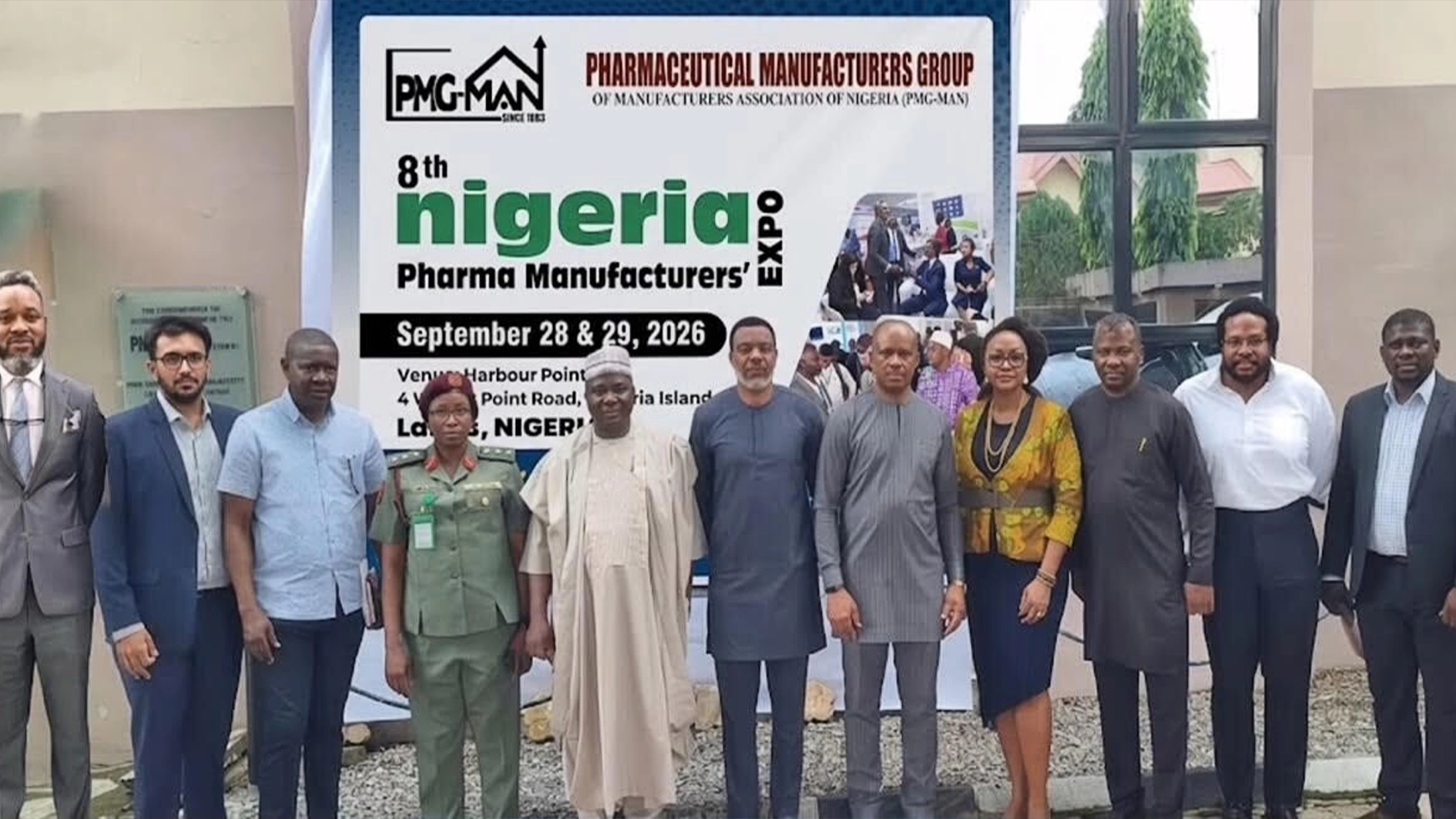
Nigeria’s pharmaceutical manufacturers have set a target of producing 70 per cent of medicines locally, as stakeholders intensify efforts to reduce dependence on imported drugs and strengthen the country’s health security.
The target will feature prominently at the eighth Nigeria Pharma Manufacturers Expo (NPME 2026), scheduled for September 28 and 29 at Harbour Point, Victoria Island, Lagos.
Chairman of the NPME Committee, Pharm. Patrick Ajah disclosed the target at a media briefing in Lagos, where he said the expo would provide a platform to attract foreign direct investment, facilitate technical partnerships, promote local sourcing of raw materials, and strengthen the capacity of Nigerian pharmaceutical manufacturers.
The event, organised by the Pharmaceutical Manufacturers Group of the Manufacturers Association of Nigeria (PMG-MAN), in partnership with GPE Expo Pvt. Ltd., will be held alongside the Nigeria Lab Expo under the theme, “Regional Manufacturing: Advancing Africa’s Pharma & Lifescience Sovereignty through Localization.”
Ajah said more than 200 companies were expected to exhibit at the expo, while nearly 10,000 healthcare professionals, regulatory experts, manufacturers and equipment providers were projected to attend.
According to him, the expo would support the development of a policy framework for reforms in pharmaceutical regulation, financing, manufacturing and supply chains across Nigeria and Africa.
He said the initiative aligned with the Presidential Initiative for Unlocking the Healthcare Value Chain (PVAC), which seeks to reposition Nigeria’s healthcare sector from heavy dependence on imports towards commercialisation, local manufacturing, technology transfer and stronger domestic value chains.
Ajah stressed the importance of indigenous pharmaceutical production, stating recent global health emergencies had demonstrated the risks faced by countries that rely heavily on foreign suppliers for essential medicines.
He assured that Nigerian pharmaceutical manufacturers remained committed to global Good Manufacturing Practice standards, with quality control, quality assurance and supply management systems in place to ensure compliance.
He also warned that manufacturers and distributors involved in counterfeit or substandard medicines would face regulatory and law enforcement action.

Ajah highlighted PMG-MAN’s 43-year history of advocacy for pharmaceutical manufacturing in Nigeria, noting that the organisation had grown from 20 pioneer members at its establishment in 1983 to more than 200 companies.
He said the sector’s growth had contributed to employment generation, tax revenue and a gradual reduction in Nigeria’s dependence on imported medicines, stressing that achieving the 70 per cent local production target remained critical to the country’s health security and industrial development.
The Executive Secretary and Chief Executive Officer of PMG-MAN, Pharm. Frank Muonemeh, said official NAFDAC data showed that imports of finished pharmaceutical products had declined from 4.03 billion units to 1.13 billion units as of 2025.
Muonemeh said the development had helped bring the ratio of imported to locally produced essential medicines to approximately 50:50, describing the trend as evidence that Nigerian manufacturers possess the technical capacity to meet a substantial proportion of domestic demand when supported by an enabling business environment.
He also highlighted improvements in the regulatory environment, noting that National Agency for Food and Drug Administration and Control (NAFDAC) had attained World Health Organisation Maturity Level 3 and was working towards Level 4.
According to him, the regulatory improvements had created conditions that enabled some Nigerian manufacturers to obtain WHO prequalification and undertake contract manufacturing for international brands.
Muonemeh, however, warned that continued dependence on imported medicines remained a threat to national health security, particularly during global health emergencies, geopolitical conflicts, border closures and disruptions to international supply chains.
He stressed that developing a resilient domestic pharmaceutical manufacturing ecosystem should no longer be viewed solely as an economic objective but as an essential component of Nigeria’s public health security and national sovereignty.
He identified high energy costs, limited access to long-term financing, regulatory bottlenecks, shortages of technical manpower caused partly by the “Japa” phenomenon and inconsistent public procurement policies as major challenges facing local manufacturers.
Muonemeh disclosed that pharmaceutical manufacturers currently spend more than 40 per cent of their income on electricity and alternative power generation, compared with less than 10 per cent reportedly spent by competitors in manufacturing hubs such as China and India.
He called for targeted government intervention, including dedicated industrial energy tariffs, to enable Nigerian pharmaceutical manufacturers to compete more effectively in the global market.
Similarly, the Executive Director of Drugfield Pharma Ltd, Pharm. Olusola Akande, called for broader incentives for local pharmaceutical manufacturing, particularly the production of active pharmaceutical ingredients (APIs) and specialised excipients.
Akande said existing interventions, including the Presidential Executive Order, currently cover only about five per cent of the APIs and specialised excipients required by local manufacturers.
He urged the Federal Government to expand tax exemptions and other incentives for the local production of pharmaceutical raw materials, arguing that such measures would boost manufacturing capacity, reduce production costs and ultimately improve medicine affordability for Nigerians.
PMG-MAN also appealed to President Bola Ahmed Tinubu to extend the Presidential Executive Order from its current two-year duration to five years, saying a longer policy window would provide manufacturers with the certainty required for sustained capital investments and industrial expansion.
The organisers said the expo would also provide opportunities for cross-border partnerships, investment, technology acquisition and market expansion while supporting greater integration of Africa’s pharmaceutical industry under the African Continental Free Trade Area and the African Medicines Agency framework.
The Coordinating Minister of Health and Social Welfare, Prof. Muhammad Ali Pate, and the Minister of Industry, Trade and Investment, Dr. Jumoke Oduwole, are expected to lead government officials, policymakers and industry stakeholders at the two-day event.
Others expected include the Minister of State for Industry, Trade and Investment, Senator John Owan Enoh; Minister of State for Health and Social Welfare, Dr. Iziaq Adekunle Salako; Director-General of NAFDAC, Prof. Moji Christianah Adeyeye; and Registrar and Chief Executive Officer of the Pharmacy Council of Nigeria (PCN), Pharm. Ibrahim Babashehu Ahmed.
Also expected are the Special Adviser to the President on Health and the Director-General of the African Medicines Agency (AMA), among other senior officials.

