 Follow Us on Google News
 Follow Us on Google Discover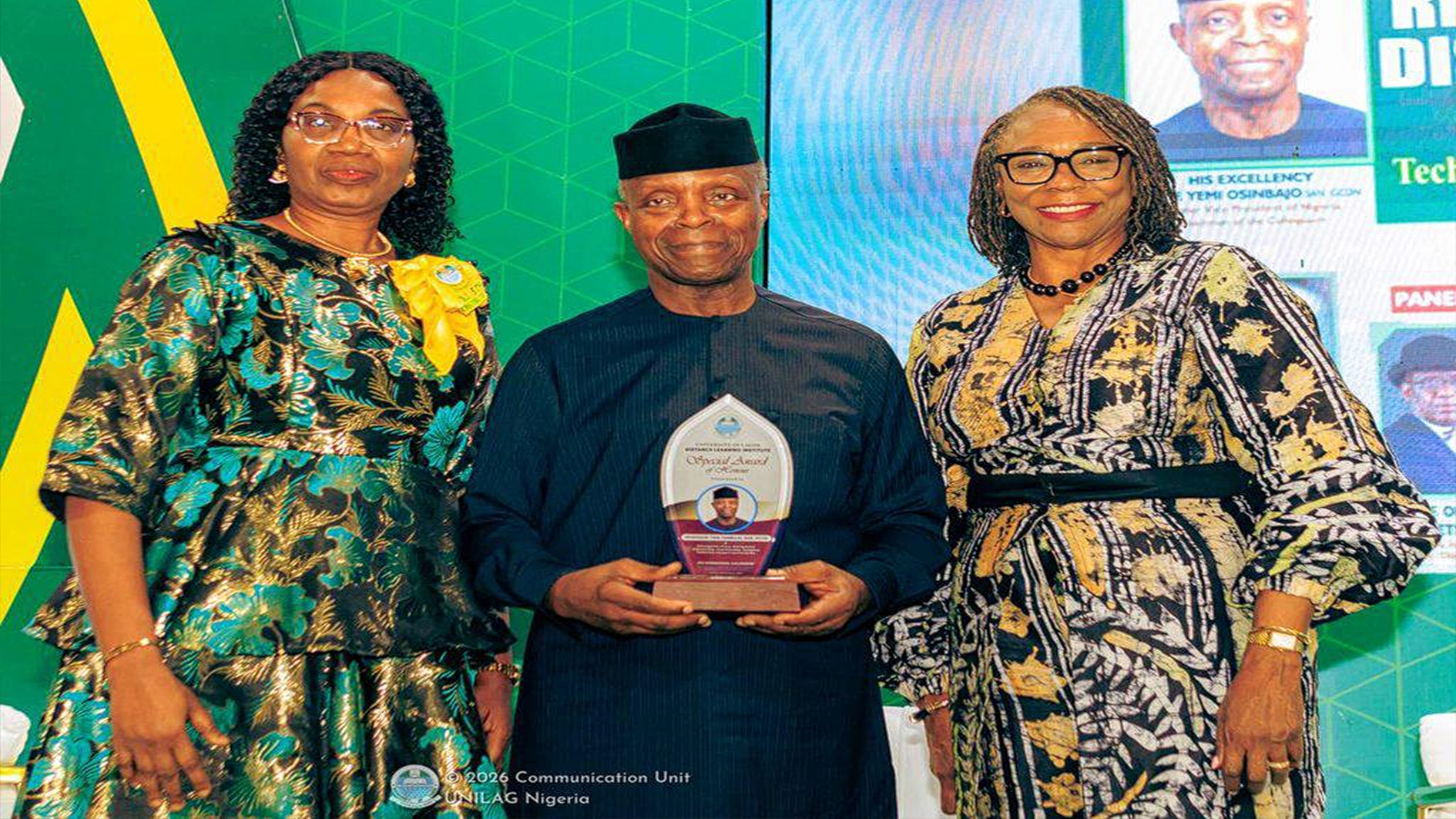
Former Vice-President, Yemi Osinbajo and Vice-Chancellor of the University of Lagos (UNILAG), Prof Folasade Ogunsola, have called for the expansion of open and distance learning (ODL) as a critical solution to Nigeria’s growing demand for university education.
They made the call at the fifth colloquium of UNILAG’s Distance Learning Institute (DLI), themed: ‘Reimagining the open and distance learning ecosystem: Technology, policy and institutional priorities.’
Osinbajo, the immediate past vice-president under the late President Mohammadu Buhari, who chaired the colloquium, said Nigeria cannot bridge its university access gap by relying predominantly on conventional campus-based education, given the growing number of young people seeking admission into tertiary institutions.
He noted that more than 2.2 million Nigerians seek admission through the Joint Admissions and Matriculation Board (JAMB) yearly, while the country’s tertiary education system has historically admitted only about a quarter of that number, adding that Nigeria’s projected population growth will further increase pressure on the existing system.
The former vice-president said it would be impractical to depend solely on the construction of more lecture theatres, hostels and other physical infrastructure to meet the demand.
“The mathematics of access to university education in Nigeria simply does not work if we continue to rely mainly on conventional campus models for university education,” Osinbajo said.

He argued that open and distance learning should no longer be regarded as a peripheral alternative to conventional university education but as a national necessity.
Osinbajo noted that emerging technologies, particularly Artificial Intelligence (AI) could help institutions provide mass access while also offering students more personalised learning experiences.
“This is why ODL can no longer be seen as something on the margins of higher education. It is now clearly a national necessity,” he said.
Osinbajo explained that AI could enable students enrolled in large numbers to receive personalised academic support, including explanations, assessments, feedback and learning materials adapted to their individual pace.
He, however, warned universities against simply transferring conventional teaching methods to digital platforms, pointing out that true transformation requires a fundamental rethink of how students learn and are assessed.
“All we do is take our lecture, put it on Zoom, upload a PDF, and call that transformation. We simply have changed the medium, but we haven’t changed the model.”
He noted that distance learning should not only cater to young people seeking their first university degrees, but also to older workers and professionals who require continuous reskilling as technology transforms the labour market.
Osinbajo noted that universities and policymakers must also address structural challenges, including unreliable electricity, expensive internet services and devices.
Besides, he emphasised the need for learning platforms that can function effectively on mobile phones and, where possible, offline.
He said the purpose of technology should remain human development, adding that innovation would only be valuable if it expanded people’s capabilities and opportunities.
In her remarks, Ogunsola said the growing youth population and demand for higher education had made it imperative for Nigerian universities to rethink the traditional model of education.
She noted that Nigeria has about 89 million young people aged 15 to 30, with an average age of 19, which creates significant pressure on the country’s higher education system.
“It is clear that this old university model will not educate our teeming youth population,” Ogunsola stated.
She stressed that open and distance learning should not be viewed as an inferior alternative, noting that accredited degrees from ODL institutions are of the same value as those from conventional universities.
According to her, UNILAG does not indicate distance learning on students’ certificates because the university applies the same quality standards to its distance and full-time programmes.
Ogunsola said the next stage of ODL development should focus on moving “from distance learning to connected learning; from content delivery to learning engagement; and from simply increasing enrolment to improving learning outcomes and employability.”
She identified artificial intelligence as an important tool for personalised learning, immediate feedback, content development, assessment and early identification of students who might be struggling.
However, she warned that universities must address concerns around academic integrity, data privacy, algorithmic bias, intellectual property and the changing role of lecturers.
The vice-chancellor also called for clear policies covering digital credentials, online assessment, AI in education, micro-credentials, credit transfers, recognition of prior learning and quality assurance.
She said universities must begin treating ODL as a core institutional strategy rather than a peripheral programme.
Ogunsola challenged stakeholders to consider whether success in distance education should be measured solely by the number of degrees awarded or by what students learn, become and contribute to society.
Delivering the keynote address, a Fellow of the University of London, Emeritus Professor Stephen Brown, said universities must redefine ODL expansion and adoption to suit their local realities.
“You need to understand your own context, but that’s not enough. You also need to be able to deal with the untamed ability of people and institutional cultures. And I hope that the way to deal with this is through collaboration, Brown said.
In her welcome address, the Director of DLI, Prof. Risikat Dauda, described the colloquium as timely, noting that Nigeria’s increasing number of out-of-school children is a cause for concern.

