 Follow Us on Google News
 Follow Us on Google Discover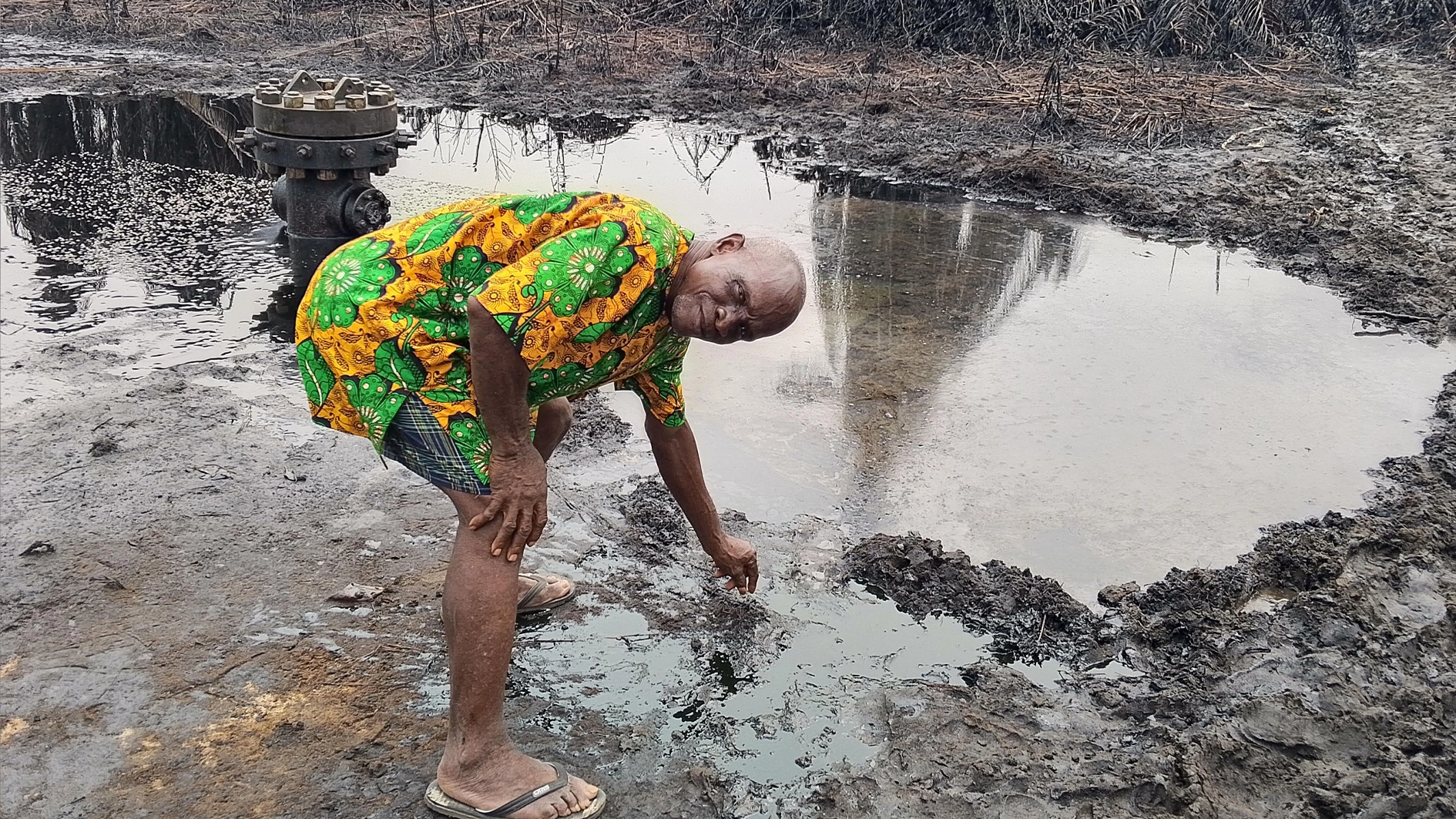
Across the sprawling farmland in Yola Oilfield, Ogoniland, Rivers State, the remains of a massive oil spill tell a grim story of environmental destruction and human suffering.
Cassava farms that should have been approaching harvest have been rendered useless. Mangroves, palm trees and other vegetation have been coated and destroyed by crude oil, while nearby creeks and waterways remain polluted.
The scene, according to environmental activist and Executive Director of Health of Mother Earth Foundation (HOMEF), Dr Nnimmo Bassey, resembles a war front.
Bassey, speaking with The Guardian at the scene of the spill, said, “This looks like a scene of fire,” Bassey said during a visit to the affected community. “All this destruction of mangroves, palm trees, mangoes and the rest were just damaged by the spill itself.”
The spill occurred at the Yola Oilfield in the Kpean community, in Khana Local Government Area of Ogoniland last year.

For residents, however, the tragedy is not merely about another oil spill. It is a reminder of decades of environmental degradation and what they describe as government neglect, even as moves intensify towards possible resumption of oil production in the area.
Bassey said what was particularly disturbing was that the spill had been reported promptly by community members, including the traditional ruler of the traditional ruler of Kpean community, Chief Lucky Gbene Ewor, who has continued to monitor their environment.
“The spill was reported right on time. The community people are monitoring the environment all over Ogoniland and Kpean community in particular. They reported the oil spill, so those authorities could not say they didn’t know about it,” he said.
He expressed concern that despite the government’s awareness and the scale of the damage, meaningful remediation had yet to commence.
According to him, a high-level government delegation visited the area on December 22, 2025, only hours after the latest oil spill breakout had reportedly been contained.
“They’ve seen the amount of devastation, and they’re just sleeping pretty, sitting pretty in Abuja, happy about what they’ve seen here,” he said.
Bassey argued that no government that had witnessed such destruction should delay action to restore the environment.
“You can’t see this level of devastation without immediately commencing action to clean up the environment,” he said.
Pointing at the polluted creeks and rivers, he stated that community members had been forced to dig trenches in an attempt to prevent the crude from spreading further.
“There is nothing from the government to help the communities,” he added.
‘Resumption of oil production could deepen crisis’
For Bassey, the unfolding crisis should serve as a warning against any hurried resumption of oil production in Ogoniland.
He questioned how oil infrastructure abandoned since production stopped in 1993 could still be responsible for such a massive environmental disaster decades later.
“If production that stopped in 1993 can still be creating this level of disaster in this territory, to reopen the wells means that nobody has taken note of what has gone wrong,” he said.
He recalled that the United Nations Environment Programme (UNEP) assessment of Ogoniland recommended, among other measures, the decommissioning of decrepit oil facilities.
“What UNEP recommended was a decommissioning of decrepit oil facilities, and this is what I believe should be done,” Bassey said.
He listed immediate clean-up, environmental restoration and compensation for affected farmers, fishermen and communities as priorities.
“The first step is to clean up the environment. The second step is to restore the environment. The third step, which could be done at the same time as the second step, is to compensate the farmers, the fishers and the community for their loss,” he said.
He also called for the permanent decommissioning of abandoned and dilapidated oil facilities.
‘They must believe the evidence of their eyes’
Bassey also took exception to reports that the outcome of recent high-level visits to Ogoniland suggested that the area was ready for oil production.
He said government officials who visited the affected areas could not reasonably claim ignorance of the environmental crisis.
“We know that the Minister of Environment was here, the National Security Adviser was here. They simply have to believe the evidence of their own eyes,” he said.
“If anybody has seen this level of devastation and believes that there’s no problem here, that everything is good,that the people are happy, that person must be living on another planet.”
Describing the affected area as resembling “a war front,” Bassey said the scale of destruction demanded urgent government intervention rather than political assurances.
‘Equipment failure caused spill’
Another environmental advocate, Dr Celestine Akpobari, said the latest incident was particularly painful because it reflected problems that had plagued Ogoni communities for decades.
“It is sad, and I’m happy that you are here yourself and you have seen things for yourself. The Ogoni, this is not new. We have lived with this,” Akpobari said.
He linked the historical Ogoni struggle to environmental degradation caused by oil operations, recalling the high human cost of the movement.
According to him, the latest incident was traced to equipment failure, but he questioned why such infrastructure had been allowed to deteriorate for decades.
“The routine checks have not been carried out by the companies,” he said.
Akpobari said a joint investigation had reportedly identified equipment failure as a cause of the incident, arguing that responsibility should not be shifted to the community.
“This is not a pipeline. This is a well-head. There is no mad person in the world that can tamper with the well-head,” he said.
He accused authorities of failing to respond with the urgency required after the incident.
“Instead of them accepting their fault and their guilt and remediating this place immediately, to declare a state of emergency, they are speaking grammar,” he said.
Cassava farms wiped out
For farmers, the environmental crisis has translated directly into lost livelihoods.
Standing beside a vast expanse of oil-affected farmland, Akpobari pointed to cassava crops that were already approaching harvest.
“Look at the cassava farm, already ripe for harvest,” he said.
He explained that farming families depend on such harvests not only for food but also for their children’s education, healthcare and general welfare.
“Those that cultivate, it’s not a fishing business. The farming, people had to wait for nine months. And the family’s livelihood, the education of their children, their well-being, healthcare, depended on that farm,” he said.
He said the oil spill had effectively destroyed the fruits of months of labour.
Traditional ruler: ‘We need assessment, compensation before resumption’
The traditional ruler of the traditional ruler of Kpean community, Chief Lucky Gbene Ewor, said residents could not understand how government officials could describe Ogoniland as ready for oil production while communities continued to grapple with abandoned oil infrastructure and environmental pollution.
“This thing is like a film, but it’s sad that I’m seeing it as reality. We watch it on video, and we think it’s mere home video and all that. But I’m here live witnessing this,” he said.
He pointed to the extensive farmland and said the timing was particularly devastating because farmers should ordinarily be preparing for cultivation.
“This is the right time for cultivation. But there’s nothing we can do,” he said.
The traditional ruler said the community would need proper environmental assessment, compensation and clean-up before any discussion about resuming oil production could be taken seriously.
“They come up for proper assessment and compensation and before clean-up and make sure things are being put in place. Then we see their seriousness,” he said.
18 abandoned wellheads, no fencing, no access road
According to the traditional ruler, the Yola Oilfield contains between 17 and 18 wellheads, many of which have reportedly remained without adequate maintenance for decades.
He said residents had repeatedly raised concerns about the condition of the facilities, but little had been done.
“They have not even visited to say, let them change all these wellheads. Nothing like that. Fencing around this place, nothing. Access road, we don’t have,” he said.
The absence of basic infrastructure around the oilfield, he said, further demonstrates the neglect suffered by the community.
He also rejected claims by some politicians from Ogoniland that government was doing well in addressing the concerns of the people.
“They are saying it out of their selfish interest and what really they want from government,” he said.
‘People are dying’
Beyond the destruction of farms and waterways, residents were also grappling with serious health and environmental concerns.
Some women seen around the spill site and the communities were looking hungry and pale.
“It is more than 11 months now since the spill happened; nothing really has been put in place. There’s no surgery. And we are talking about an emergency. This is an emergency,” he said.
He alleged that deaths had become frequent in the community, which he attributed to the harsh environmental conditions.
“People are dying. The breathing is harsh. People are dying. I buried… Every week, two, two,” he said.
He appealed to the international community and other stakeholders to intervene.
“We need the international community and people to come and help us,” he said.
‘Tinubu should come and see for himself’
As the Federal Government weighs plans to resume oil production in Ogoniland, the traditional ruler urged President Bola Tinubu to personally visit the affected communities.
“If he is serious and he really wants oil in Ogoniland, he would have come by himself to visit not only Kpean, Yola Oilfield, but every other place where there are oil facilities in Ogoniland,” he said.
According to him, a personal visit by the President would enable him to see the reality on the ground rather than rely solely on reports from officials.
“He should come and see it by himself, so that we have one or two things to tell him. We take it home so that he will know,” he said.
Also, some women in an interview with The Guardian lamented loss of livelihood, hunger, health challenges and trauma.
They called on the government for urgent care and intervention.
For the communities living around Yola Oilfield, the question is no longer simply whether oil production should return to Ogoniland.
It is whether a region still struggling with the environmental consequences of past production can safely contemplate another chapter of oil extraction without first cleaning up the damage already left behind.
For now, the crude-coated farmland, polluted waterways and abandoned wellheads remain stark evidence of a crisis the communities say cannot be wished away by official assurances.
For the communities living around Yola Oilfield, the question is no longer simply whether oil production should return to Ogoniland.
It is whether a region still struggling with the environmental consequences of past production can safely contemplate another chapter of oil extraction without first cleaning up the damage already left behind.
For now, the crude-coated farmland, polluted waterways and abandoned wellheads remain stark evidence of a crisis the communities say cannot be wished away by official assurances.

