 Follow Us on Google News


 Follow Us on Google Discover
Hello, and welcome. I am glad you found your way here, because this question deserves a proper answer rather than the one-word reply it usually gets. What follows is the conclusion of months of research and years of experience travelling, working and arguing my way across this country. So, what language do they speak in Nigeria? The short version is English, officially. The longer version is that Nigeria is one of the most linguistically crowded countries on Earth, with somewhere between 500 and 525 living languages, three regional giants, and a street creole that reaches more people than any of them.
I have been writing about Nigerian identity for long enough to know that this question arrives in my inbox in several disguises. Sometimes it is a visitor packing for Lagos. Sometimes it is a diaspora child trying to understand why Grandma switches languages mid-sentence. Sometimes it is a student in Nairobi or Accra genuinely unsure whether we speak French or Swahili.
All of them want the same thing, which is a clear answer that respects how complicated the truth actually is.
Let me give you that.
Do Nigerians Speak English or French?
English. Firmly, officially, and by a very wide margin.
English is the language of the constitution, the courts, the National Assembly, the civil service, the banks, the universities, and every secondary school certificate examination in the land. The Ministry of Foreign Affairs describes it plainly as the lingua franca that links Nigerians across ethnic lines, which is exactly how it functions day to day. If you land at Murtala Muhammed Airport and speak English, you will be understood at immigration, at the taxi rank, at the hotel and in almost every shop in the city.

So where does the French confusion come from?
Geography, mostly. Nigeria is an anglophone island in a francophone sea. Benin Republic sits to the west, Niger to the north, Chad to the north-east and Cameroon to the east, and all four conduct government business in French. Anyone glancing at a map of West Africa could be forgiven for assuming we do too.
There is also a genuine historical wrinkle here, and it is one most Nigerians have forgotten. In December 1996, General Sani Abacha announced that French would become Nigeria’s second official language, with compulsory teaching in schools to follow. The National Policy on Education picked the idea up, and for a while the phrase “second official language” appeared in official documents and even on some passports. A Guardian columnist once observed, with some exasperation, that the day a Nigerian president can hold a decent conversation in French, we should slaughter a cow. That was written a decade ago and the cow remains alive.
The honest status of French in 2026 is this: a declaration that was never implemented, a subject that appears on the junior secondary timetable in theory and vanishes in practice for want of teachers, and a small but real community of speakers concentrated in Badagry (home of the Nigeria French Language Village), in border towns, and among traders who move goods through Cotonou and Niamey. President Tinubu’s unusually warm relationship with Paris has revived talk of French teaching agreements, and a recent Guardian column called the whole thing a perilous French gambit for a country that spent sixty years keeping France at arm’s length.
None of that changes the practical answer. If you are choosing one language to bring to Nigeria, bring English. If you happen to have French as well, it will earn you smiles in Badagry and very little anywhere else.
(A small aside, because it matters: the English you will hear is Nigerian English, which has its own rhythm, its own vocabulary and its own idioms. “I am coming” means “I am leaving for a moment”. “You are welcome” is a greeting, not a reply. Nobody will correct you, but you will understand more if you know.)
Does Nigeria Have a Different Language of Its Own?
Yes, and this is where the story gets interesting.
The constitution names no single Nigerian language as the national tongue, but Section 55 provides that the business of the National Assembly is conducted in English and, when arrangements permit, in Hausa, Igbo and Yoruba. Section 97 gives each state assembly the same option with its own dominant language. That is why Hausa, Igbo and Yoruba are commonly called the three national languages. They are not official in the way English is, but they are constitutionally recognised, and each carries tens of millions of speakers.
Hausa dominates the north from Sokoto to Maiduguri and spills across the border into Niger, where it is the most widely spoken language in the country. Yoruba anchors the south-west, from Lagos through Ibadan to Ekiti, and travels as far as Benin, Togo, Brazil and Cuba through the old Atlantic trade. Igbo holds the south-east, from Onitsha to Owerri, and its speakers run trading networks that reach every market in Nigeria and a good many beyond.
Then there is the fourth language, the one nobody teaches and almost everybody speaks.
Nigerian Pidgin, increasingly called Naija by the people who speak it, is an English-lexified creole with its own grammar, its own music and its own dignity. It has no official status whatsoever. It is also, by most estimates, understood by somewhere between 75 million and 120 million Nigerians, which makes it the closest thing we have to a language common to everyone. The BBC launched a Pidgin service in 2017 for precisely that reason. Walk through Balogun Market in Lagos, a mechanic’s yard in Aba or a motor park in Jos and you will hear it stitching together people who share no mother tongue.
Rather like a well-worn wrapper, Pidgin fits everybody without belonging to anybody.
Below the big three and Pidgin, the picture fans out into hundreds of languages that are anything but small. The Nigerian Educational Research and Development Council maintains curricula for more than a dozen indigenous languages, including Edo, Izon, Efik, Ebira, Tiv, Kanuri, Fulfulde, Urhobo and Isoko, alongside English, French and Arabic. The National Library’s repository holds a state-by-state map of Nigerian languages that lists Adamawa alone with more than twenty, and Gombe with more than thirty.
So does Nigeria have a different language of its own? It has several hundred. What it does not have, and has never had, is one.
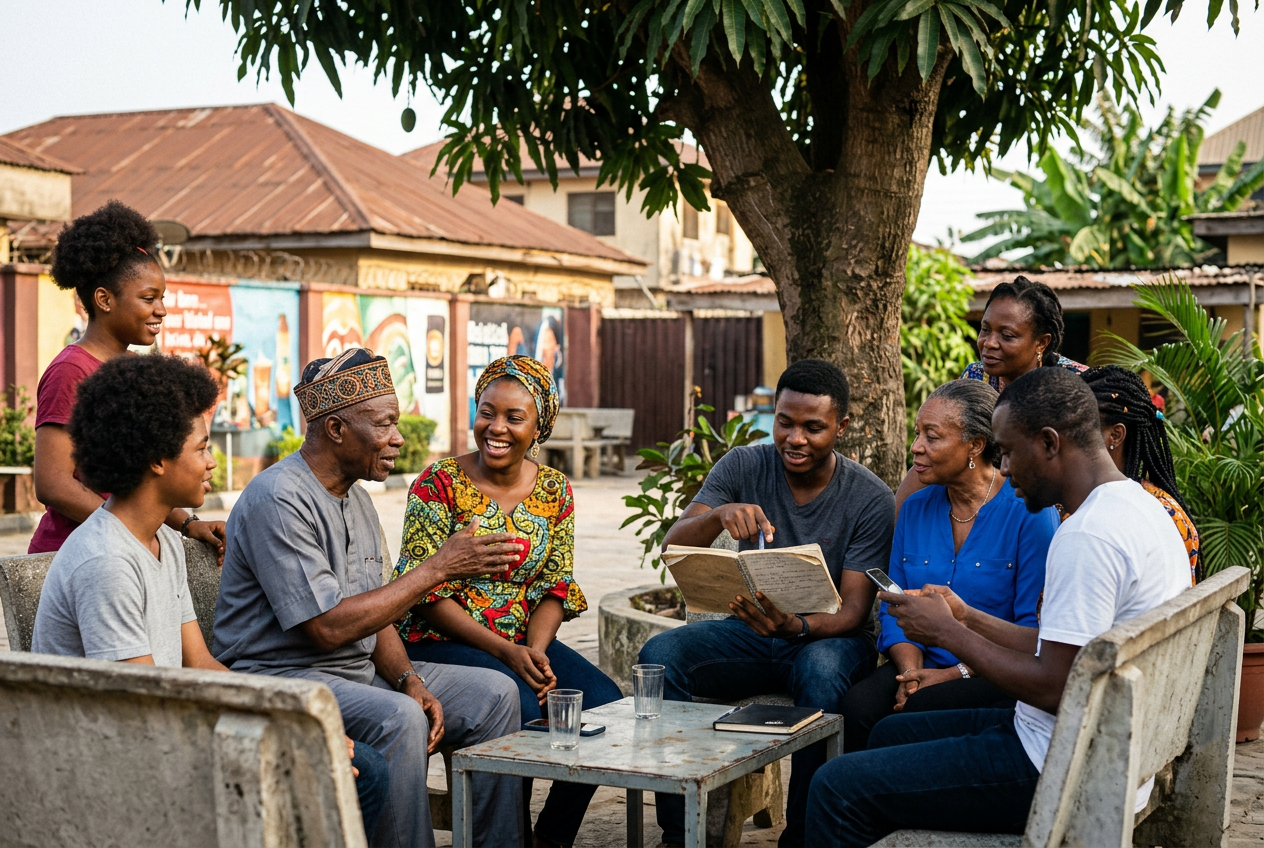
I remember a wedding in Kaduna where the groom’s family spoke Hausa, the bride’s family spoke Igbo, the pastor preached in English and the DJ took every request in Pidgin. Four languages, one afternoon, no confusion. That is not an unusual Saturday. That is Nigeria.
What Language Do They Speak in Nigeria? The Direct Answer
Let me answer the question as plainly as I can, in one paragraph, so that nobody leaves this page still guessing.
The language they speak in Nigeria, officially and in every formal setting, is English, inherited from British colonial rule and retained after independence in 1960 precisely because it belonged to no single ethnic group. Alongside it sit three constitutionally recognised national languages, Hausa in the north, Yoruba in the south-west and Igbo in the south-east, each spoken by tens of millions of people as a first or second language. Beneath and between all four runs Nigerian Pidgin, an unofficial creole that may reach more Nigerians than any other tongue. The remaining several hundred languages, from Fulfulde and Kanuri to Ibibio, Tiv, Edo and Ijaw, belong to three great families, Niger-Congo, Afroasiatic and Nilo-Saharan, and most Nigerians move between at least two of them every single day. The closely related entities you will meet in any serious discussion are:
- English (official; government, education, law, business)
- Hausa, Yoruba and Igbo (national languages; constitutionally recognised)
- Nigerian Pidgin or Naija (unofficial lingua franca; 75 to 120 million users)
- Fulfulde, Kanuri, Ibibio, Tiv, Ijaw, Edo, Nupe and Efik (major regional languages)
- French (declared a second official language in 1996; never implemented)
- Arabic (liturgical and scholarly in the Muslim north; not a spoken community language)
If someone asks you for a one-line answer at a dinner party, say this: “English officially, Pidgin practically, and one of Hausa, Yoruba or Igbo depending on where you are standing.” You will be more accurate than most encyclopaedias.
Does Nigeria Speak Swahili?
No. Not at all, and I say that with affection for a beautiful language that simply lives on the other side of the continent.
Swahili is a Bantu language of the East African coast. It is official in Tanzania, Kenya, Uganda, Rwanda and the Democratic Republic of Congo, it became a working language of the African Union in 2022, and it is spoken in one form or another across more than a dozen countries from Somalia down to Mozambique. Nigeria is not one of them. Lagos to Dar es Salaam is roughly 5,500 kilometres by air, further than Lagos to London, and the languages between the two cities have been drifting apart for something like three thousand years.
Why does the question keep coming up? Two reasons, I think.
The first is that “African” gets flattened into a single idea from the outside, and Swahili is the African language most people abroad can name. A friend in Manchester once asked me, entirely sincerely, whether my mother had taught me Swahili. My mother is from Ijebu-Ode. She taught me Yoruba, prayers, and how to haggle.
The second reason is more interesting. Nigeria’s own Niger-Congo languages, particularly the Bantoid group in the south-east and the Cross River region, are distant cousins of Swahili. Linguists believe the ancestors of the Bantu languages set out from somewhere near the present-day Nigeria and Cameroon border thousands of years ago and spread east and south across the continent. So the true relationship is the reverse of what the question assumes. Nigeria does not speak Swahili. Swahili, in a very long-lost way, speaks a little Nigeria.
Here is the practical detail. Every Nigerian I have ever met who speaks Swahili learnt it somewhere else: a peacekeeping posting in the Congo, a university year in Nairobi, a marriage into a Tanzanian family. It is not taught in our schools, not heard in our markets, and not used in our films. Wander into a shop in Wuse and greet the owner with “jambo” and you will get a polite, puzzled smile and a reply in English, Hausa or Pidgin.
Can You List 20 Languages Spoken in Nigeria?
Gladly, and with a warning first.
Counting speakers of Nigerian languages is notoriously difficult. There has never been a comprehensive language census, the 2006 population census did not ask the question, and estimates from Ethnologue, university departments and the languages’ own advocacy bodies can differ by tens of millions depending on whether second-language speakers are included. The figures below are ranges drawn from the most commonly cited sources, and I have said so plainly rather than pretend to a precision nobody has.
The 20 Largest Languages Spoken in Nigeria by Region and Estimated Speakers
| Rank | Language | Language family | Heartland states | Estimated speakers (including second language) |
|---|---|---|---|---|
| 1 | Hausa | Afroasiatic (Chadic) | Kano, Kaduna, Katsina, Sokoto, Bauchi, Zamfara | 60 to 90 million |
| 2 | Yoruba | Niger-Congo | Lagos, Oyo, Ogun, Osun, Ondo, Ekiti, Kwara | 45 to 50 million |
| 3 | Igbo | Niger-Congo | Anambra, Imo, Enugu, Abia, Ebonyi, Delta, Rivers | 30 to 45 million |
| 4 | Nigerian Pidgin | English-lexified creole | Nationwide, strongest in the south | 75 to 120 million |
| 5 | Fulfulde (Fula) | Niger-Congo (Atlantic) | Adamawa, Taraba, Gombe, across the north | 15 to 18 million |
| 6 | Ibibio | Niger-Congo (Cross River) | Akwa Ibom | 8 to 10 million |
| 7 | Kanuri | Nilo-Saharan | Borno, Yobe | 6 to 8 million |
| 8 | Ijaw (Izon cluster) | Niger-Congo (Ijoid) | Bayelsa, Delta, Rivers, Ondo | 5 to 14 million |
| 9 | Tiv | Niger-Congo (Bantoid) | Benue, Taraba, Nasarawa | 4 to 5 million |
| 10 | Edo (Bini) | Niger-Congo (Edoid) | Edo | 2 to 3 million |
| 11 | Nupe | Niger-Congo | Niger, Kwara, Kogi | 2 to 3 million |
| 12 | Igala | Niger-Congo (Yoruboid) | Kogi | 2 to 3 million |
| 13 | Urhobo | Niger-Congo (Edoid) | Delta | 2 to 3 million |
| 14 | Idoma | Niger-Congo | Benue | 1 to 2 million |
| 15 | Ebira | Niger-Congo (Nupoid) | Kogi | 1 to 2 million |
| 16 | Gbagyi | Niger-Congo | Niger, FCT, Kaduna, Nasarawa | 1 to 2 million |
| 17 | Efik | Niger-Congo (Cross River) | Cross River | 1 to 2 million |
| 18 | Esan | Niger-Congo (Edoid) | Edo | 1 to 2 million |
| 19 | Ogoni languages | Niger-Congo (Cross River) | Rivers | 1 to 2 million |
| 20 | Jukun | Niger-Congo (Jukunoid) | Taraba, Benue | 500,000 to 1 million |
Two things stand out from the table. The first is how steep the drop is: three languages have tens of millions of speakers each, then Pidgin cuts across all of them, and after Fulfulde the numbers fall quickly into the low millions. The second is how many of these languages are concentrated in a single state, which is why a two-hour drive in the Middle Belt can carry you through four or five entirely different tongues.
Some quick notes to bring the table to life. Hausa is the only Nigerian language with a serious claim to being an international one; it is spoken as a trade language in eight neighbouring countries, and the standard dialect, Kananci, is the voice of BBC Hausa, VOA Hausa and Kannywood. Yoruba is tonal, and the difference between “shoe” and “drum” is a matter of pitch, which is why my early attempts at it produced so much laughter. Igbo has more than twenty dialects and a standard written form that many speakers regard with suspicion. Kanuri is the one large language in the country that belongs to the Nilo-Saharan family rather than Niger-Congo or Afroasiatic, a legacy of the Kanem-Bornu Empire that once stretched to Lake Chad.
And Pidgin sits at number four in the table only because it is not, strictly, indigenous. By actual reach it is probably first.
How to Navigate Nigeria’s Languages in Practice
Enough theory. If you are moving to Nigeria, visiting, doing business, or simply trying to reconnect with a heritage that skipped a generation, here is what I would do, in the order I would do it.
- Start with Nigerian English, not textbook English. Learn the local idioms (“how far?”, “no wahala”, “I dey come”) and the tone of address for elders (“Ma”, “Sir”, “Aunty”, “Uncle”). This costs nothing and changes how every conversation lands.
- Work out which regional language matters for where you will be. Hausa for the north, Yoruba for Lagos and the south-west, Igbo for the south-east. In the Niger Delta or the Middle Belt, ask locally, because the answer changes every few kilometres.
- Pick up market Pidgin early. A hundred phrases will carry you through taxis, markets, mechanics and comedy nights. Pidgin is also the best bridge into the regional languages, because it borrows freely from all of them.
- Budget for a tutor rather than relying on apps alone. In Lagos or Abuja, a private tutor in Hausa, Yoruba or Igbo typically charges somewhere between ₦5,000 and ₦15,000 per session, with university language departments and cultural centres often cheaper. The apps will teach you vocabulary; a human will teach you tone.
- Listen before you speak. Radio is your friend: Bond FM and Lagos Talks for Yoruba and Pidgin, Freedom Radio Kano for Hausa, Odenigbo FM for Igbo. Nollywood and Kannywood films with subtitles work too.
- Learn the greetings properly and the numbers thoroughly. Greetings open doors; numbers close deals. Being able to say “that is too much, make it two thousand” in the local language will save you far more Naira than any dictionary.
- Accept that you will mix languages, because everyone does. A sentence that begins in English, swerves through Yoruba and ends in Pidgin is not a mistake in Nigeria. It is fluency.
I followed almost none of this advice when I first started travelling north for work, and I paid for it in overpriced kola nuts and awkward silences. Learn from my mistakes rather than repeating them.
A word on classrooms, since so many readers ask about their children. Nigeria’s National Language Policy of 2022 required the first six years of schooling to be taught in the child’s mother tongue or the language of the immediate community. In November 2025, the Federal Ministry of Education reversed that policy and restored English as the medium of instruction from pre-primary level upwards, citing examination failure rates in states that had adopted mother-tongue teaching most fully. The Linguistic Association of Nigeria petitioned against the reversal, and the argument is far from settled. One Guardian writer warned years ago that the real story was the steady decline of English use itself rather than any threat to indigenous languages, and both anxieties are alive at once. What it means for you, practically, is that a child in a Nigerian public school today will be taught in English, and will learn Yoruba, Hausa or Igbo as a subject rather than through it.
Final Thoughts: What Language Do They Speak in Nigeria?
So, what language do they speak in Nigeria? English, if you want the answer that fits on a form. English plus Pidgin plus one of Hausa, Yoruba or Igbo, if you want the answer that fits real life. And several hundred languages, if you want the answer that fits the country.
We do not speak French, despite the neighbours and despite a thirty-year-old declaration that never left the paper it was printed on. We do not speak Swahili, which lives on a coast three thousand miles away. What we do is something more unusual: we run a country of more than 220 million people, in three great language families, on a borrowed official language and a homegrown creole, and we somehow make it work every single day.
If you take only three things from this article, take these:
- Arrive with English and learn Pidgin fast; between them you can function anywhere in the country within a fortnight.
- Choose one regional language based on where you will actually live or trade, and pay a human tutor to teach you tone, because tone is where the meaning lives.
- Treat every language you hear as a door rather than a barrier. Nigerians are extraordinarily generous to anyone who tries, and a mangled “sannu” or “e kaaro” will buy you more goodwill than perfect English ever will.
Related Articles
If the sheer number of languages in the table surprised you, the reason sits in the ethnic map underneath it, and I have written a full guide to how many tribes there are in Nigeria that explains where each of the languages above comes from and why the count runs into the hundreds. And if you found yourself wondering whether any single language genuinely reaches everybody, I have taken that question head-on in a piece on the only language common to most Nigerians, which weighs English against Pidgin and comes to a conclusion that surprised even me.
Key Takeaways
- English is Nigeria’s only official language; Hausa, Yoruba and Igbo are constitutionally recognised national languages; Nigerian Pidgin is the unofficial glue.
- French was declared a second official language in 1996 but was never implemented; Swahili has no presence in Nigeria at all.
- Nigeria has between 500 and 525 living languages across three families, with speaker figures that remain estimates because no national language census has ever been conducted.
Frequently Asked Questions: What Language Do They Speak in Nigeria?
What language do they speak in Nigeria?
Nigeria’s official language is English, used in government, education, law and business across all 36 states and the Federal Capital Territory. Most Nigerians also speak one or more of Hausa, Yoruba, Igbo or Nigerian Pidgin, alongside hundreds of smaller regional languages.
Do Nigerians speak English or French?
Nigerians speak English, which has been the official language since independence in 1960. French was declared a second official language in 1996 but the policy was never implemented, so very few Nigerians outside border areas speak it.
Does Nigeria speak Swahili?
No, Swahili is an East African language spoken in Tanzania, Kenya, Uganda and their neighbours, roughly 5,000 kilometres from Nigeria. It is not taught in Nigerian schools or used in daily life anywhere in the country.
Does Nigeria have a different language of its own?
Nigeria has more than 500 indigenous languages, with Hausa, Yoruba and Igbo recognised in the constitution as national languages. There is no single native Nigerian language shared by everyone, which is why English and Pidgin serve as the common bridges.
What is the most spoken language in Nigeria?
Hausa is the most widely spoken indigenous language, with estimates ranging from 60 million to over 90 million speakers when second-language users are counted. Nigerian Pidgin may reach even more people, but it is a creole rather than an indigenous language.
Is Nigerian Pidgin an official language?
No, Nigerian Pidgin has no official status despite being understood by an estimated 75 to 120 million people. It is used widely in markets, music, comedy and broadcasting, and the BBC has run a dedicated Pidgin service since 2017.
How many languages are spoken in Nigeria?
Ethnologue lists between 520 and 525 living indigenous languages in Nigeria, though some Nigerian linguists argue the true figure is closer to 600 depending on how dialects are classified. Around a dozen languages recorded in the country are now extinct.
Which languages are recognised in the Nigerian constitution?
Section 55 of the 1999 Constitution provides for National Assembly business to be conducted in English and, when arrangements permit, in Hausa, Igbo and Yoruba. Section 97 allows each state assembly to use English plus one or more languages spoken in that state.
What language is spoken in Lagos?
Lagos is historically Yoruba territory, and Yoruba remains the dominant indigenous language there. Because the city draws people from every part of Nigeria, English and Pidgin are the everyday languages of trade and public life.
Is Arabic spoken in Nigeria?
Arabic is used for Islamic worship and scholarship across northern Nigeria, and Ajami script was historically used to write Hausa. It is not a community language spoken in homes or markets, though many northern Nigerians can read Quranic Arabic.
Are Nigerian children taught in English or in their mother tongue?
Since November 2025, English has been the medium of instruction in Nigerian schools from pre-primary level upwards, following the reversal of the 2022 National Language Policy. Indigenous languages are taught as subjects rather than used as the language of teaching.
How much does it cost to learn a Nigerian language?
Private tutors in Lagos or Abuja typically charge between ₦5,000 and ₦15,000 per session for Hausa, Yoruba or Igbo, while university language departments and cultural centres are often cheaper. Free options include radio, Nollywood films with subtitles and language exchange with friends.

