 Follow Us on Google News
 Follow Us on Google Discover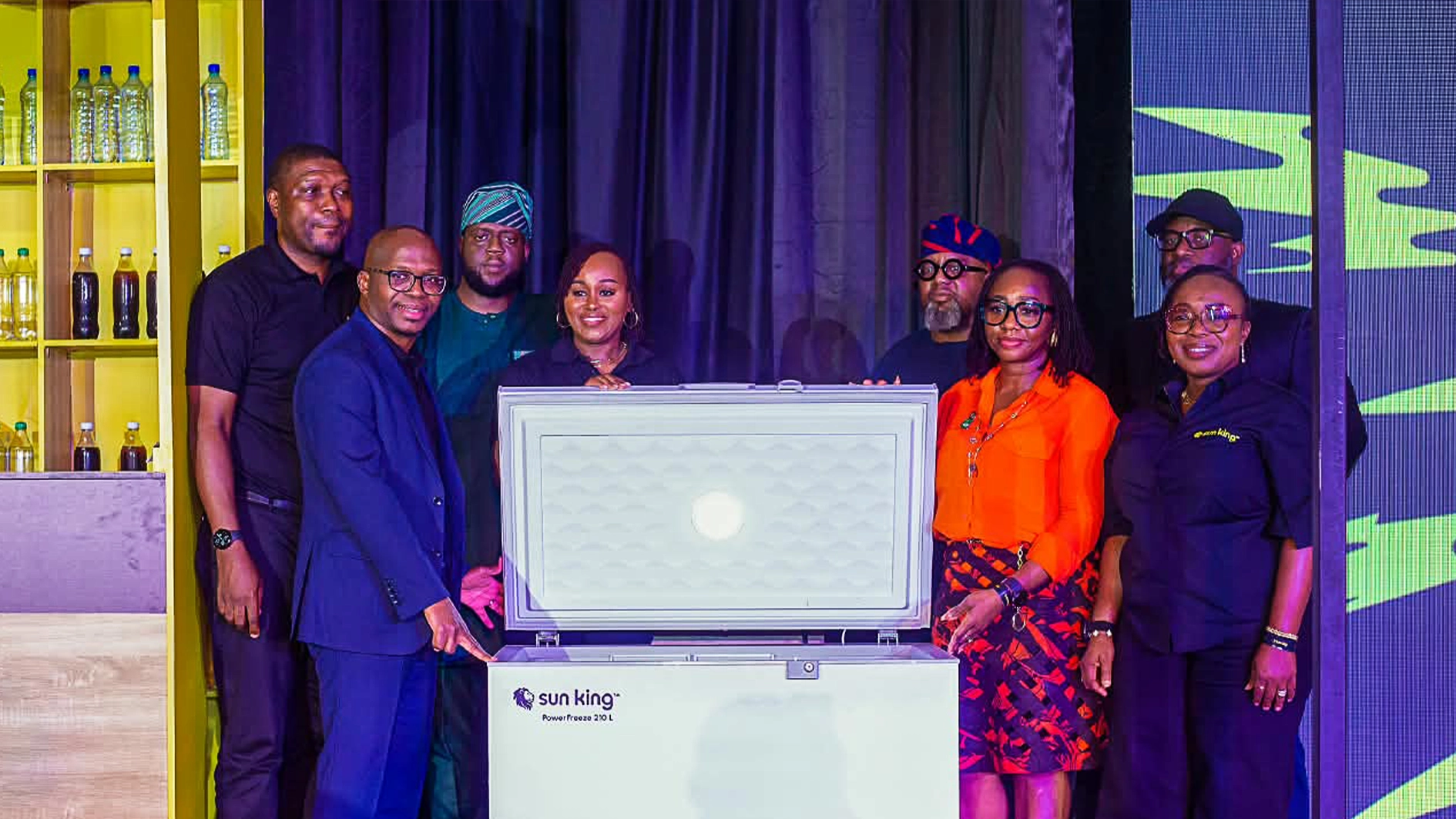
A firm, Sun King has expanded its solar inverter portfolio in Nigeria to 30 kVA and launched PowerFreeze, a solar-powered refrigeration system aimed at helping households and businesses tackle unreliable electricity supply, food spoilage and rising generator costs.
The company unveiled the products in Lagos during an event attended by customers, partners and government representatives, with discussions centred on the growing role of solar energy in meeting the electricity needs of Nigerian homes and businesses.
The expansion increases the company’s PowerHub range from the existing 2.2 kVA and 3.3 kVA systems to include 5 kVA, 10 kVA, 15 kVA and 30 kVA options.
According to Sun King, the systems are scalable, allowing customers to select inverter capacity, battery storage and solar panels according to their immediate needs and expand their installations as their energy requirements grow without replacing existing systems.
The company said the higher-capacity systems could support energy-intensive needs such as air conditioning and business operations, while larger configurations could power schools, healthcare facilities, commercial premises and light industrial operations.
Sun King’s Country Business Leader, Nigeria, Lisbon Ogunsanmi, said the expanded portfolio would give customers greater flexibility in adopting solar energy based on their needs and financial capacity.

“Our rooftop solar range now runs from a hyper-affordable solar home system all the way to 30 kVA of inverter power,” Ogunsanmi said.
“Customers can start where their budget is, expand as they grow, and stay with one company throughout.
That is big energy: power that keeps up with your ambitions, whatever their scale.”
The company said the expansion was driven by increasing demand for reliable alternatives to grid electricity and fuel-powered generators among Nigerian households and businesses.
Sun King also formally introduced PowerFreeze, a standalone solar-powered refrigeration and freezing system designed to address food spoilage associated with unreliable electricity.
The company said households, traders, restaurants and other food businesses often rely on petrol or diesel generators to keep food refrigerated during power outages, resulting in additional operating and household expenses.
For small food businesses, it said unreliable refrigeration could reduce profitability, restrict the volume of stock that could be stored and increase losses of perishable goods during prolonged outages.
PowerFreeze combines a freezer, solar panels, an energy control unit and battery in a single system.
The 210-litre energy-efficient fridge-freezer can switch between refrigeration and freezing modes and features heavy insulation and five built-in ice batteries designed to retain cold temperatures overnight and during periods of limited sunlight.
Its energy control unit has an inbuilt battery powered primarily by solar energy, with an option to charge from the electricity grid during prolonged periods of overcast weather.
The unit can also provide power for mobile phones, laptops and energy-efficient lighting.
Omoyemi Tuga, Vice President, Sales – West and Central Africa, Sun King, said PowerFreeze had demonstrated value among Nigerian households and businesses dealing with food spoilage and high generator costs.
“PowerFreeze has shown clear value for the food vendors and households in Nigeria who are already using it, particularly those dealing with food spoilage caused by unreliable power,” Tuga said.
“For small businesses, avoiding diesel generators can materially improve margins. For families, it means less food wasted and more predictable household costs.”
One of the early users of PowerFreeze, Temitope Asore, a frozen fish and prawns wholesaler at Sabo Market in Ikorodu, Lagos, said unreliable electricity had previously threatened her business.
She said electricity was available for only a few hours twice a week, forcing her to rely on a generator, which she abandoned after about a week because of the cost of fuel.
Asore, who began using PowerFreeze in 2025, said the system had enabled her to buy and store frozen products in bulk.
“There is nothing like being in the frozen food business without electricity, it’s not a business,” Asore said.
“Since I’ve been using Sun King, I buy in bulk. My customers know that whenever they come, the products will be frozen and fresh.”
Similarly, the Managing Director of Mate Supermarket Ltd, Mr Shina Adeyemi, said the PowerHub system had helped the business reduce energy costs and improve operational stability.
“We are no longer troubled by power outages. My energy costs are significantly reduced, and my board of directors are happy with me because costs have been reduced and profitability has increased.”
Sun King, which has operated in Nigeria since 2017, said it currently has approximately 16,000 trained sales agents and 136 shops across the country.
The company said customers could access its products through its EasyBuy financing model, which allows payments to be spread over an agreed period.
Under its current financing structure, PowerFreeze is available from N120,400 per month over 20 months, while the PowerHub Pro 5 kVA starts from N304,400 per month over the same period.
Sun King said its end-to-end service covers product design, installation, servicing and after-sales support, with after-sales teams operating across its zones in Nigeria.
The company added that warranties on its systems were designed to address technical and maintenance concerns associated with solar energy adoption.

