 Follow Us on Google News


 Follow Us on Google Discover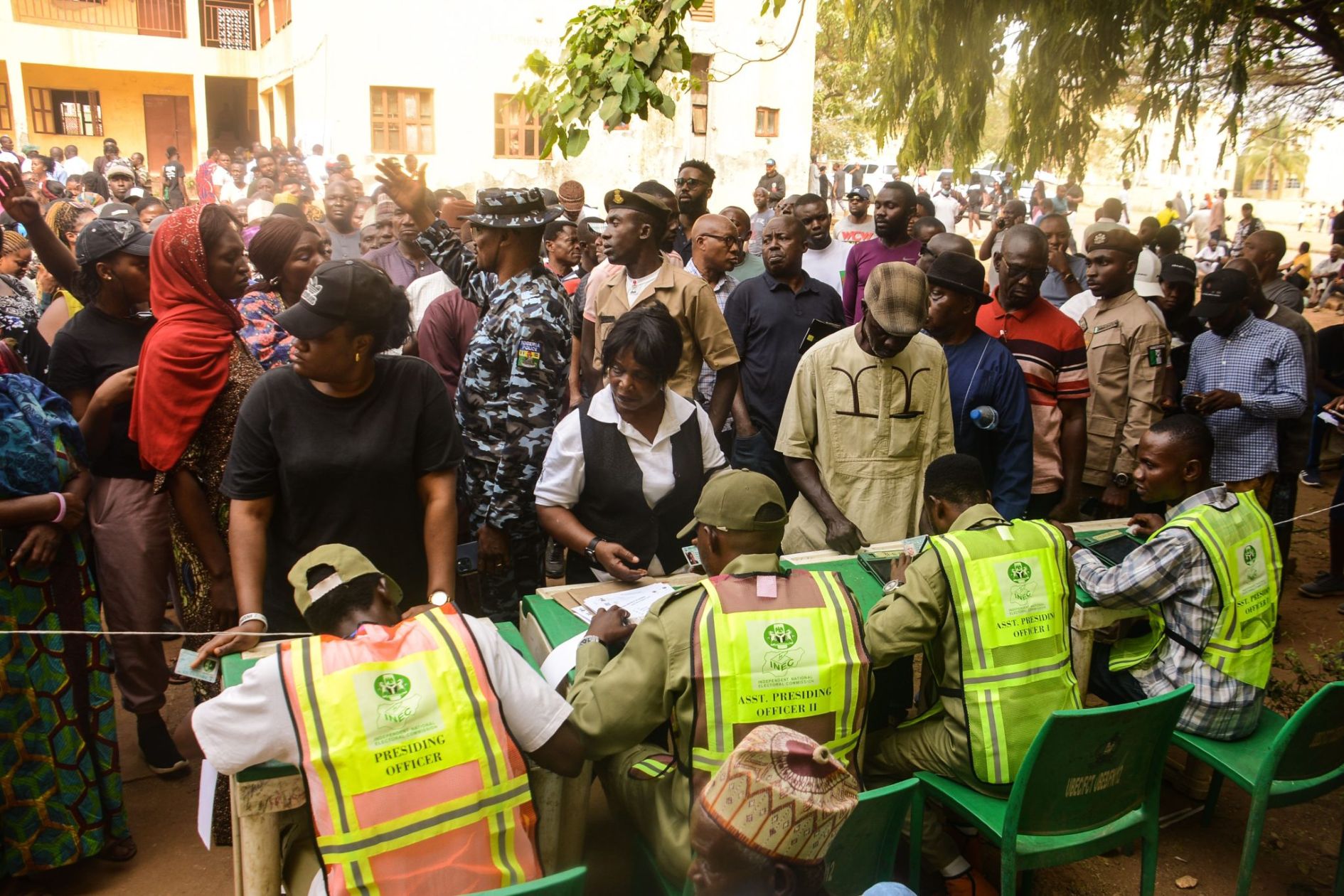
• Insecurity, economic hardship threaten voter participation
• Urbanus, Omole seek election-specific security plans, protection for voters
• Uwazurike raises concerns over INEC’s impartiality, calls for credible polls
• Mikko, Nwosu express optimism about stronger turnout in 2027
• NOA pledges nationwide voter education, civic sensitisation
• Lagos tops state register with 7.49m voters as Bayelsa records lowest figure
Nigeria’s 103.4 million registered voters present a formidable opportunity for democratic participation, but the country’s declining election turnout raises a critical question: how many will exercise their franchise in 2027?
From insecurity and economic hardship to distrust of electoral institutions and political disillusionment, several factors could determine whether millions of eligible citizens make their way to polling units or remain on the sidelines of the electoral process.
Announcing the significant increase in the number of registered voters, Chairman of the Independent National Electoral Commission (INEC) Prof. Joash Amupitan, disclosed that the North-West and South-West geopolitical zones recorded the highest numbers of registered voters, while the South-East had the lowest. The commission put the 2026 national voter register at 103,428,715.
Amupitan, who delivered a keynote address at a strategic workshop organised by the Nigerian Guild of Editors, said voters aged 18 to 49 accounted for more than 73 per cent of the national register, while Persons With Disabilities (PWDs) numbered 232,658.
The latest figure is about a 10 million increase compared with the figure before the 2023 general elections, and almost a 20 million increase over the 2019 figure.

Although studies are ongoing to establish the reasons for the steady increase in voter registration, concerns about the credibility of the electoral process, violence and political intolerance have been identified as factors discouraging eligible voters from exercising their civic responsibilities.
What the latest number says
PLACED alongside voter turnout in the last eight off-cycle governorship elections, the growing electorate raises questions about the potential to overcome voter apathy.
However, opinions are divided on whether registering more citizens will translate into improved turnout at polling units. For instance, turnout figures from eight states where off-cycle governorship elections were held show that a growing voter register does not automatically translate into higher participation.
Anambra, Bayelsa, Imo, Kogi, Edo, Ondo, Ekiti and Osun recorded considerable variations in turnout, ranging from approximately 10.2 per cent in Anambra in 2021 to 43.2 per cent in Osun in August 2026.
Anambra recorded the lowest participation, at 10.2 per cent, followed by Edo with 22.2 per cent and Ondo with 24.8 per cent. Bayelsa and Imo recorded 27.5 per cent and 27.8 per cent, respectively, while Ekiti had 36.1 per cent. Kogi recorded 41 per cent, with Osun posting the highest turnout, at 43.2 per cent.
In Osun, 1,005,800 votes were cast from a register of 2,339,544 voters, meaning that more than half of the registered electorate did not cast a recorded vote.
Although off-cycle governorship elections differ from presidential and legislative contests in their political stakes, campaign structures and mobilisation, the figures illustrate the gap between voter registration and actual participation.
The trend is also evident in presidential elections. INEC’s historical data put turnout at 53.68 per cent in 2011, 43.65 per cent in 2015, 34.75 per cent in 2019 and 26.71 per cent in 2023. The last figure indicated that fewer than three in 10 registered voters participated in the presidential election.
If the 2023 turnout rate were applied to the new register of 103.4 million voters, approximately 27.6 million people would participate in the 2027 general election, leaving about 75.8 million registered voters without a recorded vote. This is an illustration rather than a prediction, as participation could change depending on the political environment, electoral credibility, security conditions and the effectiveness of party mobilisation.
evertheless, the calculation underscores the challenge facing electoral authorities and political parties as they seek to convert the country’s growing electorate into active participants in the democratic process.
Several factors could discourage voting, including insecurity, economic hardship, distrust of electoral institutions, dissatisfaction with political leadership and logistical difficulties. Although turnout figures alone cannot establish the relative importance of these factors, insecurity remains a significant concern because it can prevent willing voters from reaching polling units.
In communities affected by insurgency, banditry, kidnapping and communal violence, fear for personal safety may discourage residents from travelling to vote. Displacement can also leave eligible voters far from their designated polling units, while attacks and threats against electoral officials, political actors and citizens can disrupt preparations and undermine confidence in the process.
A former Assistant Commandant General of the Nigeria Security and Civil Defence Corps, Billie David Urbanus, said the government must intensify security efforts in areas ravaged by insurgency and banditry to reassure citizens that they can safely participate in the 2027 elections.
He warned that the growing number of registered voters would not necessarily translate into higher turnout if residents in troubled communities continued to fear for their lives.
“People cannot be expected to exercise their civic responsibilities when their safety is not guaranteed. Those living in insurgency- and banditry-affected areas may be afraid to leave their homes, let alone travel to polling units to vote,” he said.
Urbanus urged the government to restore peace and stability in affected communities, arguing that residents would be more confident about participating in elections if their safety could be guaranteed.
The Director-General of the Institute for Police and Security Policy Research (IPSPR), Dr Charles Omole, also called for an election-specific security strategy, particularly in areas affected by insurgency and banditry.
He recommended that security agencies develop threat-based plans for affected local government areas, supported by clear command structures, rapid-response teams and measures to protect polling units, electoral officials and routes used by voters.
Omole urged INEC to conduct an early security and voter-accessibility audit to identify communities at risk of exclusion. He also advocated collaboration among the commission, security agencies, traditional rulers, community leaders and humanitarian organisations to develop lawful arrangements for displaced voters and communities that may be difficult to access.
He said internally displaced persons should receive clear information about where and how they could vote, with any arrangements complying with the Electoral Act and applicable regulations.
Beyond insecurity, economic hardship may discourage participation when transport expenses, lost wages and other election-day costs make voting difficult. Residents of remote communities may face additional obstacles where polling units are far away, or transport is inadequate.
Political disillusionment is another possible factor. Citizens who believe elections will not produce meaningful change may question the value of voting, while doubts about electoral transparency, result management and the handling of complaints could weaken confidence in the process.
A chieftain of Ohanaeze, Goddy Uwazurike, said restoring public confidence would be crucial to encouraging Nigerians to participate in the 2027 election. He urged INEC’s leadership to demonstrate impartiality and place the national interest above sectional or individual considerations.
Uwazurike said perceptions about the composition of the commission’s leadership could undermine confidence in its neutrality.
“The insinuation is that key positions in the commission are dominated by people from a particular section of the country because of a particular candidate,” he said.
He also called on the government to curb electoral violence, warning that voters might stay away from polling units in areas where violence was anticipated.
Such concerns underline the importance of distinguishing between voter apathy and the inability to participate. Low turnout does not necessarily mean that citizens have lost interest in elections; some may be prevented from voting by insecurity, intimidation or practical barriers.
Omole urged political parties to take mobilisation seriously by using trusted local networks to counter misinformation, encourage peaceful participation and reassure citizens that their votes matter. He also called on INEC to intensify voter education through local radio, community organisations and languages understood by residents, particularly in vulnerable communities.
He recommended establishing a joint electoral security coordination mechanism well before election day, with clear reporting channels, incident monitoring and agreed contingency plans. Any decision to relocate or suspend voting, he said, must be lawful, transparent and promptly communicated.
“My central point is this: we must not confuse voter apathy with voter intimidation or voter exclusion. Low turnout may be as a result of security concerns and not a lack of interest by voters. Where insecurity prevents citizens from voting, the solution is not simply to urge them to turn out; it is to reduce the danger, remove practical barriers and restore confidence in the electoral process. Every eligible Nigerian should have a realistic and safe opportunity to exercise their franchise,” he said.
Despite concerns about declining turnout, a former member of the House of Representatives from Rivers State, Bernard Mikko, expressed optimism that more Nigerians would participate in the 2027 election.
Mikko, a member of the Nigeria Democratic Congress (NDC), said he expected voters to turn out in large numbers to bring about a change in the administration of President Bola Tinubu. His position reflects the possibility that dissatisfaction with the incumbent government could encourage greater participation rather than increase voter apathy.
Former ADC National Chairman Ralph Nwosu also expressed confidence in his party’s mobilisation efforts, saying it had done its homework and that its supporters would come out to vote.
The National Orientation Agency (NOA), on its part, has pledged to intensify voter education and civic sensitisation nationwide ahead of the 2027 general elections.
The agency’s Director-General, Mallam Lanre Issa-Onilu, said the NOA would work closely with INEC, security agencies, the media and other stakeholders to promote informed, peaceful and responsible participation in the electoral process.
He said the NOA would leverage its presence across all 774 local government areas to reach citizens through community leaders, markets, motor parks, radio, television and social media platforms.
Issa-Onilu described voting as a civic responsibility and urged Nigerians to participate confidently and responsibly in the electoral process.
Political party participation
The revised voter register provides political parties with a useful resource for voter education, strategic planning and mobilisation. By analysing the figures and conducting a SWOT analysis, parties can identify their strengths and weaknesses, assess opportunities and threats, and develop strategies to maximise voter participation.
The 2026 Register of Voters presents a nationwide picture of voter registration across Nigeria’s 36 states and the Federal Capital Territory (FCT). A total of 103,428,715 voters were registered nationwide, with each state contributing a share of the national total. The figures below follow the order in which the states appear in the official register, showing their respective registration figures and percentage contributions to the national total.
Abia State recorded 2,306,520 registered voters, representing 2.23 per cent of the national total. Adamawa State followed with 2,431,146 voters, or 2.35 per cent. Akwa Ibom State registered 2,566,196 voters, accounting for 2.48 per cent. Anambra State recorded 2,917,728 voters, contributing 2.82 per cent to the national register. Bauchi State had 3,012,547 registered voters, representing 2.91 per cent. Bayelsa State recorded 1,200,691 voters, the lowest number among the states, accounting for 1.16 per cent of the national total.
Benue State registered 3,057,225 voters, contributing 2.96 per cent. Borno State followed with 2,765,165 voters, or 2.67 per cent. Cross River State recorded 1,928,978 voters, representing 1.87 per cent. Delta State had 3,525,988 registered voters, accounting for 3.41 per cent. Ebonyi State registered 1,828,056 voters, contributing 1.77 per cent. Edo State recorded 2,865,263 voters, or 2.77 per cent of the national total.
Ekiti State registered 1,055,708 voters, representing 1.02 per cent, the smallest percentage contribution among the states. Enugu State followed with 2,217,862 voters, or 2.14 per cent. The Federal Capital Territory (FCT) recorded 1,732,043 voters, accounting for 1.67 per cent. Gombe State had 1,768,566 registered voters, representing 1.71 per cent. Imo State recorded 2,706,052 voters, contributing 2.62 per cent. Jigawa State followed with 2,807,811 voters, or 2.71 per cent.
Kaduna State registered 4,662,640 voters, accounting for 4.51 per cent of the national total. Kano State recorded 6,570,276 voters, contributing 6.35 per cent. Katsina State had 3,876,051 registered voters, representing 3.75 per cent. Kebbi State recorded 2,309,503 voters, or 2.23 per cent. Kogi State followed with 2,232,398 voters, contributing 2.16 per cent. Kwara State registered 1,916,376 voters, representing 1.85 per cent.
Lagos State recorded the highest number of registered voters in the country, with 7,488,633, accounting for 7.24 per cent of the national total. Nasarawa State followed with 2,137,699 voters, or 2.07 per cent. Niger State registered 2,983,476 voters, contributing 2.88 per cent. Ogun State had 3,037,981 registered voters, representing 2.94 per cent. Ondo State recorded 2,116,057 voters, or 2.05 per cent. Osun State followed with 2,327,784 voters, contributing 2.25 per cent.
Oyo State registered 3,588,111 voters, accounting for 3.47 per cent. Plateau State recorded 2,906,570 voters, or 2.81 per cent. Rivers State had 3,736,434 registered voters, representing 3.61 per cent. Sokoto State followed with 2,633,113 voters, contributing 2.55 per cent. Taraba State recorded 2,254,380 voters, or 2.18 per cent. Yobe State registered 1,733,671 voters, representing 1.68 per cent. Finally, Zamfara State recorded 2,224,017 voters, accounting for 2.15 per cent of the national total.
Governorship spread
The 2027 electoral cycle saw 22 political parties submit nominations for governorship and deputy governorship positions, as well as seats in the State Houses of Assembly. The submissions indicate varying levels of participation, with some parties recording more nominations than others. The governorship and deputy governorship category recorded a total of 940 submissions, while the State House of Assembly category had 9,962 submissions.
Accord (A) submitted 48 nominations, while Action Alliance (AA) recorded 42. Action Democratic Party (ADP) followed with 50 submissions, while Action Peoples Party (APP) submitted 52 nominations. African Action Congress (AAC) recorded 34, the lowest figure among the first group of parties. African Democratic Congress (ADC) submitted 56 nominations, matching the All Progressives Congress (APC), which also recorded 56. All Progressives Grand Alliance (APGA) submitted 40 nominations, while Allied Peoples Movement (APM) recorded 54 submissions.
Boot Party (BP) submitted 16 nominations, the lowest figure in this category. Democratic Leadership Alliance (DLA) followed with 24. Labour Party (LP) recorded 50 submissions, while National Democratic Party (NDP) submitted 42, matching the National Rescue Movement (NRM), which also recorded 42. New Nigeria Peoples Party (NNPP) submitted 48 nominations, while Nigeria Democratic Congress (NDC) recorded 56, matching ADC and APC. Peoples Democratic Party (PDP) submitted 54 nominations, matching APM, while Peoples Redemption Party (PRP) recorded 32. Social Democratic Party (SDP) submitted 56 nominations, matching ADC, APC and NDC. Young Progressives Party (YPP) recorded 42, matching AA and NRM.
Youth Party (YP) submitted only two nominations, the lowest figure in the category, while Zenith Labour Party (ZLP) recorded 44 submissions.
The governorship and deputy governorship category recorded 940 submissions across the 22 parties.
How the parties share the votes cast by the 103 million registered voters could offer a clearer picture of the direction of Nigeria’s democracy.

