 Follow Us on Google News


 Follow Us on Google Discover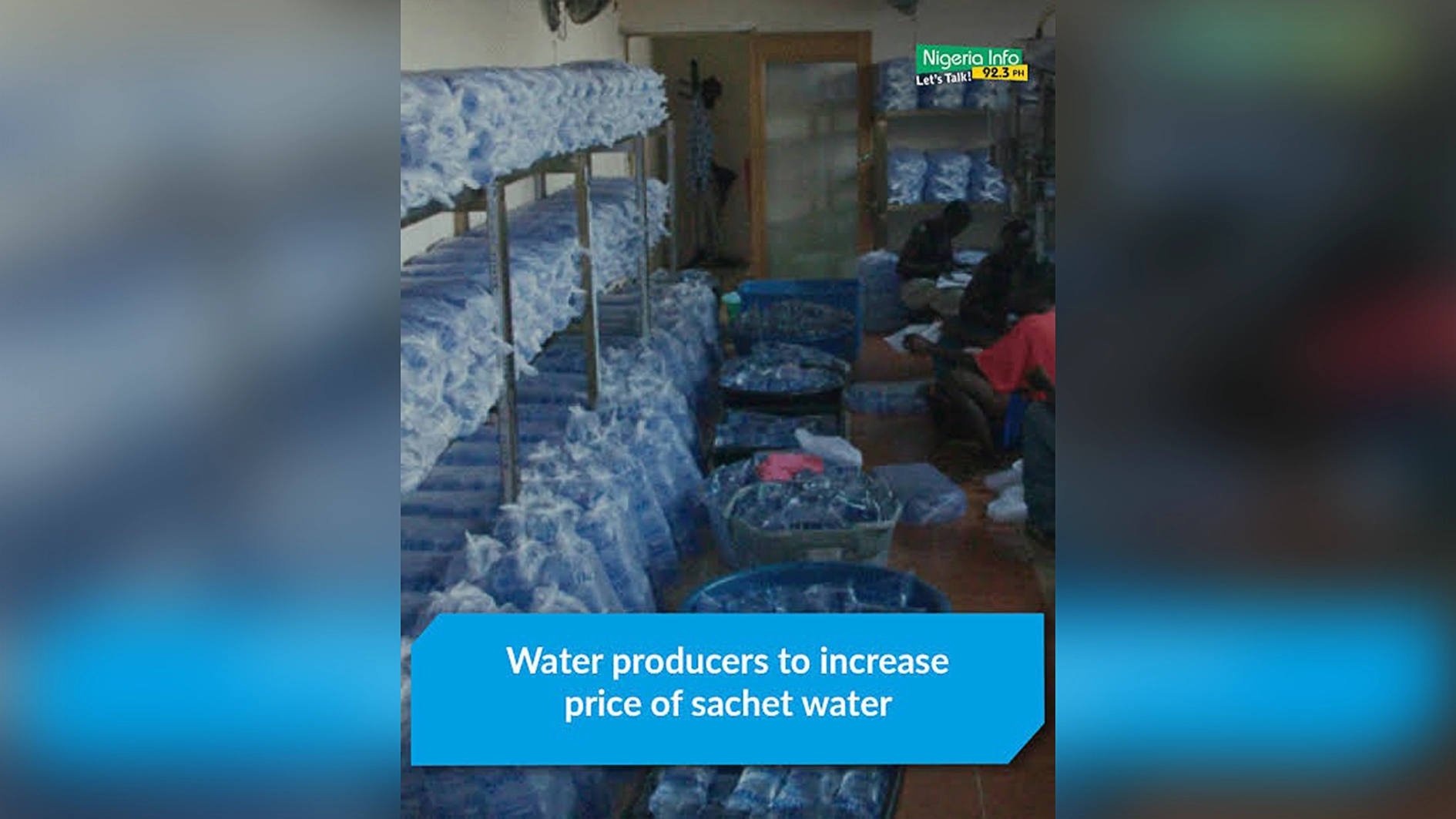
For residents who rely on sachet water for their daily drinking needs, the rising cost of the commodity is becoming another strain on already stretched household budgets, with a bag now selling for as much as N500 in parts of Lagos.
In Oshodi and Abule Aja, residents, retailers and producers have reported increases in prices, although the amount charged varies from one seller to another. While some retailers still sell a bag for N400 or N450, others have raised their prices to N500.
For consumers who buy water in smaller quantities, the increase is equally noticeable. What used to be three sachets for N100 has, in some places, become two sachets for the same amount.
A resident of Oshodi, Esther Pelumi, said she previously bought a bag of sachet water for N350 but was surprised to find that the price had risen to N500 this week.
Another resident, Noble Ojeh, said the price had increased from N300 to N400 before rising again to N500 last week.
For Chinenye Matthew, another Oshodi resident, the change became apparent during a routine purchase outside her home.

Although her family usually buys water in bulk, she said she had previously been able to buy one sachet for N15 or three for N100. This week, however, sellers no longer offered the three-sachet deal, leaving her with only two sachets for N100.
The changes mean that residents must either spend more to maintain their usual consumption or adjust how much water they buy at a time.
For households that depend on sachet water every day, the increase adds another expense to the cost of meeting basic needs.
Retailers say they are also grappling with higher purchase prices, leaving them with little room to maintain previous selling rates.
A sachet water seller in Oshodi, Taiwo Afolabi, said the price of a bag had risen from N350 to N450. She also said a previous arrangement under which customers who bought 10 bags received an additional bag had been discontinued. Under the new arrangement, customers receive only the 10 bags they pay for.
Another retailer, Mrs Susan Olagunji, said she previously bought five bags for N1,700 but now paid N2,000 for the same quantity. According to her, the increase took effect nearly two weeks before the interview.
Mrs Ajoke Fatoyi, another seller, who spoke through Sunday Akinyemi during the interview, reportedly raised her selling price from N400 to N500 per bag.
The different prices reflect variations in supply arrangements and retailers’ costs, but they also show how increases at the wholesale level can eventually affect consumers.
At the production end, the manager of Spectrum Pure Water in Abule Aja, who identified himself simply as Seun, said the price of a bag had recently increased from N480 to N500.
He attributed the adjustment to a decision by the association representing sachet water producers in Lagos to adopt N500 as the standard selling price, adding that the change took effect this week.
Seun also cited rising costs of nylon, fuel and other materials used in production as major reasons for the increase.
Oluwaseun Raji, managing director of Todd Global Business Connects, producers of Tomis Water in Oshodi, similarly identified packaging materials and fuel as significant pressures on manufacturers.
Raji said the price of one kilogramme of nylon roll rose from N3,100 in February to N4,100 in March 2026. Although it later dropped to N3,900, he said the cost remained above its earlier level.
He said the company increased its selling price from N300 to N350 per bag in response to rising production expenses.
A subsequent reduction in packaging costs had provided some relief, he added, but fuel expenses remained high.
The accounts from producers and retailers suggest that the price increases are linked to higher operating costs, although the final amount paid by consumers varies across locations and sellers.
For the Assistant Executive Director of Corporate Accountability and Public Participation Africa (CAPPA), Zikora Ibeh, however, the rising price of sachet water raises a broader concern about access to safe and affordable drinking water.
Ibeh said it was unfortunate that producers continued to raise prices in response to the difficult economic environment, particularly because many Nigerians, including residents of Lagos, had become dependent on sachet and bottled water due to unreliable public water services.
She said the increase must be considered against the earnings of ordinary residents, particularly informal workers, many of whom earn less than the national minimum wage. “Moving from N350 to N500 a bag is an immediate 43 per cent jump,” she said.
According to Ibeh, a household buying one bag daily would spend about N15,000 a month on drinking water alone, excluding the water needed for cooking, bathing and washing.
She said such expenditure could force families to make difficult choices, with money that should go towards food, rent, transport and school fees diverted to meeting their water needs.
For households unable to afford sachet water, Ibeh warned that the alternatives could expose them to health risks.
She said some people might turn to unverified wells, open streams and questionable boreholes, while sachet water itself was not always guaranteed to be safe.
The description “pure water”, she noted, did not automatically establish that the product was free from contamination.
Ibeh linked the rising cost of sachet water to wider problems with public infrastructure, arguing that residents were paying privately for essential services that should be accessible through effective public systems.
She said the unreliable electricity supply also increased production costs, as manufacturers had to rely on fuel-powered generators, with the additional expenses eventually reflected in retail prices.
In effect, she argued, households were paying for the shortcomings of public water supply and then bearing the cost of the energy required to produce the alternatives they depended on.
Despite the situation, Ibeh said the Lagos State Government had an opportunity to address the problem by strengthening public water infrastructure and expanding access to safe drinking water.
She urged the government to adequately fund and equip the Lagos Water Corporation, repair damaged pipes, restore waterworks, expand distribution and employ enough personnel to sustain operations.

