 Follow Us on Google News


 Follow Us on Google Discover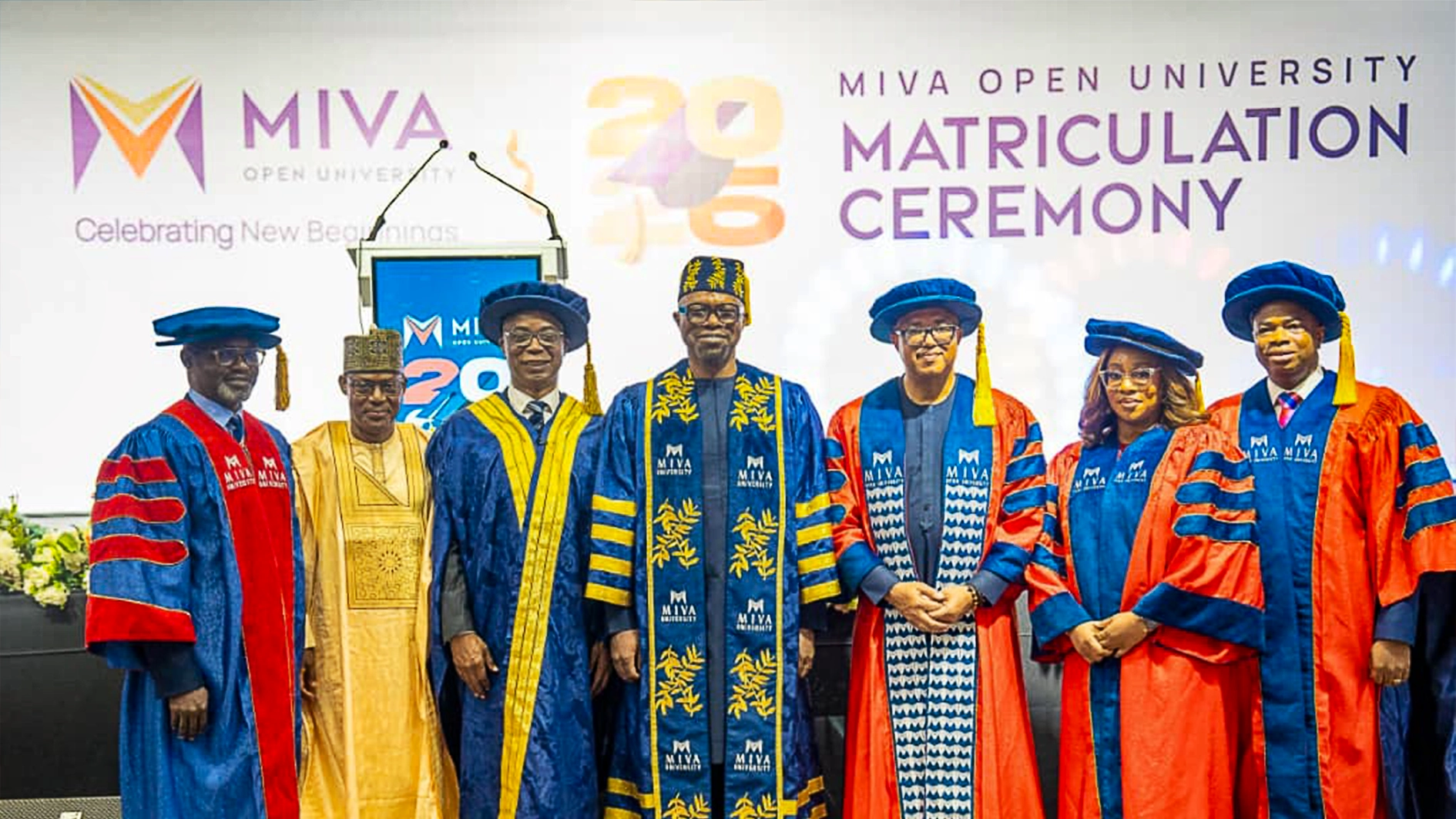
Miva Open University has set a target of reaching one million African learners over the next decade, following a record admission of 12,260 new students in its latest matriculation exercise.
The university’s Chancellor, Sim Shagaya, disclosed this at its 2026 matriculation ceremony in Abuja, revealing that more than 40,000 students had enrolled since the institution commenced operations in 2023.
Shagaya said the institution was working towards establishing study centres in every local government area in Nigeria, alongside developing state-of-the-art robotics and drone laboratories and a world-class research institution.
He said the one-million-learner ambition was not merely a slogan but a commitment to expanding educational opportunities without compromising academic standards.
“Our ambition is to impact one million Africans over the next decade, and it is not just a slogan; it is a commitment,” he said.
The chancellor, who described the university’s growth as evidence of the potential of technology to transform access to higher education, said Miva had progressed from its initial enrolment of about 500 students to more than 40,000.

Shagaya said the university was established to address barriers that prevent capable Nigerians and other Africans from accessing quality education, particularly those constrained by work, family responsibilities, financial difficulties or conventional university admission structures.
According to him, Africa’s projected population growth presents both an opportunity and a responsibility to rethink how societies organise education, develop human capital and prepare young people for the future.
He noted that Africa’s population, estimated at 1.6 billion, was expected to exceed two billion by 2038, requiring new approaches to education and economic development.
The chancellor argued that traditional approaches to education could no longer adequately meet the needs of a rapidly growing population, insisting that technology-enabled learning would be critical to widening access.
“When we set out to build Miva, we asked ourselves one question: Why should a brilliant mind be locked out of quality education by lack of access, or even worse, because we insist that the way things have always been done must be the way they will always be done?” he asked.
He said the university had already demonstrated its commitment to providing opportunities for people who might otherwise have abandoned their educational ambitions.
Shagaya also revealed that two members of his household staff were among the matriculating students, describing them as examples of the kind of people the university was established to serve.
He, however, warned the new students that the flexibility of online education should not be mistaken for an easy route to obtaining a degree.
He said the university owed its students rigorous academic standards, accessible lecturers, learning centres and technological support, including an artificial intelligence learning companion to assist them with their studies.
“We owe you rigour. Your degree must carry weight in an interview room, in a boardroom, and in a country you choose to work in, whether that is Nigeria or elsewhere,” he said.
The chancellor urged students to embrace discipline, consistency, curiosity and hard work, stressing that their academic success would depend on sustained effort rather than talent alone.
He also called on them to challenge ideas, engage critically with their studies and support fellow students who might struggle with the demands of their programmes.
Shagaya expressed confidence that graduates of the university would contribute to addressing Africa’s development challenges, including the need for better infrastructure, electricity, water supply, security and economic opportunities.
He said the continent’s expanding population made it imperative to develop new systems for education, governance and economic organisation.
In his address, Vice-Chancellor of the institution, Prof. Tayo Arulogun, reaffirmed the university’s commitment to expanding access to quality higher education through flexible, technology-driven learning.
He said the institution was focused on providing students with the knowledge, practical skills and competencies required to thrive in an increasingly competitive global economy.
Prof. Arulogun noted that Miva’s growing student population reflected the increasing demand for alternative pathways to university education, particularly among Nigerians seeking to combine academic pursuits with work, business and family responsibilities.
He urged the newly matriculated students to take their studies seriously, remain disciplined and make effective use of the learning resources available to them.
In his keynote address, the Assistant Director-General, World Health Organisation (WHO), Dr Chikwe Ihekweazu, urged Nigerian students to use education to challenge injustice, demand accountability and create opportunities for others, warning against pursuing academic qualifications solely for personal success.
Ihekweazu, who served as the pioneer Director-General of the Nigeria Centre for Disease Control (NCDC), challenged the new students to develop the knowledge, skills and social consciousness needed to contribute to national development.
He cautioned students against abusing artificial intelligence (AI) to obtain academic qualifications without acquiring the knowledge and skills their education was intended to provide.
According to him, digital learning has expanded access to knowledge, while AI is transforming how people learn, work and access information.
He, however, warned that students must choose between using the technology to deepen their understanding and relying on it to avoid learning.
“If you use AI to deceive your assessors to pass rather than to learn, you may actually get the grades. You may even get the degree, but you will have denied yourself something far more valuable: the education that you actually came to seek,” he said.
On Nigeria’s development challenges, Ihekweazu urged the students not to lose hope in the country, insisting that its future depended on educated, engaged and courageous citizens rather than natural resources alone.
The Nigerian epidemiologist and public health physician argued that the country’s education challenges, including millions of out-of-school children and poor conditions in many schools and universities, reflected policy choices and misplaced priorities rather than inevitable circumstances.
“The millions of children who are out of school today, and the poor conditions in many of our schools and universities, are not inevitable. They reflect the choices of our political leaders about how our commonwealth is used and what our country prioritises,” he said.
He questioned the rationale behind prioritising expensive infrastructure and official convoys over investments in education, saying such decisions determined the country’s development trajectory.
The WHO official urged students to see education as a tool for societal transformation rather than merely a pathway to personal comfort, saying their qualifications should empower them to widen opportunities for others.
He cited the arguments in Why Nations Fail, a book by economists Daron Acemoglu and James Robinson, to explain how societies advance when institutions broaden access to opportunities and participation.
He noted that European societies, which are now regarded as relatively egalitarian, were historically characterised by aristocracies, monopolies and barriers that protected privileged groups.
According to him, wider access to education helped more people acquire the knowledge and confidence to challenge the status quo and demand more inclusive societies.
“Your degree may open doors for you, but your education should help you open doors for others,” he said.
Ihekweazu challenged the matriculating students to cultivate curiosity, read beyond their prescribed materials, ask difficult questions and develop expertise alongside character.
He also urged them to build relationships with people who could challenge their thinking, embrace technology as a learning tool and develop the courage to take opportunities even when they felt unprepared.
On employability, the former NCDC director-general warned that a university degree alone might not guarantee employment, urging students to acquire practical skills and demonstrate their capacity to solve problems.
He said employers were increasingly interested in what prospective employees could contribute to their organisations beyond academic qualifications.
He expressed hope that the students would graduate from Miva Open University with not only excellent academic qualifications but also practical knowledge, strong values and the confidence to make meaningful contributions to society.

