 Follow Us on Google News



 Follow Us on Google Discover
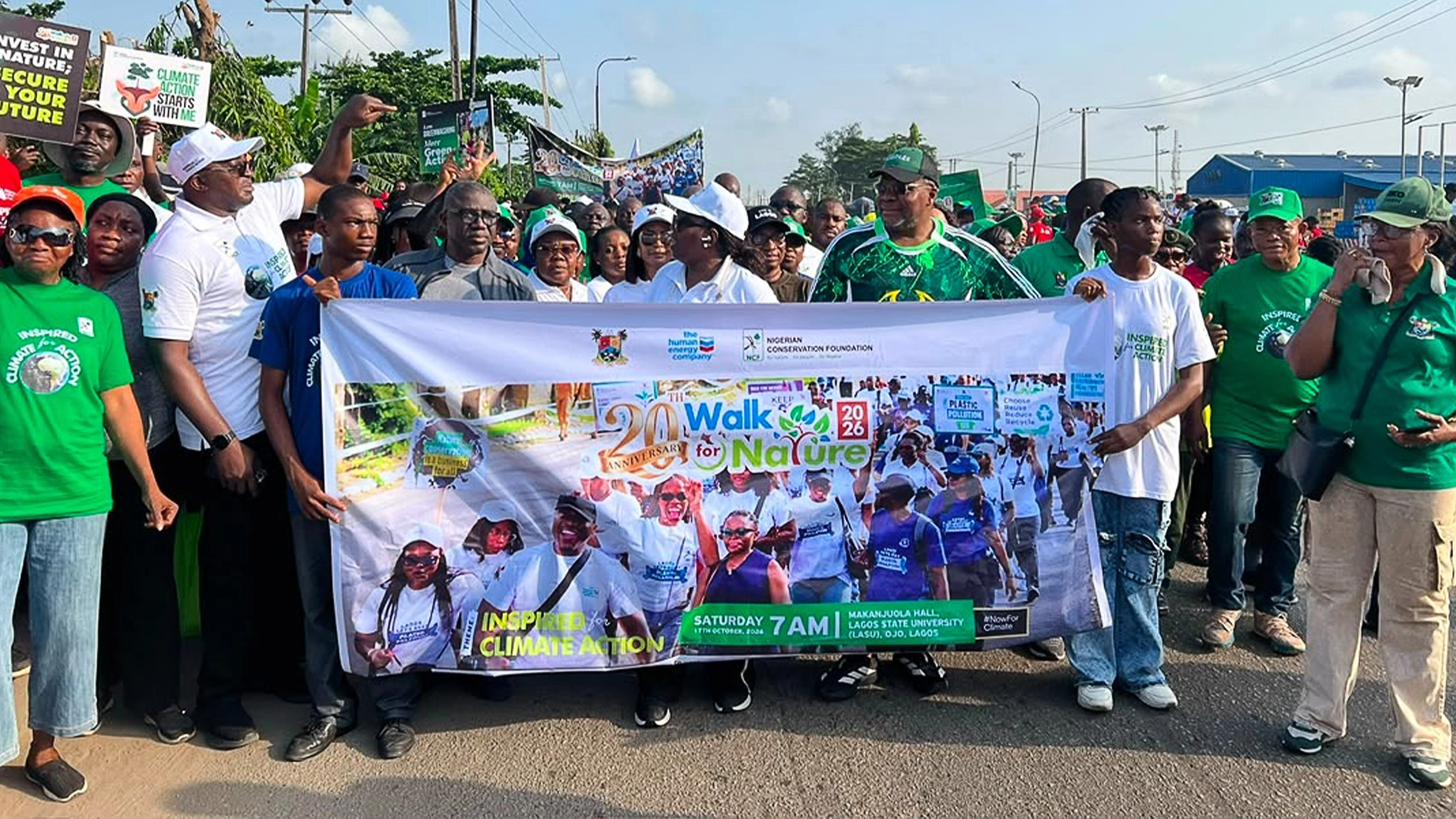
The Nigerian Conservation Foundation (NCF) has called on the Lagos State Government to introduce carbon budgeting, designate more protected wetlands, enforce compliance with Environmental Impact Assessment requirements and increase investment in green infrastructure, public transport and renewable energy.
The Chairman of the NCF National Executive Council, Hon. Justice Raliat Adebiyi, made the call at the 20th annual Walk for Nature, themed “Inspired for Climate Action: Lagos Must Listen, Our Action Matters.” The event, held at Lagos State University, Ojo, was organised in partnership with the Lagos State Government.
Adebiyi urged the state to make environmental protection central to its development decisions, saying climate action should go beyond public awareness to include stronger environmental policies, enforcement of existing requirements and increased investment in natural systems that protect communities against climate-related risks.
She called for the full domestication and implementation of the Climate Change Act 2021 at the subnational level, including carbon budgeting for Lagos, and the integration of nature-based solutions into the state’s climate adaptation and drainage master plans.
“Climate action must be fully integrated into land-use planning, flood management, urban development and environmental governance. What is required now is execution,” she said.
Adebiyi identified wetlands, forests, waterways and green spaces as essential to Lagos’ ability to withstand environmental pressures, warning that their destruction weakened natural systems that protected communities.

“Lagos is at the frontline of Nigeria’s climate vulnerability. A city surrounded by water yet increasingly threatened by it. Rising sea levels, annual flooding, extreme heat and the steady loss of wetlands are putting our communities, our livelihoods and our future at risk,” she said.
She also urged businesses to make environmental responsibility part of their investment decisions, supply chains, production systems and waste management, rather than limiting their commitments to sustainability reports and environmental, social and governance statements.
Adebiyi encouraged universities to use research and innovation to develop practical solutions to environmental problems. She also urged students to support community initiatives, promote responsible consumption and hold institutions accountable through informed advocacy.
Speaking at the event, Governor Babajide Sanwo-Olu, represented by the Permanent Secretary, Office of Environmental Services, Ministry of the Environment and Water Resources, Tajudeen Gaji, said development must comply with environmental and drainage requirements.
He stressed that wetlands and mangroves were important natural defences against flooding and coastal erosion, adding that Lagos’ coastal location, dense population and rapid growth made the protection of its natural ecosystems particularly important.
He said communities paid the price when wetlands were filled or built over, leaving water with nowhere to drain.
The governor also identified plastic pollution and blocked drainage channels as major environmental concerns, saying Lagos generated about 13,000 tonnes of waste daily, with plastics accounting for roughly 15 per cent. Much of the plastic waste, he said, ended up in drains, canals and the lagoon before returning to streets as floodwater during the rainy season.
Sanwo-Olu said the government was continuing to invest in drainage infrastructure, restore mangroves, plant trees and develop parks to strengthen the state’s resilience to flooding and extreme heat.
He added that the state had been enforcing its ban on Styrofoam and other single-use plastics since July 1, 2025, with sanctions for outlets found storing, selling or distributing prohibited items. The government was also working with innovators to develop sustainable alternatives and extending environmental education to schools and communities.
The governor urged residents to keep refuse out of drains, avoid single-use plastics and refrain from building on drainage channels and wetlands, noting that environmental protection required the participation of individuals and communities.
Earlier, Gaji said the state had intensified its tree-planting campaign in 2026, targeting 20,000 trees to improve air quality, cool urban areas, conserve biodiversity and strengthen climate resilience.
He said the government was also promoting waste recovery and recycling to reduce indiscriminate disposal and protect drainage channels, waterways and wetlands.
Gaji described wetlands as important to climate resilience, livelihoods, public health and sustainable development because they help regulate water, store carbon, support biodiversity and protect vulnerable coastal areas.

