 Follow Us on Google News



 Follow Us on Google Discover

Since 1 May 2026, licensed money transfer operators such as Western Union and MoneyGram have had to route every remittance they deliver in Nigeria through naira settlement accounts at Nigerian banks, under a Central Bank of Nigeria (CBN) circular dated 24 March 2026. The change comes as more money arrives through those operators. In a statement on 30 August 2026, the CBN said inflows through them reached $947 million in July, a record for a single month. They totalled $3.8 billion in the first seven months of the year, 50.2 per cent more than in the same period of 2025. The CBN governor, Olayemi Cardoso, has set a target of $1 billion a month. Two years earlier, the bank had reported $553 million for July 2024 as an all-time high.
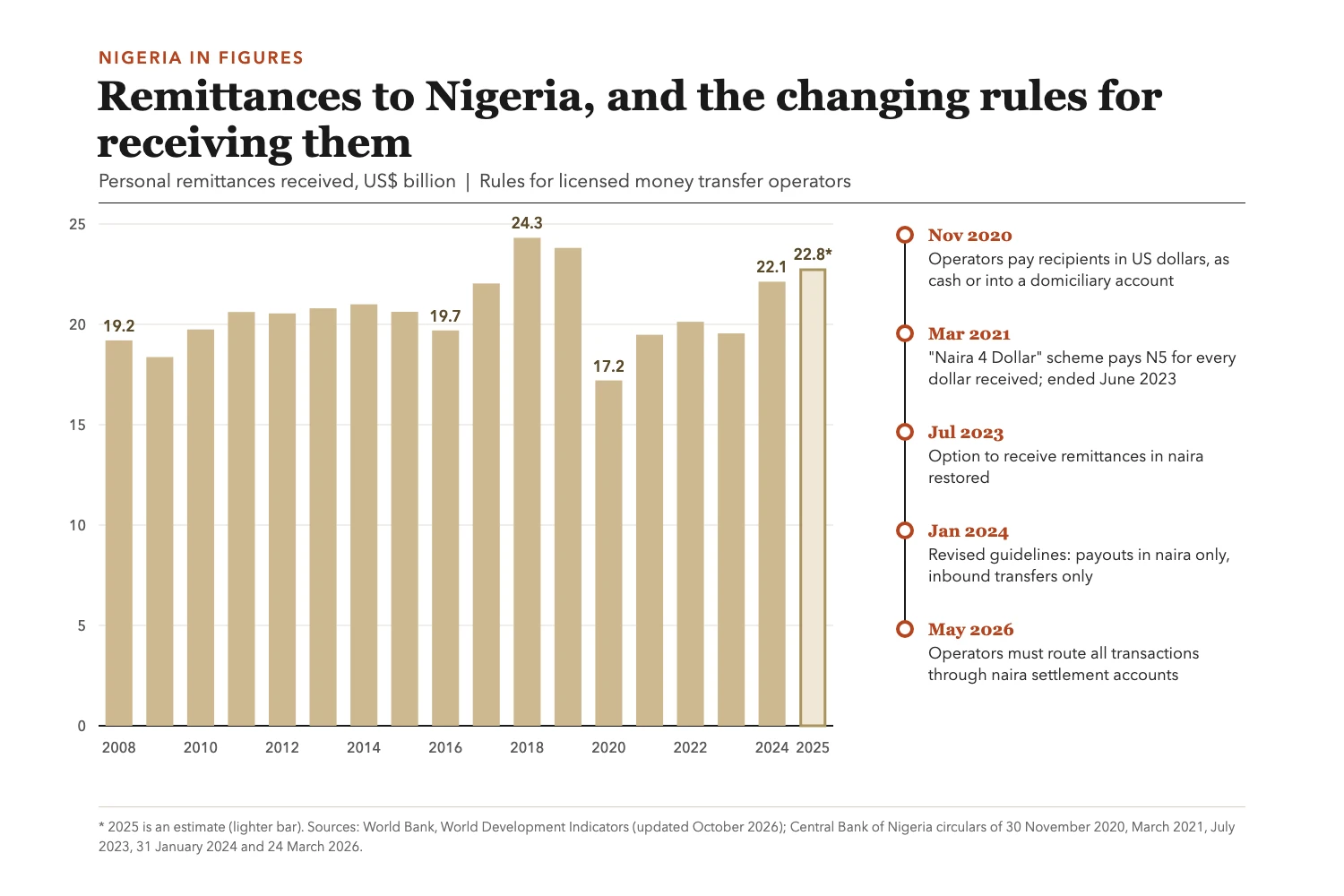
Remittances as a whole are much larger. Money sent home by Nigerians living abroad is one of the country’s largest sources of foreign exchange. World Bank data, last updated in October 2026, put personal remittances received by Nigeria at an estimated $22.8 billion in 2025, up from $19.5 billion in 2023. In 2024, Nigeria received $22.1 billion, about 39 per cent of the $57.2 billion recorded for the whole of sub-Saharan Africa and roughly three times the amount received by Ethiopia, the next largest recipient in the region.
For the families and businesses at the receiving end, a common problem is a transfer that the sender says has left but that has not yet arrived.
Did the CBN ban dollar payouts?
Leadership newspaper reported the March circular as a ban on foreign currency payouts from 1 May. The circular itself, reference TED/FEM/FPC/PUB/001/002 and signed by Musa Nakorji, director of the CBN’s Trade and Exchange Department, deals with settlement accounts and pricing and does not mention the currency in which recipients are paid. The requirement that licensed operators pay recipients in naira dates from the CBN’s revised guidelines of 31 January 2024, as the law firm Udo Udoma & Belo-Osagie notes in its analysis of the circular.
The operator rules do not cover money sent directly from a bank abroad to a Nigerian bank over Swift. A payment of that kind in foreign currency can be credited to a domiciliary account.
Two routes into a Nigerian account
Money from abroad usually reaches Nigeria by one of two routes.

The first is a bank transfer. The sender’s bank sends a payment instruction over Swift, the messaging network that banks use for international payments, while the money itself moves through accounts that banks hold with each other. Nigerian banks keep foreign currency accounts with correspondent banks abroad, and the payment travels to that account, sometimes through one or more intermediary banks, before the Nigerian bank credits its customer. A payment sent in dollars or another foreign currency can be credited to a domiciliary account, the foreign currency account that Nigerian banks offer alongside naira accounts.
The second route is a licensed international money transfer operator (IMTO), such as Western Union or one of the app-based services. The sender pays the operator abroad, and the operator settles with a partner bank in Nigeria, which pays the recipient.
The two routes are governed by different rules, and the rules for the second have changed several times since 2020.
Rule changes since 2020
On 30 November 2020, the CBN directed that recipients of remittances sent through IMTOs should receive the money in foreign currency, either as dollar cash or as a credit to a domiciliary account at a bank of their choice. A clarification dated 2 December 2020 required operators to pay the funds into the correspondent accounts of their agent banks, which would then pay the recipients. A separate circular of 30 November 2020 allowed holders of ordinary domiciliary accounts funded by electronic or wire transfer to use the money without restriction for eligible transactions, while cash deposits stayed under the existing rules.
In March 2021, the CBN introduced the “Naira 4 Dollar” scheme, which paid recipients N5 for every dollar received through licensed operators. It was first set to run for two months, was extended in May 2021 and ended on 30 June 2023, the same month the CBN merged the segments of the official foreign exchange market into the Investors’ and Exporters’ window.
In July 2023, the CBN restored the option of receiving remittances in naira, priced at the rate of that window on the day of the transaction. In September 2023, it required operators to quote rates within 2.5 per cent either side of the previous day’s closing rate.
Both measures were replaced on 31 January 2024. The CBN’s revised guidelines for international money transfer services limit licensed operators to inbound transfers and require them to pay recipients in naira only, through a bank account or in cash, with no cash payments above $200. Operators must use the prevailing rate in the Nigerian Foreign Exchange Market on the day the transfer is received. A circular issued the same day removed the 2.5 per cent band. The guidelines also set a minimum share capital of $1 million and a licence application fee of N10 million.
The latest change is the circular of 24 March 2026, “Measures to Further Deepen Diaspora Remittances and Compliance”, which took effect on 1 May 2026. It requires every licensed operator to open naira settlement accounts with authorised dealer banks and to route all its transactions through them, including payments to recipients. Banks may transfer foreign currency from those accounts to other banks and to approved market participants, including licensed bureaux de change. Operators must use real-time prices from Bloomberg BMATCH as a guide when they price transactions.
Remittances to Nigeria in figures
In the World Bank’s series, recorded inflows rose from $1.4 billion in 2000 to $18.0 billion in 2007. Since then they have stayed between about $17 billion and $24 billion a year, with a high of $24.3 billion in 2018 and a low of $17.2 billion in 2020. The series puts the 2016 total at $19.7 billion. For 2026, balance of payments figures published by the CBN put personal transfers, which include workers’ remittances, at $11.1 billion in the first half of the year.
Measured against the size of the economy, the change has been larger. Remittances were equal to 8.8 per cent of gross domestic product in 2024, up from 4.0 per cent in 2023. Most of that rise reflects the smaller dollar value of the economy, which the World Bank puts at $252 billion in 2024, down from $487 billion a year earlier.
The number of Nigerians living abroad has also grown. United Nations estimates count about 2.1 million international migrants born in Nigeria in mid-2024, up from about 394,000 in 1990.
 Where a transfer can slow down
The cross-border leg is usually quick. Swift says its data show three in four cross-border payments arriving at the recipient’s bank within ten minutes. The longer wait usually comes at the end: Swift estimates that the final domestic step, from the receiving bank to the customer’s account, can take around 80 per cent of the total processing time.
A receiving bank may hold a payment while it reviews it under anti-money laundering rules, or while it resolves beneficiary details that do not match its records, for example a misspelt name or an account number with a missing digit. A payment that arrives after the bank’s cut-off time or on a non-working day is usually processed on the following business day. When a payment passes through an intermediary bank, that bank can also deduct a fee, so the amount that arrives can be smaller than the amount sent.
How a recipient can track a transfer from abroad
Each payment instruction on the Swift network includes a code of 36 characters known as the UETR, short for Unique End-to-end Transaction Reference. Intermediary banks must keep the code unchanged, so it stays with the payment from the first bank to the last. When a bank transfer is late, it is the first detail to ask for.
Senders can get the UETR from their bank, and it is often printed on the detailed payment confirmation, which banks may call the MT103 copy. An MT103 shows that the sending bank issued the payment instruction; it does not show that the money has been credited. With the UETR, the recipient’s bank can locate the incoming payment. Recipients can also check the payment themselves: a person waiting for money can track a wire transfer as the receiver by entering the UETR on an independent tracking service. One such service, uetr.ai, lets anyone check a Swift transfer free of charge. The user enters the 36-character code with the amount and date and sees the status reported for the payment, with bank codes such as ACSP (accepted, with settlement in process) and ACCC (credited to the recipient’s account) explained in plain English. Users can also ask to be emailed when the status changes.
Transfers through licensed operators work differently. They come with the operator’s own reference, such as Western Union’s money transfer control number (MTCN), and the operator’s website or app is the first place to check.
If the money has not arrived
Ask the sender for four details: the UETR or the operator’s reference number, the exact amount and currency, the date the transfer was sent, and the name of the sending bank or operator. Give them to your bank in writing and keep a copy.
The CBN asks customers to give their bank two weeks to resolve a complaint. If the bank has not resolved it by then, the complaint can be escalated to the CBN’s Consumer Protection Department, by email to [email protected] or by letter to its director, with evidence that it was first lodged with the bank.
The cost of sending money to Nigeria
The World Bank’s Remittance Prices Worldwide database tracks what money transfer providers charge. In the third quarter of 2025, sending $200 from the United States to Nigeria cost an average of 2.72 per cent of the amount. Sending £120 from the United Kingdom cost 1.96 per cent. The global average was 6.36 per cent.
Targets for cross-border payments set by the Financial Stability Board, which G20 leaders endorsed in 2021, call for three quarters of remittances in each corridor to reach the recipient within an hour by the end of 2027, and all of them within one business day. They also call for sending $200 to cost 3 per cent or less on average by 2030, with a ceiling of 5 per cent for any one corridor. On cost, both corridors to Nigeria are already under that mark.

