 Follow Us on Google News



 Follow Us on Google Discover
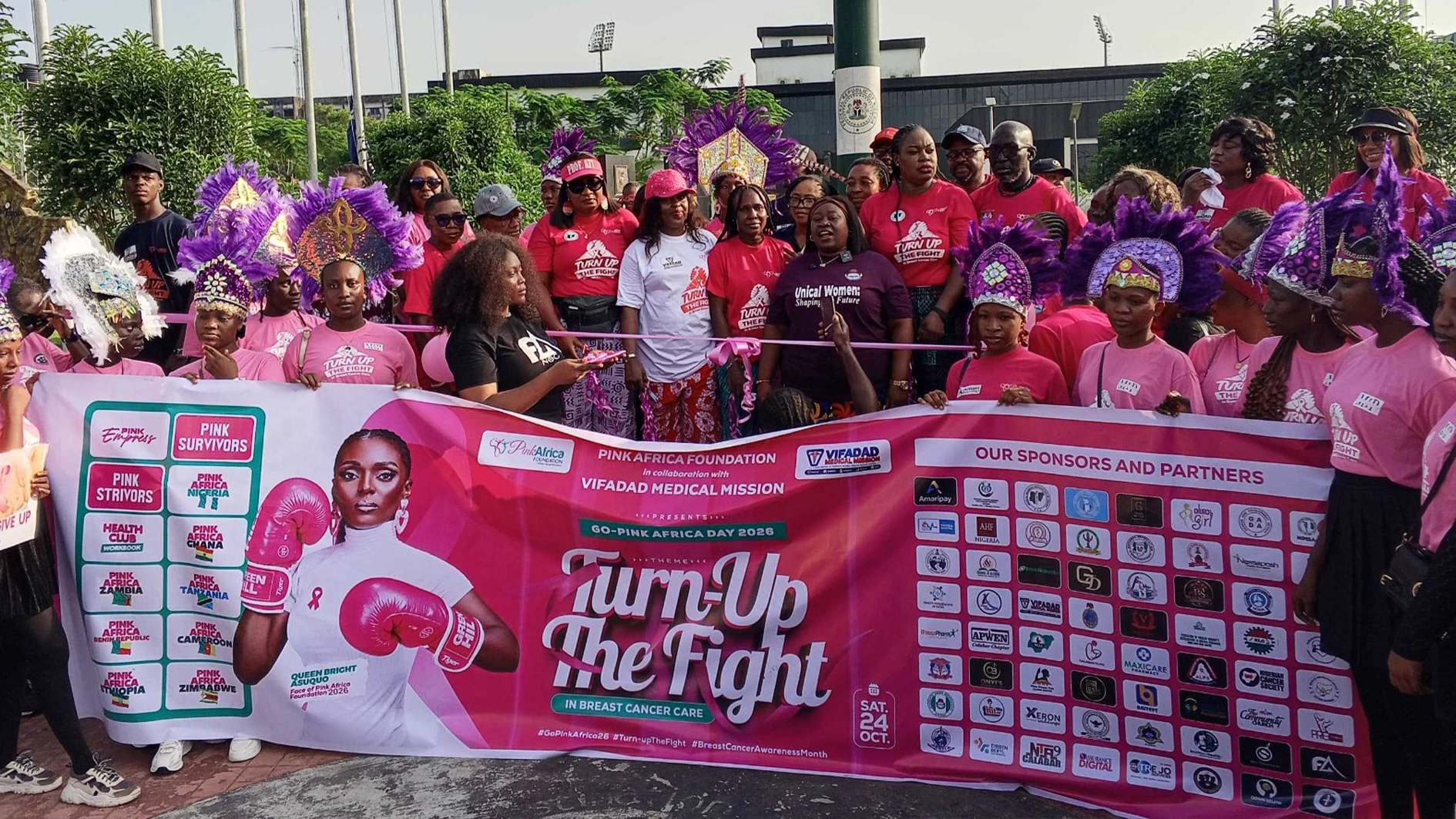
…As Pink Africa screens hundreds in Calabar
Stakeholders in the health sector have raised alarm over rising breast cancer burden in Nigeria, revealing that one in 11 women is at risk and 70 to 80 percent of cases present late, as Pink Africa Foundation offered free screening for breast, cervical, prostate cancers and eye care to hundreds in Calabar.
The free screening exercise, which also featured blood drive and first aid services, was part of the Go Pink Day 2026 global awareness event themed “Turn Up the Fight in Breast Cancer Care.”
Executive Director of Pink Africa Foundation, Glory Enoh Egrinya, said the theme is targeted at closing critical care gaps affecting women, especially in underserved communities.
“We are not just creating awareness. We are backing it up with action,” she said.
Egrinya flagged late presentation and poor awareness as major drivers of deaths, stressing monthly self-breast examination and immediate hospital visit for any lump, noting that not all lumps are cancerous.

She disclosed that the Foundation has sponsored several mastectomies and chemotherapy treatments, with many survivors recorded due to early detection.
“Early detection saves lives. Over 50 cases have been reported at our center since January, but many patients cannot afford even transport or basic investigations,” she said.
She lamented that treatment remains expensive and inaccessible in Cross River State, with few centers like the University of Calabar Teaching Hospital unable to meet demand, calling on government to subsidize care, provide more radiotherapy machines and deploy more oncologists.
“We need government to come in and support us. A woman is caught between buying food for her children and paying for treatment. Women in rural areas like Ikom don’t have access,” she appealed.
Corroborating, Executive Director of Asi Ukpo Hospitals and Asi Ukpo Comprehensive Cancer Centre, Calabar, Yegwa Ukpo, said Nigeria records about 144,000 new cancer cases yearly, with breast cancer as number one globally and in Nigeria, followed by cervical cancer in women and prostate cancer in men.
“The burden is quite heavy. About 60 percent of patients that come to our hospital are breast cancer patients. 70 to 80 percent present late,” Ukpo said.
He noted that breast cancer also affects men, hence the need for regular screening for both sexes, listing alcohol, smoking, processed foods, canned sausages and smoke-heavy foods like suya as carcinogenic, though cancer can still occur as a malfunction in body function.
“The best thing is regular checkups. There are cancers with no symptoms until it is too late. Testing does not invite cancer,” he warned.
On affordability, Ukpo disclosed that the hospital is in talks with the National Health Insurance Authority to include cancer care in health insurance to make it affordable.
Director General of Cross River State Primary Health Care Development Agency, Dr. Vivian Mesembe Otu, described breast cancer as the commonest cancer killing females in Nigeria and Africa, warning women against dying in silence.
“Many women present very late due to ignorance, poor awareness and beliefs, when it is already too late,” she said.
She said breast cancer is predominantly hereditary but other factors include obesity, sedentary lifestyle and smoking. She stressed monthly self-examination by dividing the breast into four quadrants and using the pad of fingers to feel for lumps.
“If we pick this lump early at fibroadenoma stage and remove it, the woman is free,” she said, lamenting limited resources and fake drugs.
She announced that Medical Women Association of Nigeria, Cross River Chapter, offers free breast and cervical screening every second Wednesday of the month at Barracks Road, Calabar, and that government is pushing mass enrollment into National and State Health Insurance Schemes while Pink Africa offers free mastectomy for confirmed cases at UCTH.
She added that rural women are being reached through radio jingles, social mobilization officers in all LGAs and social media.
President, Medical Women’s Association of Nigeria, Cross River Branch, Dr. Funke Ebughe, who put the risk at one in 11 women, warned that men account for 0.5 to 1 percent of cases.
“If you walk through streets and pass 100 people, at least 10 have risk factors. This is really scary,” she said.
Explaining the disease as abnormal mitotic changes in breast cells, she divided risk factors into non-modifiable – being female, advancing age after puberty, family history and BRCA genes – and modifiable – sedentary lifestyle, alcohol, tobacco including second-hand smoke, and excessive radiation.
On warning signs, she listed breast lumps, skin changes resembling orange peel with dimples, and nipple discharge of clear, coloured or bloody fluid when not breastfeeding.
“If not, by 2040, we will not be able to prevent 2.5 billion women from having breast cancer. Fighting it is not the job of health workers alone. Spread the right information and discard myths,” Ebughe urged.

