 Follow Us on Google News


 Follow Us on Google Discover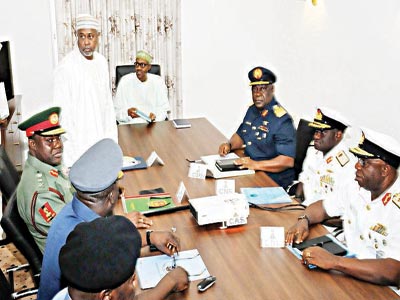
 FROM Borno to Yobe, Plateau and Kaduna states, the renewed attacks on people and institutions, including places of worship, all bore the trademarks of Boko Haram, even as no group has claimed responsibility for the heinous crime against humanity.
Indeed, there has been a change of government, with the new administration riding to power on the ‘change’ mantra, but that has not made the terror group to relent, resulting in the death of over 500 Nigerians so far.
If anything, it has changed tactics to its initial method of attacking soft spots, asymmetric attacks, before it declared a caliphate in parts of northern Nigeria.
Since the inauguration of President Muhammadu Buhari’s government on May 29, and as if reacting to his inaugural speech, where he vowed to crush the insurgency and assured Nigerians that they (insurgents) would be defeated soon, Boko Haram has stepped up its attacks, gradually eroding whatever victories the Nigerian military and other regional armies had achieved prior to that time.
To show that he meant it, he ordered that the military High Command and Control Room should be relocated to Maiduguri, the Borno State capital, from Abuja, a directive many Nigerians received with mixed reactions.
Buhari has in the last one month engaged in several security moves geared towards tackling the Boko Haram insurgency. But the renewed attacks by the sect members seems to have raise question on the ability or otherwise of the present government to deal with the monster.

Although it may be too early to assess the government’s failure or success in the war against insurgency, having not stayed long in office, but many Nigerians argue that the rate at which the insurgents have carried on in the last one-month calls for serious concern.
Before Buhari assumed office, the Jonathan’s administration had recovered some lost territories from the insurgents.
Buhari had during his electioneering campaign promised to tackle the Boko Haram if elected into office.
This week, like the previous week since Buhari assumed office, started on a bloody note for some people in the northern part of the country, as over 100 Muslims and Christians were killed in the insurgents’ attacks in Borno, Yobe, Adamawa, Kano, Kaduna and Plateau states.
Like his predecessor, President Goodluck Jonathan, Buhari had condemned the attacks on people and places of worship and condoled with the affected families, saying his government will defend Nigerians’ right to worship freely.
Meanwhile, the Nigeria Police Force (NPF) has announced heightened security around mosques and churches and said they were setting up roadblocks in and out of major cities and towns following undisclosed intelligence/ information they had received lately.
Meanwhile, the British High Commissioner to Nigeria, Dr. Andrew Pocock, believes for Nigeria to overcome the current security challenges, the government must properly equip its military, against the backdrop of increasing Boko Haram attacks.
Pocock, speaking to journalists in Kaduna, attributed the increasing bombings in the north to lack of cohesion among security agencies and other stakeholders, noting that the only way to defeat the insurgents is to make Nigeria’s security forces more resilient.
There are reports that like the past administration, the present government is pondering the idea of negotiation with the insurgents.
But unlike that regime, where many government officials deceived or scammed the government into bogey dialogues, the Buhari government is threading with cautious optimism.
The extremists are reported to be offering to free the over 200 girls kidnapped from a boarding school in Chibok, whose mass abduction in April last year elicited global outrage and a “Bring Back Our Girls” campaign, the leaders of which met the President on Wednesday, in exchange for the release of militant leaders held by the government.
Buhari’s special adviser, Femi Adesina, said last Saturday that government “will not be averse” to talks with the sect, adding: “Most wars, however furious or vicious, often end around the negotiation table.”
The mindless attacks by the insurgents might continue endless and uncertainty pervades the land over the safety of Nigerians and residents.
The situation poses serious challenge for Buhari’s administration, just as it was for his predecessor’s.
Nigerians want immediate solution to the menace, irrespective of how it is achieved.
Insurgents’ Attacks In The Last One Month
May 30: At least 13 people killed during an attempted night invasion of Maiduguri by the insurgents.
May 30: About 26 people killed in a bomb attack on a mosque near Borno market.
May 31: Four killed at Gamboru Market in Maiduguri.
June 2: 17 people killed at Maiduguri Abattoir.
June 3: Four people killed in attack on mechanical workshop on Baga Road, Maiduguri.
June 4: Female suicide bomber killed two near a military checkpoint in Maiduguri.
June 5: 40 killed people killed in a suicide attack on Jimeta Night Market, Adamawa State.
June 7: Three people killed in a suicide attack on Baga/Monguno Highway.
June 11: 37 people killed in separate attacks on six villages in Borno State.
June 15: Twin suicide bomb attacks killed 11 persons in Potiskum, Yobe State.
June 17: Accidental explosion killed 15 persons in Monguno.
June 22: Eight people killed in twin suicide attacks on Baga Fish Market, Maiduguri.
June 23: 15 people killed in suicide bomb attack on Nannawaji Village, Gujba Council of Borno State.
June 23: 20 people killed in an attack on Debiro, headquarters of Hawul Council of Borno State.
June 27: Five people killed at General Hospital in Molai, Borno State.
June 30: 48 people killed in Mussaram I and Mussaram II, near Monguno.
July 1: 98 people killed in Kukawa Village.
July 2: 11 people killed at Malari Village along Bama/Konduga Highway.
July 3: 29 killed in Mussa Village, Askira-Uba Council of Borno State.
July 5: 51 people killed in a bomb explosion in a church in Jos, the Plateau State capital.
July 7: 26 people killed in a bomb blast in Zaria, Kaduna State.

