 Follow Us on Google News
 Follow Us on Google Discover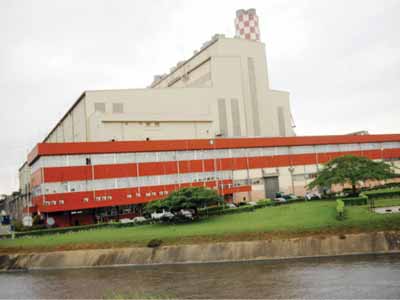
 FOR residents of Lagos and its environs, the significance of the Egbin Power Station cannot be overstated. It is the largest power generating station in Nigeria with an installed capacity of 1,320 megawatts. The construction work on the station was started in 1982 by Marubeni Consortium, which used the Japanese company Hitachi for the electrical and mechanical works and Bouygues of France for the civil works.
The station comprises of six units of 220 megawatts each and is located at Egbin, in Ijede Town, about 40 kilometres North East of the city of Lagos in Ikorodu Local Government Area. The plant was commissioned between July 1985 (for the first unit) and September 1986 (for the last unit). Power generated at the station is sent to the national grid through the Ikeja West (330 KV) transmission line, Aja (330 KV) transmission line, and Ikorodu (132 KV) transmission line. It is something of a model of versatility in energy utilisation, being a a gas-fired plant with six 220-megawatt independent boiler turbine units that can also run on High Pour Fuel Oil, commonly called HPFO.
To put its contribution in perspective, authoritative information obtained from the Nigerian power sector indicates that, of the 4,410.9 megawatts generated by the 24 power generating stations in the country on October 13, 205, Egbin generated 684 megawatts, which represents 15.5 percent. However, its installed capacity of 1,320 megawatts represents approximately 21 percent of the country’s total installed capacity of 6,287 megawatts.
Egbin is a source of pride to the host community and state. But more importantly, it is a major source of a vital resource – electricity – for powering industrial production nationwide, but especially in a region that is arguably the most industrialised in the country. Egbin has become one of the more remarkable success stories from the privatisation of the recent power utilities in the country, especially the generating stations, in spite of the reservations in some quarters that privatisation would leave the station worse off.
Amid scepticism over the desirability of privatising the power plant and several other power utilities nationwide under the privatisation programme of its power sector reform, the federal government had handed Egbin power plant over to the core investor on November 1, 2013, after a series of negotiations and the payment of $407.3 million.
Prior to that, there had been an attempt to privatise the power plant in May 2007 when the same company that eventually acquired it in the 2013 privatisation exercise had offered $280 million to acquire 51 per cent of the company’s shares. Due to unresolved issue such as gas supply and power purchase agreement, that earlier bid had been halted even after the company had paid $28 million as the initial 10 per cent of the bid price.
However, the subsequent 2013 bid to privatise the power plant proved successful, contrary to the expectation of the sceptics. To facilitate its success, the company was granted approval to acquire an additional 19 per cent of the plant at a new evaluation cost as a continuity of the 2007 agreement between the federal government of Nigeria and the company. The transaction was jointly managed by the National Council of Privatisation (NCP) and the Bureau of Public Enterprises (BPE), with the BPE handling the sales process while the NCP approved the transaction. In what, for the sceptics, turned out to be an unexpectedly successful and mutually satisfactory transaction, the BPE had set a deadline for the preferred bidder to pay the sum of $407.3 million as the new cost of 70 per cent of the plant at its current value.
Following its successful privatisation, the power plant has undergone rehabilitation in keeping with the terms of its sale to the new private investor. For instance, the rehabilitation of its Unit Six (ST-06), which suffered a boiler tube explosion in 2006, commenced in November 2014 and was completed in January 2015. The successful rehabilitation improved the capacity of the power plant and its efficiency and further underscored the success of the privatisation exercise which mandated the new owners of such facilities to rehabilitate and/or upgrade them under the supervision of the Bureau of Public Enterprises.
But the positive result of this supervision in the case of Egbin should spur the BPE to reproduce more of such results in addition to the success of Egbin by strengthening its supervision of other privatised power facilities in the country.
• Oluwole wrote from Lagos.

