 Follow Us on Google News
 Follow Us on Google Discover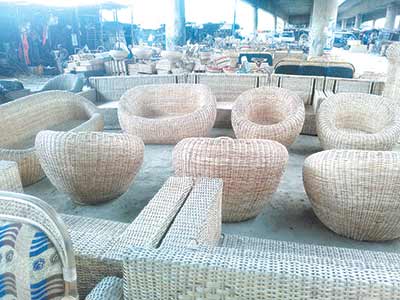
Want Technical, Entrepreneurial Education In Schools
NO country, big or small, can survive without the contributions of informal, small-scale production, otherwise known as the underground economy. Many big companies have emerged from this sector; little wonder manufacturers refer to it as breeding ground for a nation’s industrialization.
Lacking precise data to determine its real level of contributions to the nation’s Gross National Product (GNP), it’s a known fact that for its flexibility and ingenuity, the sector has provided essential services and jobs for many people, including those considered unemployable in the formal sector of the economy.
Knowing the import of cottage industries to the people and the economy, proprietors are calling on government to look into their needs and create healthy environment for them to operate, especially in the New Year.
For Benjamin Aruma of Benja Chips, makers of chips government should revisit the policies that set up Microfinance banks, to enable them give loans at a unit digit interest rate. According to him, lack of fund has hindered many operators from expanding or getting machines that would enable them improve on their production or services. He disclosed that he had to mortgage his father’s house and even raised fund to buy his first flour mixing machine and electric baker.
He observed that many people would go into cottage production if banks can give long-term loans at a very low interest rate.
“Microfinance charge like any normal banks; they claim to give cheap loans, but if one considers their interest rate you would know that it is just like the conventional banks. Their modus operandi may appear flexible, the fact, remains that they are banks and behave like one.
“Dearth of fund and high interest rates are killing cottage production and the effect is that many people that would have been gainfully employed are denied the opportunity, because we are not expanding. Many youths now depend on government for employment because we are not engaging them and even when we do, we do not have the funds to expand and pay them well,” he said.
Emphasising the need to have stable and quality power supply, Michael Oriola of Mark Nylons, producers of nylon sheets wants power to be regular, as this would encourage local production, apart from improving the economy. According to him, most proprietors run their machines on generator, which makes overhead cost of production to be high and the unit price of product also high. He disclosed that cottage industries would fill the gap created by the organised sector in terms of employment and providing domestic products if power supply is regular and in good quality.
“Power supply is key to production. Quality power supply will encourage operators to produce more because it would make us to depend less on generators. Could you imagine, I spend close to N50,000 per month to run my generators, outside the wear and tear. Just think what that would amount to in a year. If we can be guaranteed adequate power supply, then we would know that our problem is half solved.”
Mark Ewibeano, chairman, National Cane Chair Association of Nigeria, lamenting some of the challenges of small-scale production wants government to provide space for artisans and craftsmen to carry out their trade. He noted that producing under the bridge, as they are presently doing does not give them the space to operate as expected.
“We need a space like cottage village, where all of us doing one thing can operate from. This will serve as a market and also provide platform to build our offices, where government and other concerned agencies can come and assess our performance. Outside this, such provision would enable us to network with one another, and with other allied outfits whose products would be of importance to us.
“Carrying out our activities on dump grounds or under the bridge does not give us good image, especially with clients that come from abroad. It presents us as unserious business people to secure even loans from banks or get electricity power supply from the electricity board. This on its own might even discourage potential investors, especially the youths from coming into the business,” he revealed.
Aunty Yinka, who is into bean cake business (akara), wants government to check, what she described as double taxation. According to her different people come in the name of federal, state ad local government agencies to extort various sums of money from her and others doing similar business. She wants Lagos State government to put a check to this. She disclosed that this fraudsters, who come in uniform are depriving government of money that should have gone to their coffers and also making operators to operate under fear.
“Government should harmonise its agencies and avail cottage producers the challenges of paying the same charges to state and local government agencies. This is annoying as such money could be used to do other things, including paying staff salary.
“The most annoying thing is that these monies are not receipted and they are often collected with threat. These fraudsters often come with threat that failure to pay would lead to closing ones’ shop or seizing our products, as nobody would want to face such embarrassments, we pay,” she said.
She called on government to set up a bureau for intelligent gathering and also to deal with anybody or group of persons caught defrauding operators. According to her, this will calm the fears of those already in small-scale production and also encourage new entrants.
For Lucky Amadi, who is into disinfectants and liquid detergent, lack of access to research works of experts has contributed to making household producers unable to produce for the bigger markets and also for export. He called government to help support research works and also to interpret same to local languages, as this would encourage investors who may want to go into production, but do not have the funds to embark on research or hire people to do them, to begin producing things.
There are many research works languishing on government shelves because government has failed to make them public. Since the initial expenses have been taken care of by government, it would be proper to make them accessible to those that might need them at a token. Also, sometimes, when such are available, they are not written in local language; they are written in technical terms that would make it difficult for anybody wanting to use it to interpret.
If government is serious about encouraging local production, making research work understandable and available to those that would use them is vital. This would not only make those already producing to improve, but would also assure producers that they are not endangering the lives of people using their finished products in the market.
“There are works on how to use bitter cola, shea butter and others to chase away rodents, snakes, mosquitoes, cure cough and do many others things, but such research works are not simplified for household producers to use them,” he revealed.
Charting a way forward, he called on government to motivate local producers by bringing all those producing similar or same products together to register as co-operatives, so that they can get the necessary information and help from government and corporate bodies whenever they want.
Lamenting the various hurdles small-scale producers face, Shola Adeleke, a farm produce seller, wants government to put and end to the incessant destruction of shops without adequate notice to occupiers or owners. According to her, the destruction of workshop is a set back, as it puts the occupier in a tight corner to look for money to rent another. And if such takes place in states like Lagos, where landlords ask for a year or two rent upfront, would mean putting heavy burden on the operator. She then called on government to encourage private property owners to construct affordable lockup shops for traders.
Thanking God that she left her banking job to pursue her passion in dressmaking, Aminatu Hassan, said, the idea has paid off, as she feels happier and richer. But bemoaning the challenges she encounters, she noted that there is inadequate trainees to handle some of the jobs, which have mounted pressure on her and affected supply.
According to her, most youths do not want to work with their hands; they believe so much in getting white colour jobs, but little do they know that they can make good money using their skills. Putting the blame on the school curriculum, she called on government and curriculum planners to include entrepreneurial education in the curriculum.
She believes doing this would inspire learners to embark on business ventures, hone their skills and be self-reliant.
“If we must think of industrialising Nigeria, produce our local goods; we must begin with household production. And we cannot do this without having technical and entrepreneurial education. You will only think of enterprise when one has something to sell,” she noted.
Seeing government as thermostat that regulates the polity for underground economy to strive, Hassan disclosed that some government policies are too harsh on small-scale producers.
“As a dressmaker, I need electricity to run my machines, iron cloths and do other things, but this is not always available and now we hear that generators would be banned. How are small producers that depend on them to power their machines going to carry on with their businesses, when government cannot guarantee regular and adequate supply?

