 Follow Us on Google News
 Follow Us on Google Discover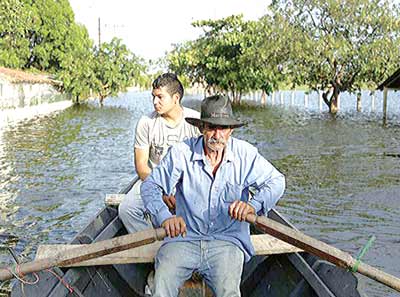

More than 150,000 people in Paraguay, Argentina, Uruguay and Brazil have been driven from their homes by some of the worst flooding in years. In Paraguay, the most affected country, President Horacio Cartes declared a state of emergency, freeing up $3.5m (£2.3m) in relief funds.
AS 2015 ended, it brought misery and suffering in parts of the globe, with storms triggering chaotic weather and causing severe destruction in United States, Europe and South America.
In the United States, historic flooding, forced authorities to shut down a second major highway, Interstate 55. High water rushed southward, threatening more flooding in southern Missouri and Illinois,Tennessee and Mississippi.
The flooding has left at least 20 people dead in Missouri and Illinois, mostly involving vehicles that drove onto swamped roadways.
Missouri Gov. Jay Nixon, who activated the National Guard, tweeted that state and local responders are “working around the clock to keep folks safe.” He added that low temperatures would further complicate things.
Flood warnings remained in place in England, Scotland and Northern Ireland last week after Storm Frank’s heavy rain and strong winds battered parts of Britain.
The government-affiliated Environment Agency said more than 6,700 homes in northern England were flooded during the last week as river levels reached all-time highs.
The Energy Networks Association, which represents power operators in the United Kingdom, said around 1,000 customers still had no power Thursday morning. Energy to nearly 100,000 properties has been restored since Tuesday.
More than 160,000 have been displaced in Paraguay, Argentina, Uruguay and Brazil over the last week by what is being described as the heaviest floods to strike South America in 50 years, Al Jazeera reports.
The floods have caused at least eight deaths, according to the news organization.
Streets and homes have been completely submerged in the city of Concordia in Argentina
More than 150,000 people in Paraguay, Argentina, Uruguay and Brazil have been driven from their homes by some of the worst flooding in years.
Heavy summer rains have caused rivers to swell across a vast area.
In Paraguay, the most affected country, President Horacio Cartes declared a state of emergency, freeing up $3.5m (£2.3m) in relief funds.
The Paraguay river in the capital, Asuncion, is just 30cm (12in) away from overtopping its banks.
That could lead to widespread flooding in the Asuncion area.
And it could affect thousands of other people who live by the Paraguay – the country’s main river – the authorities said.
Some 130,000 people have been forced to leave their homes in Paraguay alone Image copyright AP Image caption Tens of thousands of people in Paraguay have been sleeping in temporary shelters
Nearly 200 electricity pylons have been damaged or destroyed by strong winds.
Four people were killed in the country by fallen trees.
In northern Argentina, some 20,000 people have been evacuated.
At least two people have died in the floods, which have mostly affected the provinces of Entre Rios, Corrientes and Chaco.
Some experts have linked the weather to a stronger than usual El Nino phenomenon Image copyright AFP Image caption Flooding in north-eastern Argentina is the worse to hit the region in five decades
In the southern Brazilian state of Rio Grande do Sul, nearly 1,800 families in dozens of towns had been forced to leave their homes.
Heavy rain began to fall in the region on 18 December, swelling the Uruguay and Quarai rivers.
South of the Brazilian border, in Uruguay, thousands of people have been made homeless in the past few days.
But most of them have now returned home.
Dry weather is forecast for the Brazilian-Uruguayan border region in the next few days, but in Paraguay and Argentina water levels are still expected to rise.

