 Follow Us on Google News
 Follow Us on Google Discover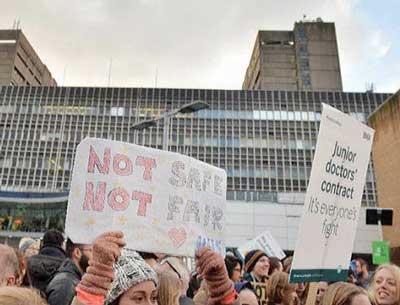
THOUSANDS of junior doctors yesterday went on strike in England, the first of such strike in the country’s medical sector causing major disruption to healthcare delivery.
There was however only emergency service during the period, meaning that several thousand routine operations, appointments and tests were cancelled.
The strike is over a new type of contract which the government said would improve healthcare at night and at weekends but the workers however said it would drastically reduce their pay.
Many doctors also claimed that Prime Minister David Cameron’s government was not providing enough resources for the widely cherished, state-run National Health Service (NHS), founded by a socialist government in 1948 to provide free care.
“The new contract is not fair, it’s not safe and from the beginning, we as a profession have been bullied, intimidated and threatened by the Department of Health,” said Florence Dalton, 29, a psychiatrist picketing at St Pancras hospital in central London. She added that many workers in the state-run health service felt “exhausted, overstretched and undervalued”. “Staff are already leaving in their droves,” she said. “Fewer and fewer people are coming into the profession. It makes me so angry.”
At St Thomas’s Hospital in south London, another junior doctor, Paul Robinson, said: “It’s a great shame the government has managed to alienate so many doctors. “We’re not radicals, we are ordinary, smart, working, caring individuals and we’re worried about the NHS.”
There are more than 50,000 junior doctors in England, making up a third of the medical workforce. They are qualified medical practitioners who work while studying for qualifications for more senior roles.
Health Secretary Jeremy Hunt had said the strike was “unnecessary” and urged fresh negotiations, adding that 40 percent of junior doctors had turned up to work.
Cameron’s centre-right government had said the reforms were needed to help create a “seven days a week” NHS where the quality of care is as high at the weekends as on weekdays. “We have to do something about this, people get ill every day of the week,” Hunt told BBC radio. “At the moment, for example, if you have a stroke at the weekends, you are 20 percent more likely to die.”
While Cameron’s government had increased NHS spending, many hospitals were still in debt, due to issues including soaring drug costs and an ageing population.
The NHS is the fifth largest employer in the world, providing health care which remains largely free at the point of delivery nearly 70 years after it was set up. It is widely respected in Britain, with pollsters YouGov rating it the institution which the most people view positively.
Nigel Lawson, finance minister under Margaret Thatcher in the 1980s, once described the NHS as “the nearest thing the English have to a religion”.
A further 48-hour stoppage is due to take place on January 26, while on February 10, there will be a full withdrawal of labour.

