 Follow Us on Google News
 Follow Us on Google Discover
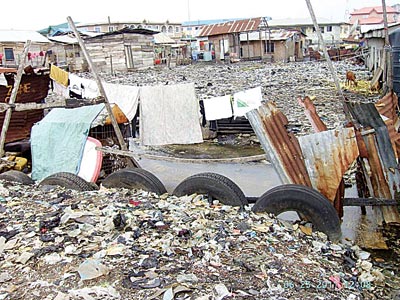
No fewer than 150, 000 under-five children die annually from poor sanitation and hygiene, Concern Universal, an NGO implementing the Global Sanitation Fund (GSF) programme in the country has said.
Mr Nanpet Chuktu, Programme Manager of the NGO made this known in an interview with the News Agency of Nigeria (NAN) in Abuja on Friday.
He stressed the need for all tiers of government to improve allocation of appropriate resources for scaling up sanitation and hygiene.
Chuktu said it was a matter for regret that diarrhoea alone kills no fewer than 150,000 under-five children annually.
According to the programme manager, for the poorest Nigerians, diarrhoea is responsible for one-quarter of all child deaths.
“Approximately 90 per cent of diarrhoea prevalence is directly attributed to poor quality Water, Sanitation and Hygiene (WASH).
“Sanitation coverage actually decreased from 37 per cent in 1990 to 28 per cent in 2012.
“100 million Nigerians, roughly two in three persons, have no access to sanitation.
“Meanwhile, over half of all rural water points are dysfunctional, with over 63 million Nigerians lacking access to safe water,’’ he said.
He said the group was focusing on expanding its WASH programming in the South-East states, saying it was one of the regions mostly affected by diseases related to poor water,
Chuktu said since its interventions in Benue and Cross River states, no fewer than 820 communities have claimed open-defecation-free (ODF) status, with 210,725 people gaining access to improved sanitation.
The programme manager said experience from Nigeria and elsewhere has shown that simply constructing toilets, or offering subsidies for construction, is not an effective way to improve sanitation.
He said the group introduced the ‘Community-led Total Sanitation’ (CLTS), which empowers all communities to collectively change their sanitation and hygiene behaviour and ensure that every community member uses a toilet and practices good hygiene.
Chuktu said Benue and Cross River states’ delay to pay up their counterpart funding was still a challenge to scaling up sanitation and hygiene in more Local Government Areas in the two states.
He stressed the need for this to be done, to reduce the increasing rate of open defecation and its effects to its populace.
Chuktu said to achieve Local Government Areas-wide coverage, the NGO built the capacity of six local governments’ WASH units and 11 NGOs in CLTS facilitation, monitoring and evaluation, and financial management.
NAN reports that the WSSCC programme of the UN is called the Rural Sanitation and Hygiene Promotion in Nigeria (RUSHPIN).
NAN also recalls that in June 2014, Nigeria benefitted from the Global Sanitation Fund (GSF) of five million dollars to meet the sanitation and hygiene challenges in the country.
The RUSHPIN is an initiative of Nigeria’s Federal Ministry of Water Resources and the Global Sanitation Fund, the grant giving body of the UN WSSCC.
The innovation sees international funding matched by national, regional and local funding, setting a framework for replication to achieve the national target of ending open defecation in Nigeria by 2025.

