 Follow Us on Google News
 Follow Us on Google Discover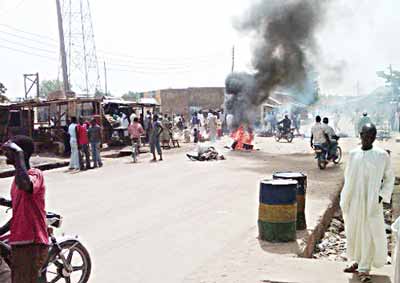
 Under a subhead of the capital side of the 2016 Appropriation Bill is the sum of N2.5 billion for rehabilitation of public properties and places of worship that were damaged during the 2011 election as a result of violence and civil disturbances.
Ironically, five years after the violence and civil disturbances that followed that election, those who suffered one loss or the other are still being compensated, while none of the persons, who perpetrated the act of violence or their sponsors have been brought to book. This is despite the fact that not all the losses could be quantified and compensated for. Though institutions or individuals who suffered some loss in terms of material and properties could have a sigh of relief with the compensation, but that cannot be the case for the families who lost dear ones.
Government, at the federal, state or local levels, after every election violence, mouth the need for justice for those who suffered loss and punishment for those who perpetrated the act but usually there is no follow up.
The 2015 Bayelsa Gubernatorial Election was inconclusive because of the violence that marred the conduct of the election in the Southern Ijaw Local Government, reason the election in that local government was cancelled. Commenting, Lawyers in Defence of Democracy called on the Federal Government to properly investigate the alleged role of the military and Police in the anarchy that led to the cancellation of the election by the Independent National Electoral commission (INEC).
Violence before and after election in Nigeria is not new. But the first massive post election violence was in the Western Region of Nigeria, dubbed ‘Operation wetie’, a fallout of the rift between Awolowo and Akintola. Although there was violence in the north, but that of the West was more grievous in terms of negative consequences.
In 1983under the second republic, when there was massive post election violence especially after National Party of Nigeria (NPN) was declared winners of the governorship elections in Oyo and Ondo States considered the strong bases of Unity Party of Nigeria (UPN). In all the instances, many lives were lost.

A research conducted by the Nigeria Watch revealed that between June 2006 and May 2014, there were about 915 cases of election violence resulting in about 3934 deaths. A further breakdown of the figures showed that the North Central geopolitical zone had the highest casualties among the country’s six zones, recording 1463 deaths. It was followed by the North West with 911 deaths and the South-south with 644 deaths. The South East had the least figure of 152 deaths, the North East and South West recorded 319 and 386 deaths respectively.
Each time, there were political statements from the representatives of the people or candidates in the election demanding that those, who perpetrated the dastardly acts be brought to book, but nothing would happen thereafter.
Senator representing Bayelsa East, Ben Murray Bruce, after about four people lost their lives in the first round of the recently held Bayelsa election, threatened to drag perpetrators of electoral violence to the International Criminal Court, at the Hague. He wondered why citizens, who have a right to vote for candidates of their choice in any election are not allowed to do so without coercion or intimidation.
At the supplementary election with fewer polling units compared to the first round of election, more casualties were recorded. About 12 people were feared dead.
Bruce indicted security agencies, saying the military and police watched with indifference, while thugs and criminals kill law abiding citizens who were out to perform their civic responsibility.
Speaking specifically about the Bayelsa Election, Lawyers in Defence of Democracy maintained that it is important that government carried out investigations so that those who corrupted the process were brought to book and punished to serve as deterrent in future elections.
The group stated that what it saw, as an accredited observer in the election, was nothing short of anarchy. There was extreme display of desperation on the part of politicians, leading to a gross manipulation of the electoral process.
The body also noted that although the political leaders must be blamed in the whole scenario, there was worrying cases of seeming collusion among the military top brass, the Police and other highly placed individuals in the Federal Government.
An activist, Miss. Uju Okeke said that allowing violence during election is a deliberate ploy to disenfranchise women from the electoral process and not make their votes count.
“Electoral violence affects women more as many could become widows. Government should conduct an investigation into the violence and ensure that the perpetrators are punished to deter others.
“If the perpetrators are not punished, it means women should not be part of the electoral process because they cannot exercise their voting right in a violent atmosphere,” Okeke said.
In the build up to the 2015 general election, there were several efforts to ensure peaceful conduct of the election and prevent a repeat of what happened in 2011.
It was in one of the peace building fora that the then President, Goodluck Jonathan said, “After the 2011 general elections, some unpatriotic elements embarked on an orgy of violence, resulting in the destruction of lives and property. That will not be allowed to happen this time around. This government will act decisively against anyone who disrupts the public peace before, during or after the 2015 general elections.”
Ironically, unlike the 2011 election, where the election violence was more of post election, that of 2015 was pre and during election. And it would have probably escalated if Jonathan had won or declared winner by INEC, given the pre-election mood of the then opposition party, APC. Prominent supporters of one of the candidates were not allowed to campaign openly and it would be recalled that on the day of election, the Special Adviser to Jonathan on Agriculture was prevented from voting in Kano by political thugs.
The coordinator, Network on Police Reform in Nigeria (NOPRIN), Okechukwu Nwaguma, who identified the action of security agents especially the police as a threat to general elections suggested a proper education of the members of police force on the need to remain neutral in election.
Nwaguma said unless security agents maintain neutrality in elections, the quest for a free and fair election or a vibrant democracy would remain a mirage.
Though the Inspector-General of Police, Solomon Arase, said that perpetrators of the violence that marred the Bayelsa supplementary poll would be punished as investigation to apprehend the masterminds had commenced, the outcome of his declaration is still being awaited by Nigerians.
Arase boasted that the police, under his leadership, was being driven by rule of law, accountability, technology and intelligence.
“The violence during the Bayelsa supplementary poll is regrettable, but let me assure you that the perpetrators will be brought to book soon. Investigation has commenced to unravel the people behind the incident that led to the death of three people,” the IG stated.
Speaking generally on election violence, Prof. Etannibi Alemika noted that past elections in Nigeria were characterised by both psychological and physical violence, though most incidences often tend to be localised, short-lived and restricted to polling centres and communities.
According to him, the incidences of large-scale post-election violence of 1963-65; 1983 and 2011 in the then Western Region and later in Oyo and Ondo states and in several Northern states, recorded large scale loss of lives and destruction of property. He however observed that electoral violence in the country is primarily due to the perception of politics and political office as investment and an avenue for the acquisition of extraordinary wealth through corruption, which is otherwise not possible through any other form of legitimate vocation and enterprise.
This, to the professor of sociology, is why Nigerian politicians turn electioneering and elections into warfare in which violence and ethnic, religious and other forms of primordial sentiments and prejudices are employed.
“Violence has been a feature of the country’s electoral process since the colonial era. But during the colonial rule, they were easily curtailed due to the nature and scope of participation, characteristics of the politicians and electorate and the nature of colonial domination. However after independence, electoral violence became more intense as struggle for power among politicians increased.
“Electoral violence in the country can be attributed to the actions and inactions of several actors, who are determined to secure or retain political power without adhering to the rules of democratic competitive elections, and consideration for the long-term negative effects of electoral fraud and violence on national integration, security and development.”
Alemika however suggested that in moving forward, security agencies should be adequately equipped to enable them adopt measures for preventing and controlling violence during political campaigns and elections as well as safeguard the security of electoral officers, materials, polling stations and documentation of results.
He also believed that the Police criminal intelligence and investigation capability is grossly inadequate and should be addressed as contemporary crimes require evidence-led strategies, plans and operations.
“The Nigeria Police Force is extremely ill-prepared to curb contemporary crimes of terrorism, insurgency, organised and transborder crimes. Police training and deployment as well as procurement of services and facilities should take into consideration contemporary forms of security threats. Further, the Nigerian police need to introduce career-long specialisation in criminal intelligence and investigation, patrols, etc. The current general duty paradigm is outdated,” said Alemika.
On his part, a professor of Political Science at the University of Lagos, Onuoha Browne argued that until one understands the background of Nigeria’s politics, then one may not be able to appreciate the level of violence and the reason. According to him, there was a civil war that lasted 30 months but the crisis started in 1960 and that civil war had consequences; one of which was the type of social formation, human beings who emerged from the civil war; military men and war contractors. He also noted that the war produced social deviants who made up the society today.
“This is about 50 years now and our society had ignored the consequences of civil war, nobody has ever addressed its consequences and those consequences live with us. The human beings the war produced are those managing our affairs today, so they are deformed citizens, who have no values of what nation building is all about.
“These same citizens made politics a very expensive venture, where you are in politics only to make money. You can buy and sell, if you can pay for the office, you get it. And because politics is now an economic venture, they invest money and must recoup the money.”
Browne said to recoup the money spent for election; part of it is to recruit militants and thugs, who will fight to ensure victory, which means election, must be won, so that they can now recover the money invested.
He maintained that it is a vicious circle and part of the ways to resolve it is to make both politics and political posts less expensive and less attractive. And this, he said could be done by ensuring that fraudsters, those who grew by military adventure do not get into politics.
“How do you push them out when they have control now? It is going to be difficult because if you make legislation, they will ensure it does not work; it means changing societal values and redefining who and who come into politics.”
 In his view, election violence promotes instability in the system, which makes it difficult to plan and forecast the trend of development in the nation.
“Once violence becomes a part of the social life, then that is the end of nation building, and if there is no nation building, the nation cannot progress. In fact, Boko haram was able to drown us due to this disadvantage. Do not take it lightly, how many Nigerians have what it takes to talk of the commitment of nation building.”
Browne however stated that there are challenges prosecuting election violence perpetrators because those who perpetrate the violence are not the engineers and motivators; their godfathers are behind and would ensure that the culprits are not prosecuted to protect their foot soldiers.
“And this is because political power is for individuals and that also shows the ineffectiveness of nationhood.”
The professor of political science believed that still providing compensation about five years after the election violence happened with nobody yet brought to book is an unfortunate scenario.
“And it will be used by politicians to cover whatever they lost during the election, because who is defining who is going to be compensated? Believe it or not, that money if it is eventually allocated will end up in the pockets of some very big people in the party to compensate themselves. So, it is political and it does not define properly the change we are talking about. For me, it is money for the political parties.”
He however said that there must be clear efforts to prosecute those who engage in election violence, if not, it will embolden them to continue.
The university don also believed that since it is a criminal offence, whether during election or not, there should be no special tribunal for the trial of election violence offenders, as their cases should be considered under criminal offences.
A Senior Advocate of Nigeria, Paul Ananaba said that it is basically the duty of Independent National Electoral Commission (INEC), under the electoral act, to prosecute election violence perpetrators, but often INEC does not take the cases serious.
“Once the election is over, the crimes committed are overlooked and that is not good. So, it is for INEC to recruit enough lawyers internally and appoint external lawyers, who will work together to prosecute offenders. Then, there should be a meeting with the Attorneys General and Chief Judges of the states, so that some courts can be designated to hear these matters for determination within a short period.”
On whether the cases must go through INEC before prosecution, Ananaba said that the offences are created under the electoral act. He however did not agree that there should be specialised courts to try electoral offences, rather specific courts within the judicial system be designated to hear and determine electoral offences.
Another Senior Advocate of Nigeria, Mike Ozekhome said that cases of electoral violence are not followed up to the letter due to the conspiracy of the political elite.
“They know themselves, do not be deceived, these politicians are all friends, when it comes to sharing the national cake. There is no difference between the APC, PDP, Labour Party, and APGA. There is no ideological difference between them, that is why a politician can decamp from one political party to another and within the same year, move back to his original party.
“And that is why, suddenly, all those who were painted as corrupt, when they were in PDP became saints after crossing to APC. This is because no ideological lines among the political elites, which is why they can never prosecute serious electoral violence. The political elite sponsor these electoral violence perpetrators, who are paid N500 or N1000 to carry cutlass.”
Ozekhome said the negative implications of electoral violence made members of the National Conference in 2014 recommend the establishment of special electoral courts to deal solely with electoral offences, the same way election tribunal operates.
“Electoral tribunal sits to adjudicate on disputes that arise from election petitions, they do not try criminal cases, so there is need for special election offences tribunal to try the criminal cases that arise from elections.”
He noted that the special court is important because the electoral act had sections that deal with electoral violence such as ballot boxes snatching. “So all the offences are in the electoral act, but they are obeyed much in the breach than compliance. So if they like, they can create a division within the federal high court or high courts just to face election violence. After all, the election petition tribunals, the judges are drawn from serving federal high court judges, so you can also set these tribunals just to try election offences for a specific period. They can go back to their normal duty and it does not have to be a standing tribunal like the industrial court.”
He noted that it is the big politicians that are the big masquerades at the background as election in Nigeria has become so violent that it is like going to a third world war.
“Look at what happened in Bayelsa State, people were preparing for election as if it was war. And that is why Jonathan will still remain in the heart of democrats across the world because he conceded defeat, when he could have challenged it. He maintained that no blood of a Nigerian is worth his ambition. If our politicians can emulate him, then we would have a better clime to operate in.”
Attempt to get the Nigeria Police was not successful as the Force Public Relation Officer, ACP Bisi Kolawole, did not pick her calls neither did she respond to the text message sent to her phone.

